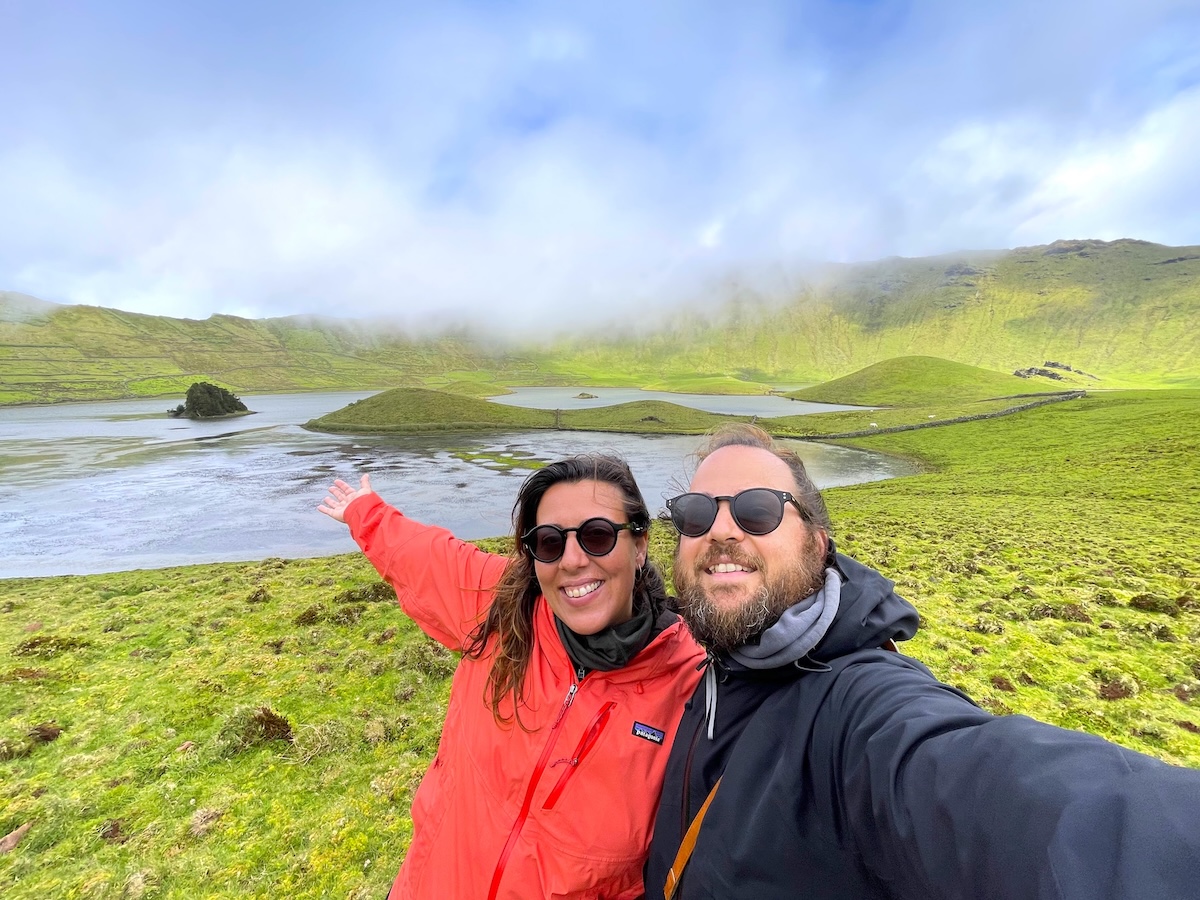
Islands and lagoons, inside a volcanic crater, inside an island. Ever since we saw the documentary “É Na Terra Não é Na Lua” (“It’s the Earth Not the Moon”), our curiosity to explore Corvo, the smallest and most remote island in the Azores, has been growing. When the time finally came to set foot on it, we discovered that it hides a treasure within: the Caldeirão is one of the most beautiful landscapes in the entire archipelago. It was one of the most special islands on our 2-month trip in the Azores (and one we revisited on our trip to the Azores in 2025), and beyond being an island to visit, it is an island to be experienced—if you give it the time it deserves.

In this guide we help you understand why Corvo deserves (if you can) much more than a few hours visit from Flores.
If you don’t have much time, you can book here your 1-day tour of Corvo island from Flores
Check out our complete guide to the Azores Islands if you are planning a trip to the archipelago.
Basic facts for traveling to Corvo
About 790,000 years ago, an eruption gave birth to the smallest of the Azores islands, Corvo. Neighboring the island of Flores (which is about 40 minutes by boat or just over 10 minutes flight) the truth is that although both are in European territory geographically, Corvo and Flores are in America geologically as they sit on the American tectonic plate. Corvo was first called Santa Iria (almost all the Azores have or had saint names) but due to a supposed abundance of sea crows, it was renamed (“Corvo” means crow in Portuguese). It is the Azorean island with more endemic plants per m2, a total of 98 plants and part of the World Network of Biosphere Reserves of Unesco since 2007. Don’t let its size of 6km by 4 km make you underestimate its importance since with less than 400 (resilient) inhabitants living on the most remote island of the archipelago, it represents two deputies at the regional government level. Maybe that’s also why in Corvo we experienced the best mobile coverage of our trip throughout the Azores and if you can consider staying longer, don’t hesitate. Of course, organize your trip with some time because there is only one (charming) hotel and little local accommodation offer.
Language: Portuguese
Currency: Euro
Population: 384 (in 2021)
When to visit: The best time to visit is during the summer months, as the climate can get quite bad during winter canceling flights/boats. It is an island where (unfortunately) most tourists do not stay overnight so you will not have to worry too much about avoiding the high seasons of July and August (when it is more appetizing to enjoy its waters) in terms of accommodation but you should book the boat and/or flight as soon as possible. Keep in mind that October is peak season in Corvo due to the “invasion” of ornithologists. More info on when to visit Corvo here.
How long to stay: Minimum 1 day, ideally 3 days.
How to get there: There are no direct flights to Corvo from outside the archipelago but once you arrive in the archipelago you can fly to Corvo with Sata, the Azorean airline. To find the cheapest flight option we recommend you use flight comparators such as Skyscanner and Kiwi and be flexible with dates. Alternatively, you can reach the island by boat from the neighboring island of Flores. More info about this in the section on How to get to Corvo
Where to stay: There is only one hotel on the island, the charming Hotel Comodoro, where we stayed and loved it. You also have the option of local accommodation, such as Joe & Vera’s Place.
What to bring: A good travel insurance (in this link we give you a 5% discount on the one we always hire) and here is the list of what you must have in your backpack for this trip
How to get around: In Corvo there is no possibility to rent a car and there is no need to rent a car on an island of 6km X 4km. The ideal is to get to know it on foot and go up to the Caldeirão with local people. We tell you how to do it in the Caldeirão guide section.
How much it costs: From 65€/day per person (approx.) for a 2-day trip. More budget details in this section
Internet connection: If you are visiting for a few days, your phone supports eSIM and you don’t want to complicate things, we recommend Holafly eSIM (unlimited data, 5% discount with the code RANDOMTRIP) or Airalo eSIM (limited data, but cheaper, 15% discount with the code RANDOMTRIP15). Otherwise, the cheapest way is to get a local SIM (the main companies are Vodafone, Meo and Nos). More info here
Time zone: UTC +0. The time in the Azores archipelago (Portugal) is one hour behind mainland Portugal and two hours behind mainland Spain.

When to visit Corvo
The best months to visit Corvo are from May to October, keeping in mind that July and August are the busiest months for tourism, so it’s best to book your trip to Corvo and your accommodations well in advance. June and September are usually the best months, with good weather (though, as we all know, the weather in the Azores is a bit of a gamble) and inviting waters.
In October, the (limited) accommodation available on Corvo fills up with birdwatching enthusiasts eager to spot and observe some of the migratory birds from the Americas. It’s not that these birds don’t pass through the other Azorean islands, but given Corvo’s size, the lack of dense vegetation, and the number of birdwatchers with binoculars on the island during those days, the likelihood of spotting certain species increases significantly.
Climate table for Corvo, showing monthly temperatures and number of rainy days:
| Month | Minimum temperature (ºC) | Maximum temperature (ºC) | Water temperature (average) (ºC) | Rainy days |
|---|---|---|---|---|
| Enero | 13º | 17º | 16º | 11 |
| Febrero | 13º | 16º | 16º | 10 |
| Marzo | 13º | 17º | 16º | 9 |
| Abril | 14º | 17º | 16º | 7 |
| Mayo | 15º | 19º | 17º | 6 |
| Junio | 17º | 21º | 19º | 6 |
| Julio | 20º | 24º | 23º | 3 |
| Agosto | 21º | 25º | 23º | 4 |
| Septiembre | 20º | 24º | 22º | 7 |
| Octubre | 18º | 21º | 21º | 9 |
| Noviembre | 16º | 19º | 19º | 10 |
| Diciembre | 14º | 17º | 17º | 13 |
| Month | Minimum temperature (ºC) | Maximum temperature (ºC) | Water temperature (average) (ºC) | Rainy days |

How to get to Corvo
There are no direct flights to Corvo from the mainland, so the only way to get there is by flying from other islands in the archipelago or by boat from Flores. There are flights from Lisbon to Ponta Delgada (São Miguel), Lajes (Terceira), Pico, or Horta (Faial); from Porto to Ponta Delgada (São Miguel) and Lajes (Terceira); and from Madrid to Ponta Delgada (São Miguel). The cheapest flights are usually Ryanair from Lisbon/Porto to Ponta Delgada (São Miguel) or Lajes (Terceira), but to get the best price, it’s best to be flexible with your dates and use price comparison sites such as Skyscanner and Kiwi.com.
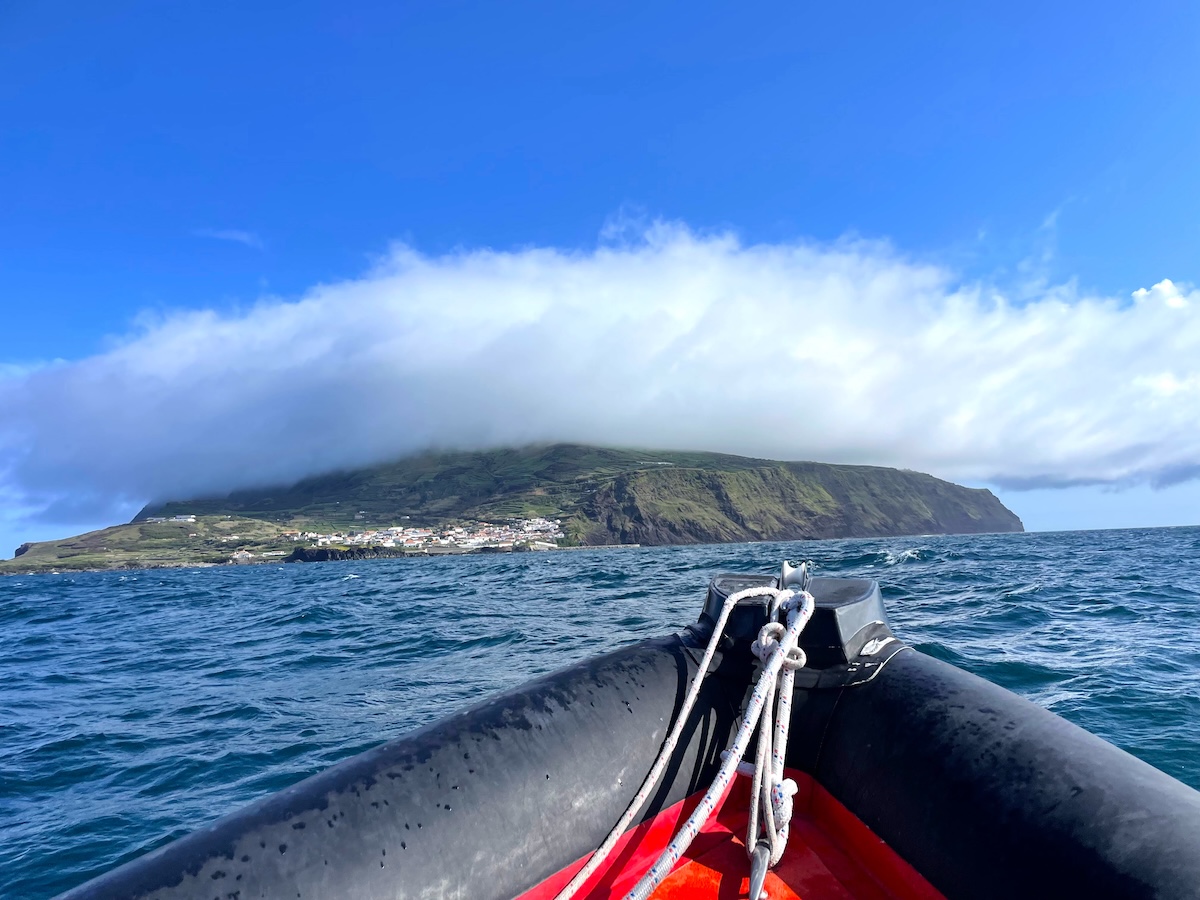
If you do not have time for it, you can visit the island on a day tour from Flores. The three ways to get to Corvo Island from Flores are:
- By speedboat:
- With Carlos Mendes from ExtremOcidente, (book by email info@hotelocidental.pt or phone +351 918 390 189). It costs €50
- Here online or here (includes only the boat trip to Corvo and back and a tour of some points along the northeast coast of Flores)
- Here online also with guide, transfers, and food included.

- By ferry with Atlantico Line (only for passengers; you cannot take your rental car, so you will have to arrange transportation to Caldeirão upon arrival). This service was not available when we visited the island.
- By plane with Sata, on the shortest flight we took, just 7 minutes. Although we arrived in Corvo by speedboat, after two days we had to return by plane because the sea conditions did not allow the speedboat to leave (we spent two nights on the island of Corvo and highly recommend it).

How many days to spend in Corvo
At least one day, but Corvo is an island that’s meant to be experienced rather than just visited, so if you can, stay at least two nights—just like we did at Randomtrip on our first visit.
On our second visit to Corvo, we had planned to spend the night on the island, but due to bad weather once again, we were only able to visit Corvo on a day trip.
Azores travel insurance
Do you know what cannot be missing in your luggage? A good travel insurance! We are affiliates of several specialized travel insurance companies and you can get a discount in some of them if you book with us:
Appart from the medical assistance in case something happens when you visit Portugal, the insurance can also cover anything that happen while you get into adventures like hiking, kayaking, snorkeling and diving. Also, if something happens to your luggage (damage, theft, delays, losing it) or if your flight is cancelled or delayed (or, if because a delay you lose another connecting flight), a travel insurance can also help
Carefully read the terms and conditions of each policy and hire the insurance that best suits your needs.
Things to do in Corvo
Here is a summary of the places of interest to visit in Corvo with a map made by Randomtrip that you can take with you on your cell phone:
Map of Corvo
Here we leave you all the places of interest in Corvo that we mention in this guide on a Google Maps map that you can carry on your smartphone to consult at any time.
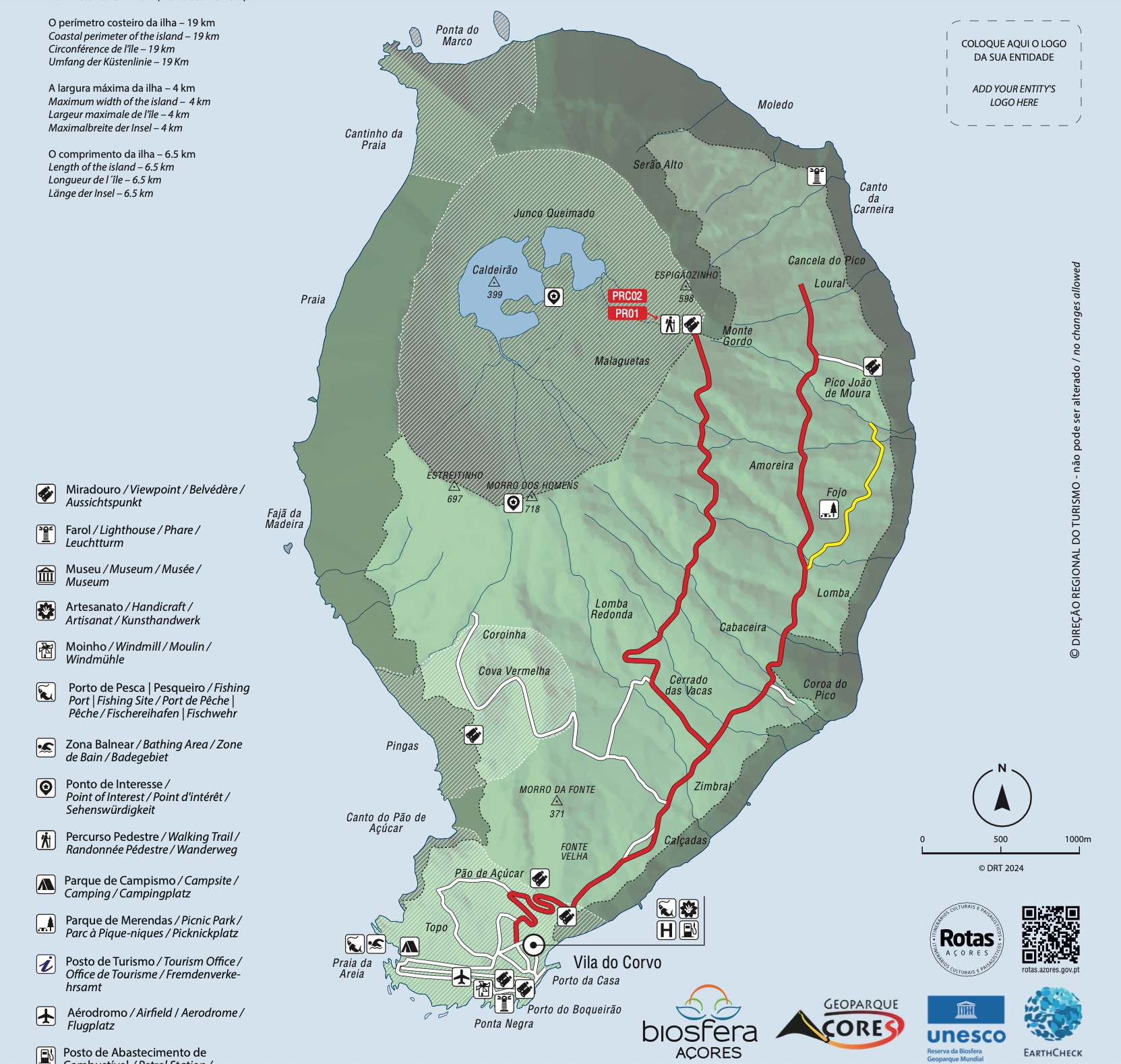
And here is also a tourist map with the roads of Corvo (click on the image to download it in larger size and resolution).
Caldeirão
Corvo Island is crowned by a volcanic crater whose scenery is so spectacular that it is reason enough for many people to come to the island on a day tour from neighboring Flores.

We went to Caldeirão, about 6km from the village of Vila do Corvo. We got into the van of our Corvo driver, who was waiting for us at the exit of the Hotel Comodoro and, as soon as we started the tour, he told us: “Close your eyes. Don’t open them until I tell you. That’s how my father did it with me when I was 6 years old”. A few meters before arriving by car to one of the landscapes we were most looking forward to during the whole trip through the Azores, the famous Caldeirão, we closed our eyes, opened our minds to questions and a childish excitement invaded our bodies. For what we felt when we opened them, there are no words.

Islands and lagoons, inside a volcano crater, inside an island. The most remote and the smallest Azorean island hides several treasures inside. One is the caldeirão, and so many others that are there to be discovered if you give it the time and curiosity that Corvo deserves.

Once we were standing right in front of it, we were told that the islands within the Caldeirão de Corvo represent the nine islands of the Azores. We at Randomtrip weren’t able to sketch them, but that might have been because we were so overwhelmed with excitement. Throughout our two-month trip through the Azores, many people promised us that this was where we’d find the most breathtaking scenery, and they weren’t wrong.
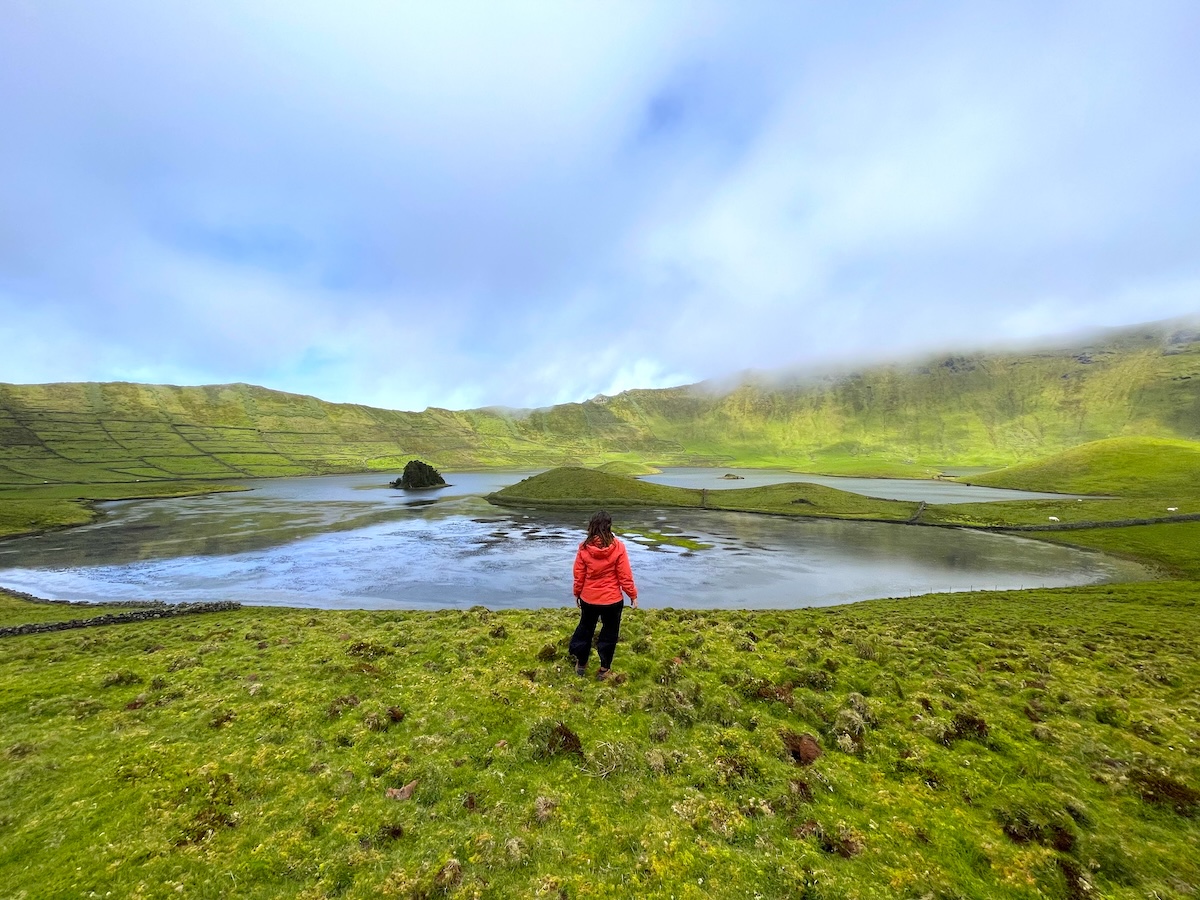
The Caldeirão de Corvo is about 3.5 km in diameter and 300 meters deep, and if the weather is on your side—the weather is a guaranteed uncertainty on a trip to the Azores —you can even hike the trail into its interior and get a close-up view of the wetland system, fed by rain and the water stored by the turf bogs, which cause the lagoon’s water level to fluctuate throughout the year.
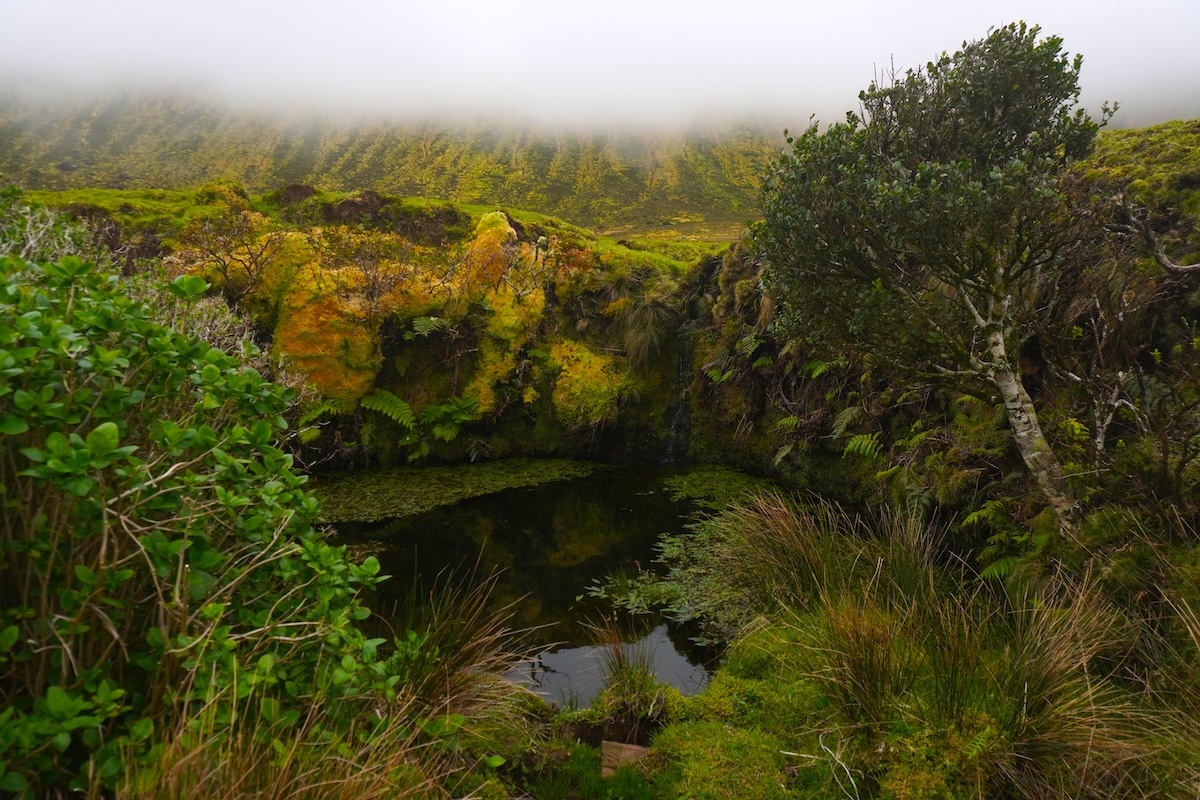
If you have been to Flores you already know that the turfeiras (peat bogs)—musgão, as the locals call them, or Sphagnum spp. to botanists—are a very unique ecosystem, as they are veritable water reservoirs. They act as sponges made of moss and vegetation that has accumulated over thousands of years without fully decomposing, in an environment saturated with water.
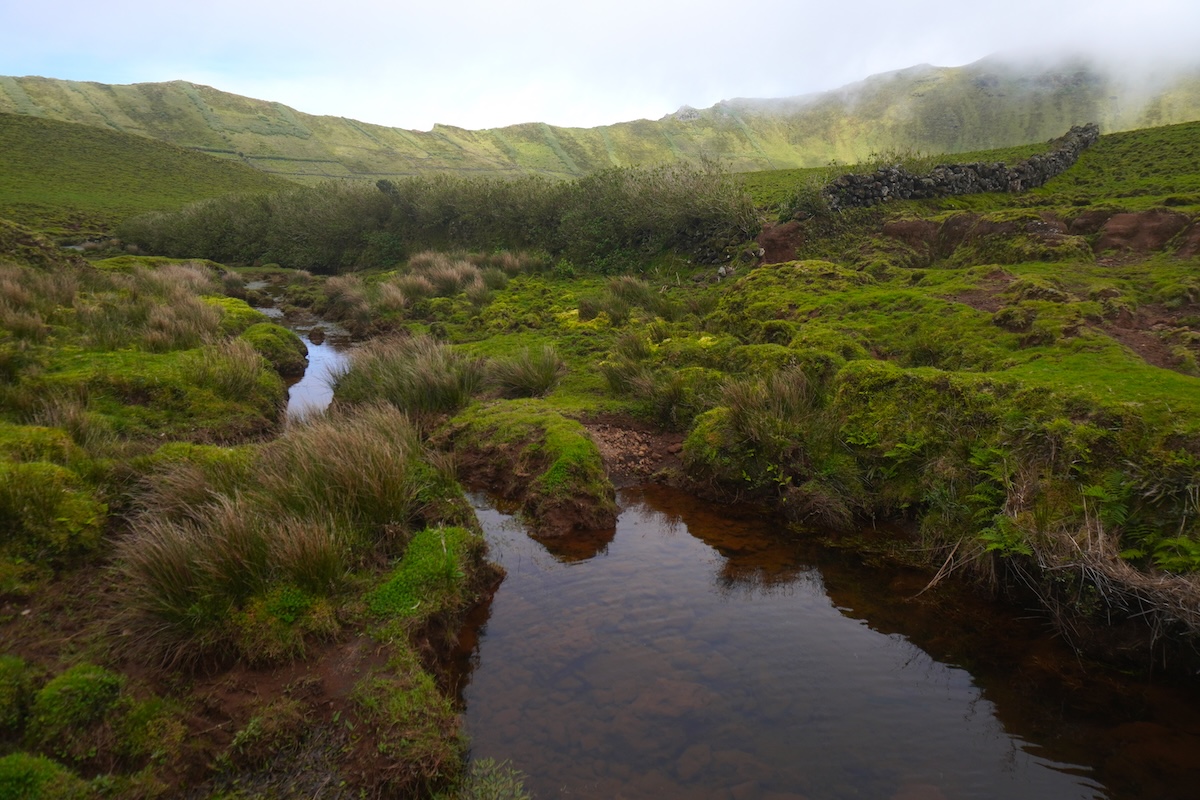
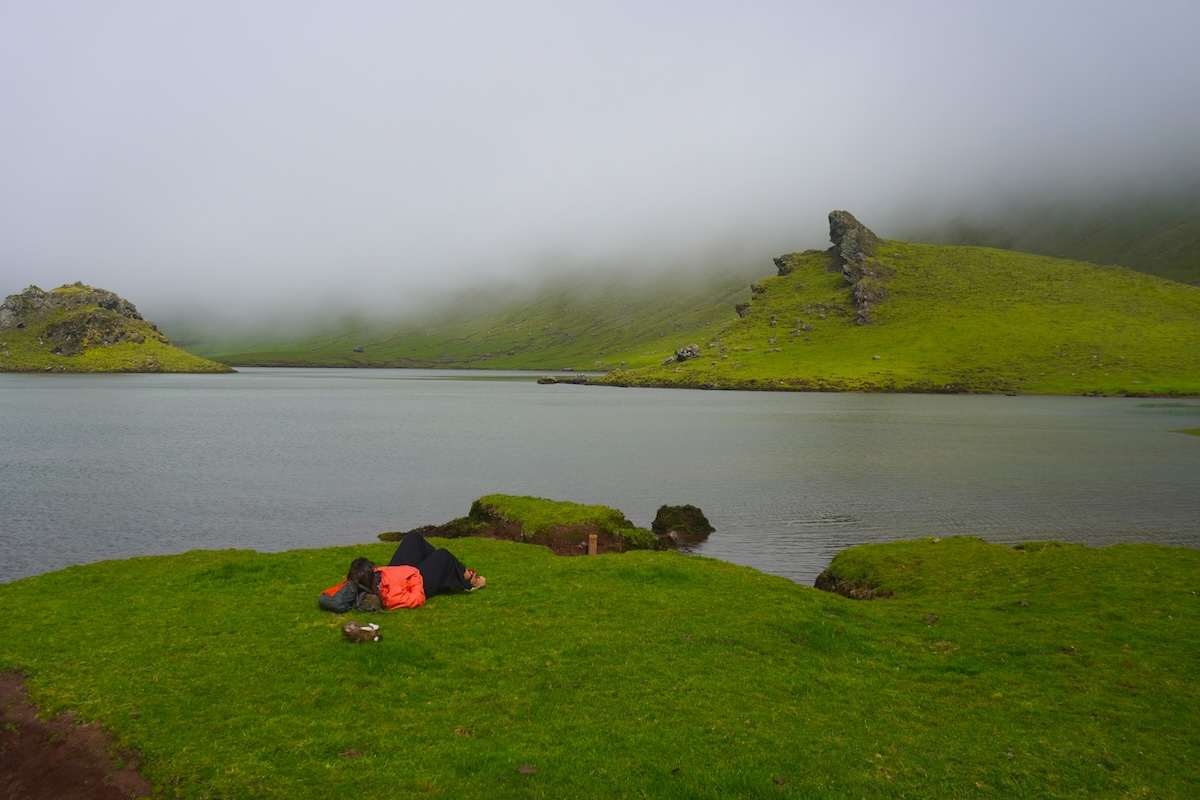
The trail through the heart of Caldeirão is a 4.8-kilometer loop (about 2.5 hours) that offers views of Caldeirão from various angles. On our first visit, we were disappointed because the weather didn’t cooperate; although it was clear when we arrived, the sky clouded over and it started to rain a few minutes later.
On our second visit to Corvo in 2025, even though the weather wasn’t great either (we could barely see the Caldeirão from above because of the clouds, and the wind was extremely strong), we were determined to hike the trail all the way to the bottom, hoping the weather would improve as the day went on. And that’s exactly what happened! Although it never fully cleared up, we were able to enjoy the hike almost entirely on our own and take in some incredible scenery.
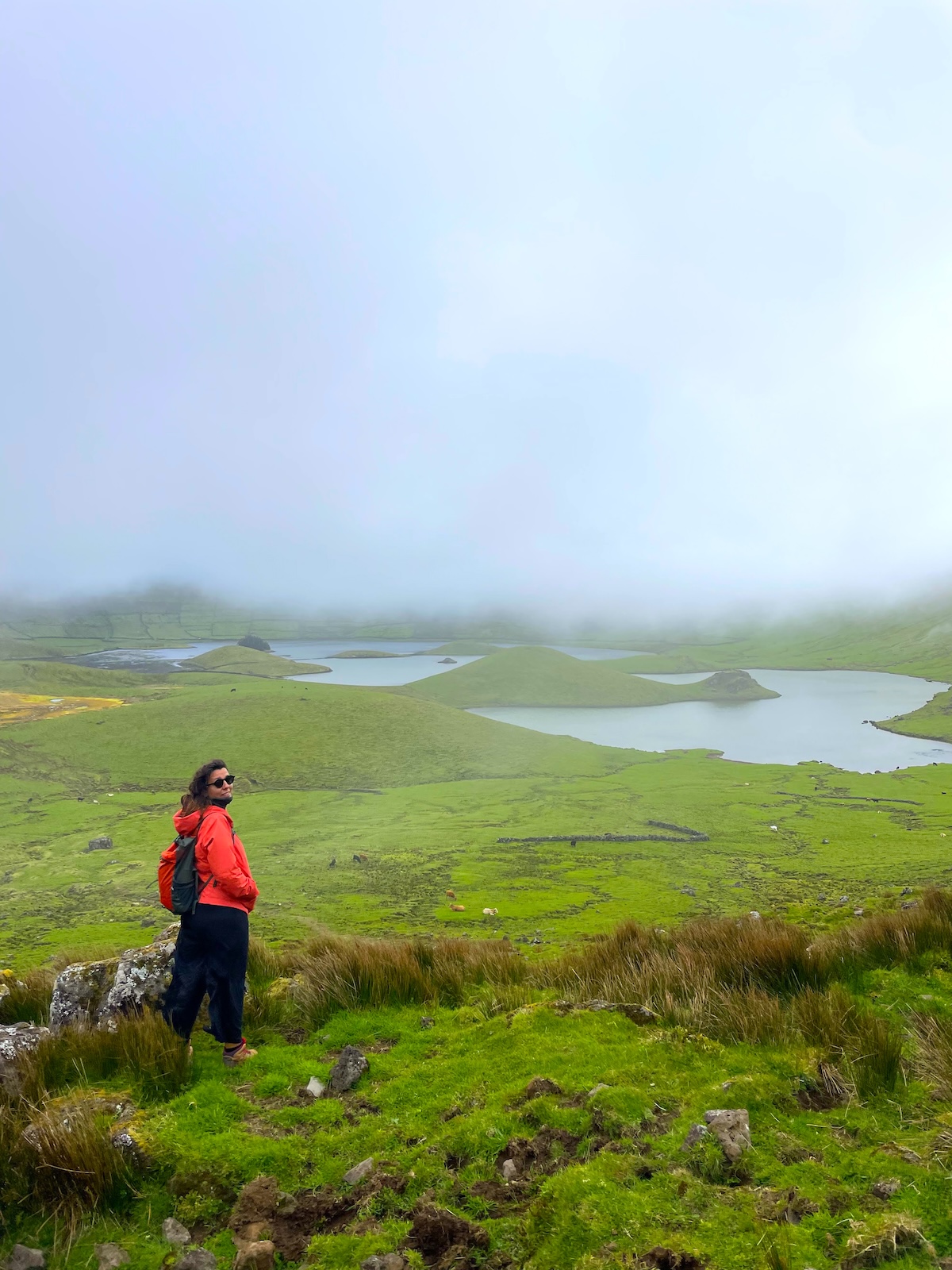
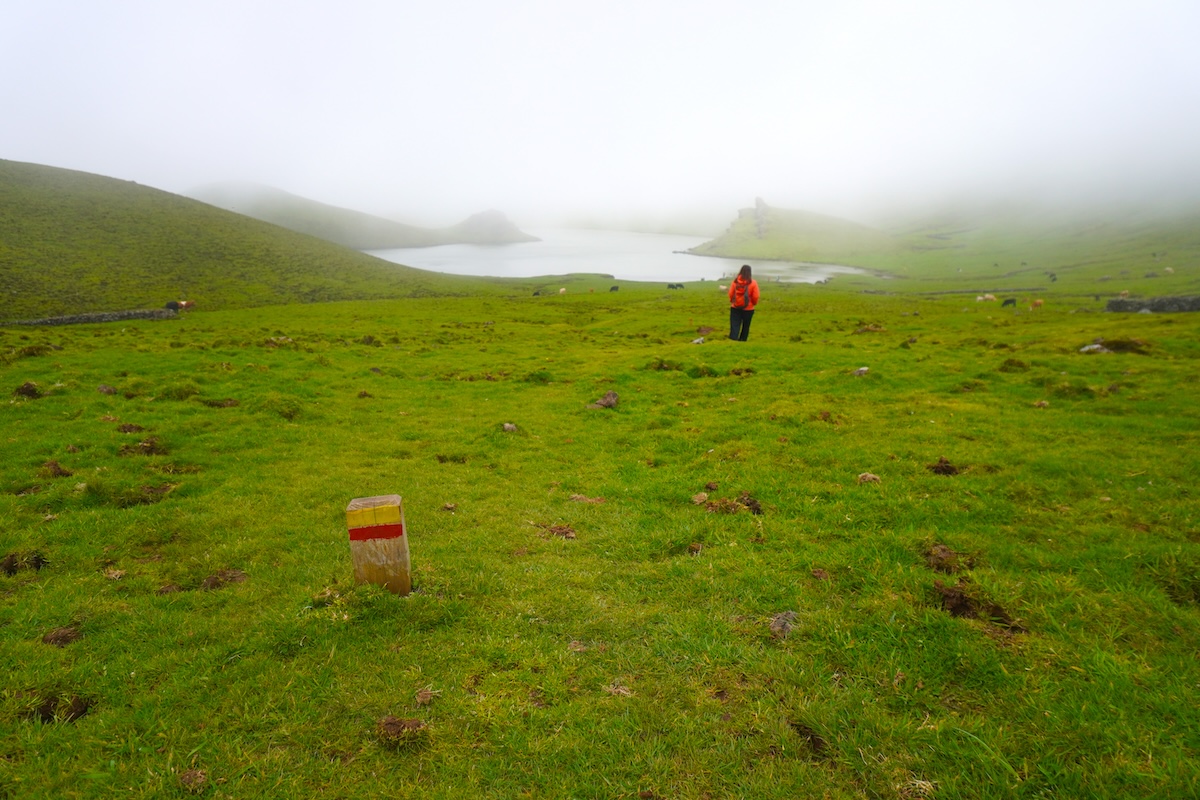
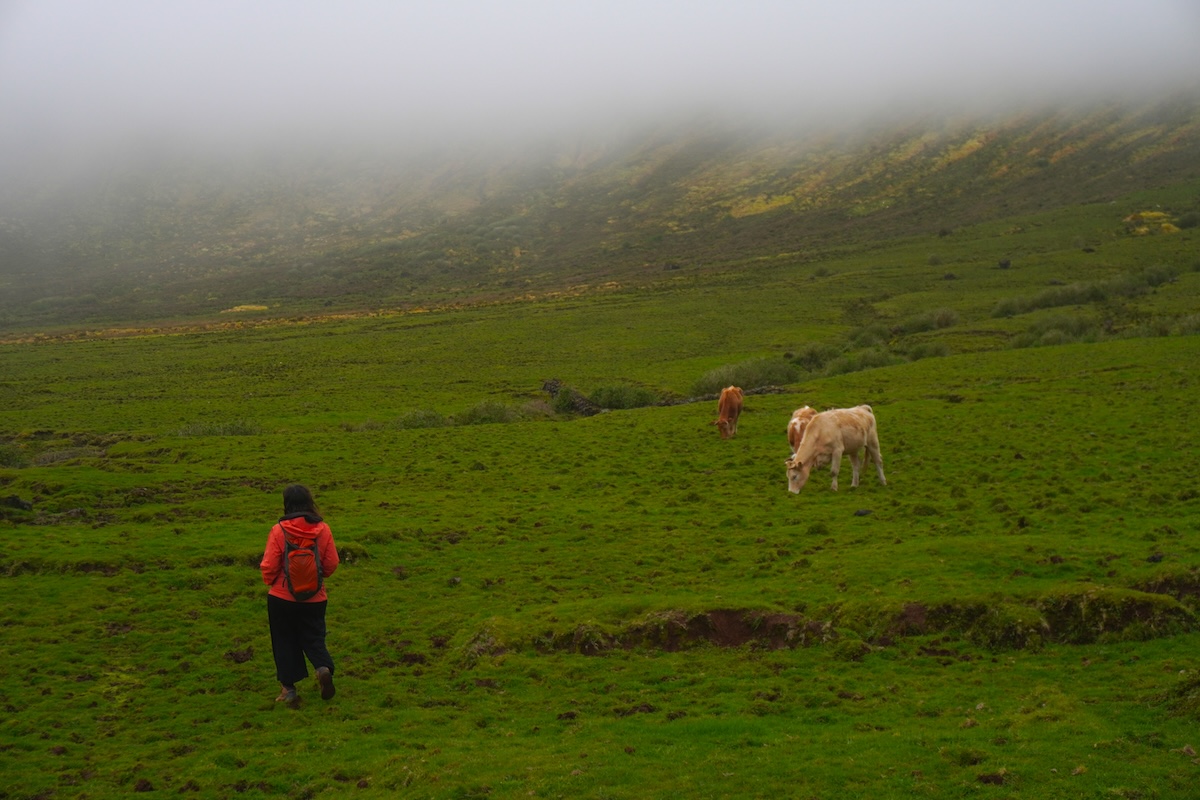
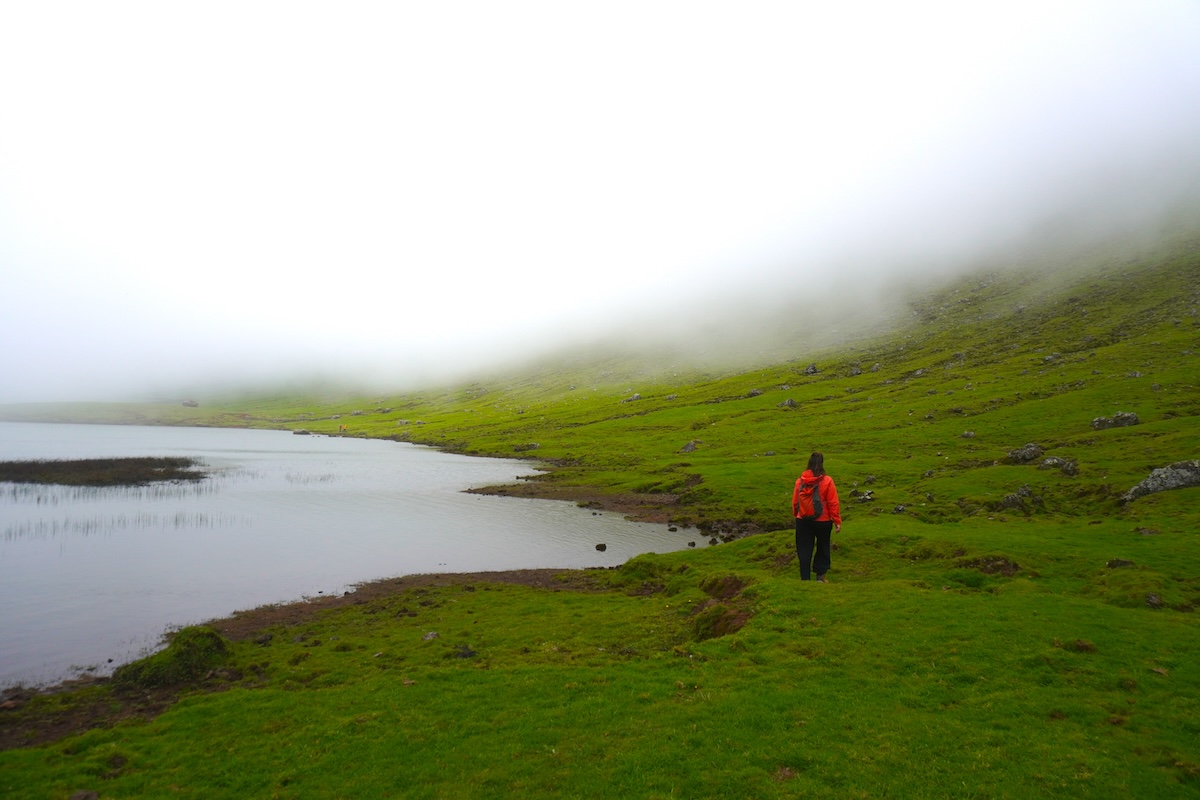
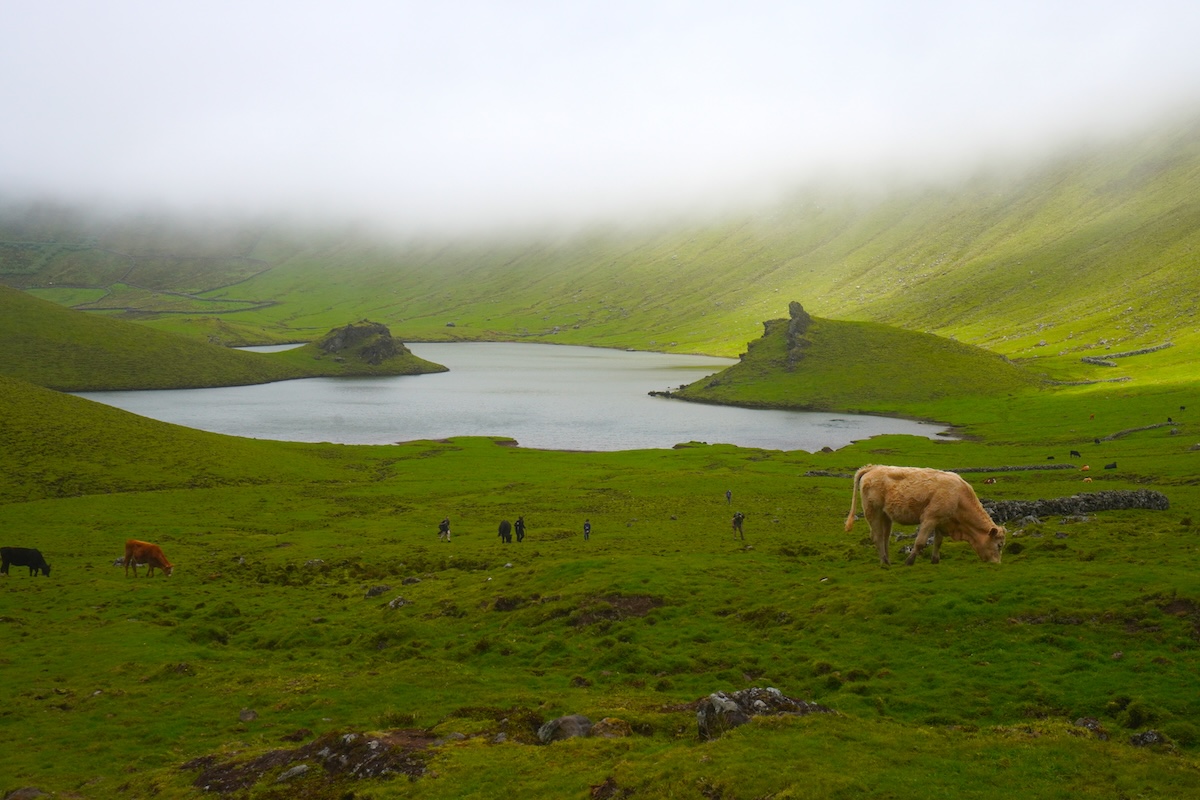
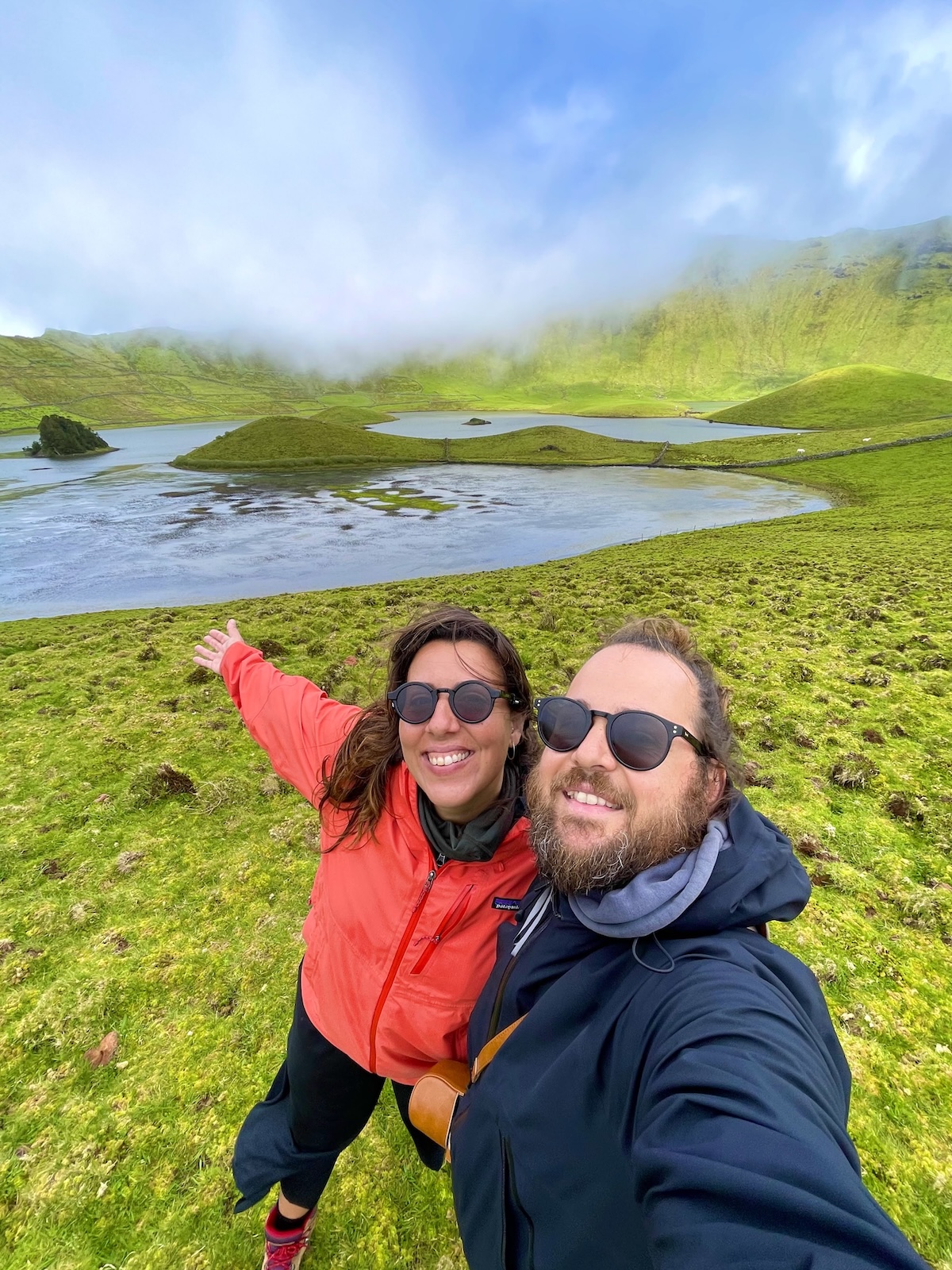
Another hiking option is to climb to the highest point, located on the southern edge of the Caldeirão at 718 meters, where, from Morro dos Homens, you can enjoy a breathtaking view of the contrast between the green of the caldera and the blue of the Atlantic. To the north of the Caldeirão lies Ponta do Marco.

Since Caldeirão is about 6 km from the village, if the weather is nice and you feel like going up, you can walk there. You can’t miss it—just follow the “Estrada para o Caldeirão” (road to Caldeirão)—but if you want to add some excitement to the trip, we recommend going at least once with a local guide. When we went, the round-trip cost was €10 per person. Here’s a contact for a guided hike up to Caldeirão:
- Carlos Reis: +351 964 577 765
If you are in Flores and want to visit Caldeirão in Corvo, you can book your excursion to Corvo here but we warn you that it will not be enough.
Cara do Índio Trail
This linear trail connects Caldeirão to the village of Vila do Corvo passing by a rock that gives its name to the trail since its profile reminded to what was baptized as the stereotypical profile of the face of an “Indian”, with his eyes, nose, mouth and headdress.

The trail, which can be done in its entirety (about 10.3 km, about 3 hours approximately), or, as we did in Randomtrip, from less than half towards the village (3.9km) avoiding a long stretch of road that is not so worthwhile, pass through the main geosites of the island, in addition to the famous face carved in basalt rock (you can also do it backwards if someone takes you to the point where the trail connects with the road).


It starts next to Cova Vermelha and you will pass by a viewpoint with a panoramic view over the village and the Atlantic in the background that invites you to take a break before continuing along the trail that reveals several shelters carved into the rock and interesting geological formations.

Among endemic flora, you will pass the tanks in the area known locally as Baldio, and continue the tour around the volcanic cone with open crater to the south, known as geosite of Coroínha e acima (falésia) das Pingas, from where you can see the island of Flores on clear days.
After encountering the basaltic face, you will have to decide whether to return to Vila do Corvo or continue to the volcano’s caldera, the Caldeirão, to follow the trail that runs inside it.

You are likely to encounter some goats and cows along the way and even have the opportunity to do some bird watching. A highly recommended trail.

Vila do Porto
The best of the village of Vila do Corvo cannot be listed. It’s walking into a café and striking up a conversation (on an island with less than 400 inhabitants it’s impossible to go unnoticed), accepting an invitation to learn how to play Marralhinha (a typical Terceira game) or entering a garage to buy artisan cheese. Still, here are some of the spots you should not miss:
Casa do Tempo Ecomuseu do Corvo
To approach this museum is to approach the history of Corvo and begin to unveil the resilience and courage of the people of Corvo that persists (and persisted) in the most remote island of the archipelago (sometimes with several weeks without supply due to the impossibility of being reached by sea or air due to storms). It is an excellent starting point so we would recommend you to go the first day (if you can make the very good decision, as in Randomtrip, to extend your stay to at least 3 days).

The EcoMuseum inaugurated in 2019 takes a journey from the volcanic origin of the island some 790,000 years ago, explaining how the Corvo people persisted throughout 500 years of history in such a remote place and with such harsh weather conditions, the main economic livelihood activities and the difficulties they went through and even the innovations that were implemented in Corvo over time such as the construction of the airfield in 1993.

In this “laboratory for the study of the past, present and future” of the island (as the museum defines itself) we can also find a lot of audiovisual material such as interviews with its inhabitants about milestones, legends and customs of the island. For example, we can learn that the “Wool Day” was very important on the island and reflected the spirit of community and inter-help characteristic of Corvo’s population.

Or learn about one of the episodes that reflects the resilience of Corvo’s people, the Bavarian pirate attack on Corvo Island in 1632. The story goes that the 200 inhabitants living on the island at the time managed to repel a pirate ship with the help of Our Lady of Miracles. Legend has it that for every bullet fired by the invaders, Our Lady of Miracles returned seven. The episode was turned into a comic book by the great Portuguese comic author and illustrator José Ruy, in his book “A Ilha do Corvo que venceu os piratas” (“The Island of Corvo that defeated the pirates“).


Until the mid-19th century, Corvo’s population were forced to pay a harsh tax on wheat and money, forcing them to feed on flour from hazel sedge (junça, in Portuguese), a tuber with great nutritional potential that is now known to be a superfood. Perhaps that helps explain the strength, fiber and resilience of Corvo’s people over time.

We also learned a curiosity that we think you will like to know: Did you know that probably without the whalers in Corvo, there would have been no poetry by Pablo Neruda? Neruda’s editor, Manuel Carlos George Nascimento, was from Corvo, son and grandson of whalers, who went to Chile persuaded by his father after hearing him say so many praises of that country and its people when he went into Chilean waters.
Centro de Interpretação de Aves Selvagens (Wild Bird Interpretation Center)
As we mentioned in the section on the best time to visit Corvo, during the month of October the island is “invaded” by birdwatchers, eager to see and contemplate some of the birds of the American continent that are migrating and passing through here. The dimensions of the island of Corvo, the absence of dense vegetation and the number of enthusiasts with binoculars per square meter makes the probability of sighting some species multiply and this small island is quite famous in the world. In this small Wild Bird Interpretation Center you can learn about some of the species that can be sighted on the island, such as the roseate tern (garajau rosado), the pigeon shearwater (estapagado) or the painho da madeira, as well as those that visit the European continent, coming from the American continent, such as the red kite (pilrito-acanelado), the American woodpecker (picoteiro-americano) or the cerulean warbler (mariquita azul).

Praia da Areia
At the southern tip of the island, between Caminho dos Moinhos and Rua da Cruz, is the best beach of the small island with a very descriptive name (like all of Corvo), Praia da Areia (Sand Beach). Surrounded by volcanic rocks and sheltered by the cliff, the beach is very close to the village and right at the end of the airfield runway, so you can almost take a dip as soon as you land. Don’t worry about aircraft noise, even in high season, there are never more than four planes a day arriving (or departing). The black sand is formed by the decomposition of volcanic rock into ash and small shells, accumulated over thousands of years in this place, sheltered from the coast. Surprisingly, it was the hottest seawater in which we bathed in the Azores! Apparently it was due to the currents. The water temperature is usually around 20ºC between May and October.

Moinhos do Corvo
Like all the islands of the archipelago, also on the island of Corvo cereals played a fundamental role in the subsistence of the community and in Corvo there were six mills from the 19th century. Nowadays there are only three, butall of them have been restored. Here we enjoyed one of the most impressive sunsets of the entire trip through the Azores that dyed the clouds in shades of pink and orange forming a beautiful postcard with the mills, the Atlantic Ocean and the island of Flores in the background.

A curiosity that our friend Joana Lima (a true RandomAzores Consultant who already knows all the islands too) told us is that here, in this area of the coast where the mills are located, in front of the Caldeirão restaurant, the people of Corvo used to light bonfires as a from of communicating with the neighboring island of Flores. For example, if one bonfire was lit it meant they had a cow to sell, if there were two bonfires it meant they had none. They also used this code to ask for help such as a doctor or a priest.

Casa do Bote (Corvo Tourist Office)
In addition to teaching us about Corvo’s past, when one of the island’s main economic activities was whaling—its name comes from this, “Whaling Boat House”)”, because there is a whaling boat on display—this house also serves as the island’s Tourist Office. As a fun fact, whaling continued on Corvo until the mid-1950s. It ended when a famous whaler—a “trancador” (blocker), the person in charge of throwing the harpoon to, as the slang goes, “trancar” (block) the whale—died when one of the massive cetaceans tried to escape.


It is also, together with Monaco, the only place where you can see the photographs documenting some of the scientific expeditions of Prince Albert I of Monaco in the archipelago between the late nineteenth and early twentieth century (did you know that he had been one of the researchers of the Furna do Enxofre of Graciosa Island in 1879?) There are about 600 photographs, some of them taken by the prince himself, including his visit to Corvo in 1896.
Artesanato do Corvo
We first learned of the existence of these peculiar blue caps, the Barretas do Corvo, in the documentary “É na Terra não é na Lua“. Rosa Mendonça learned to knit them with her mother, Inês Inês (Inês by name and surname), who had already recovered this centuries-old tradition in 1986. Apparently, it was the whalers who started knitting these hats centuries ago, for the days at sea due to the influence (and proximity) of the United States and Canada.


Since almost everyone in Corvo has two jobs (for example, when we were there, the doctor was also an actor at the village theater), Rosa, in addition to her work as a craftswoman, also works as an administrator at Santa Casa da Misericórdia, which means she doesn’t have all day to devote to her craft. Each hat takes about 15 hours of work and 237 meters of yarn, and it has exactly the same shape and the traditional pattern. The only difference is the wool; since there are no longer any sheep in Corvo, Rosa works with acrylic wool or merino wool imported from Ireland. To prevent counterfeits, she registered the Corvino brand in August 2017 and, under that brand, the name Barreta do Corvo 1452, in reference to the year the island was discovered. Since then, she has numbered every woolen hat that comes from her hands, but watch out! Numbers 1 through 452 are for people from Corvo, and only starting with 453 are they available to people from outside the island who want to buy one. Rosa always keeps track of who buys one, so she knows who, around the world, is lucky enough to own a Barreta do Corvo. When we visited, Rosa told us that a wool barreta costs around €130 (€40 if it’s acrylic) and that you can order it at artesanatodocorvo@gmail.com or through her website, and she’ll mail it to you. Today, it’s the best tangible souvenir you can have from the island.

Besides the special hats, you can also buy other traditional objects from the island such as the particular wooden Corvo lock, recovered by Rosa’s father, José Mendonça de Inês.
Street art by Bordalo II
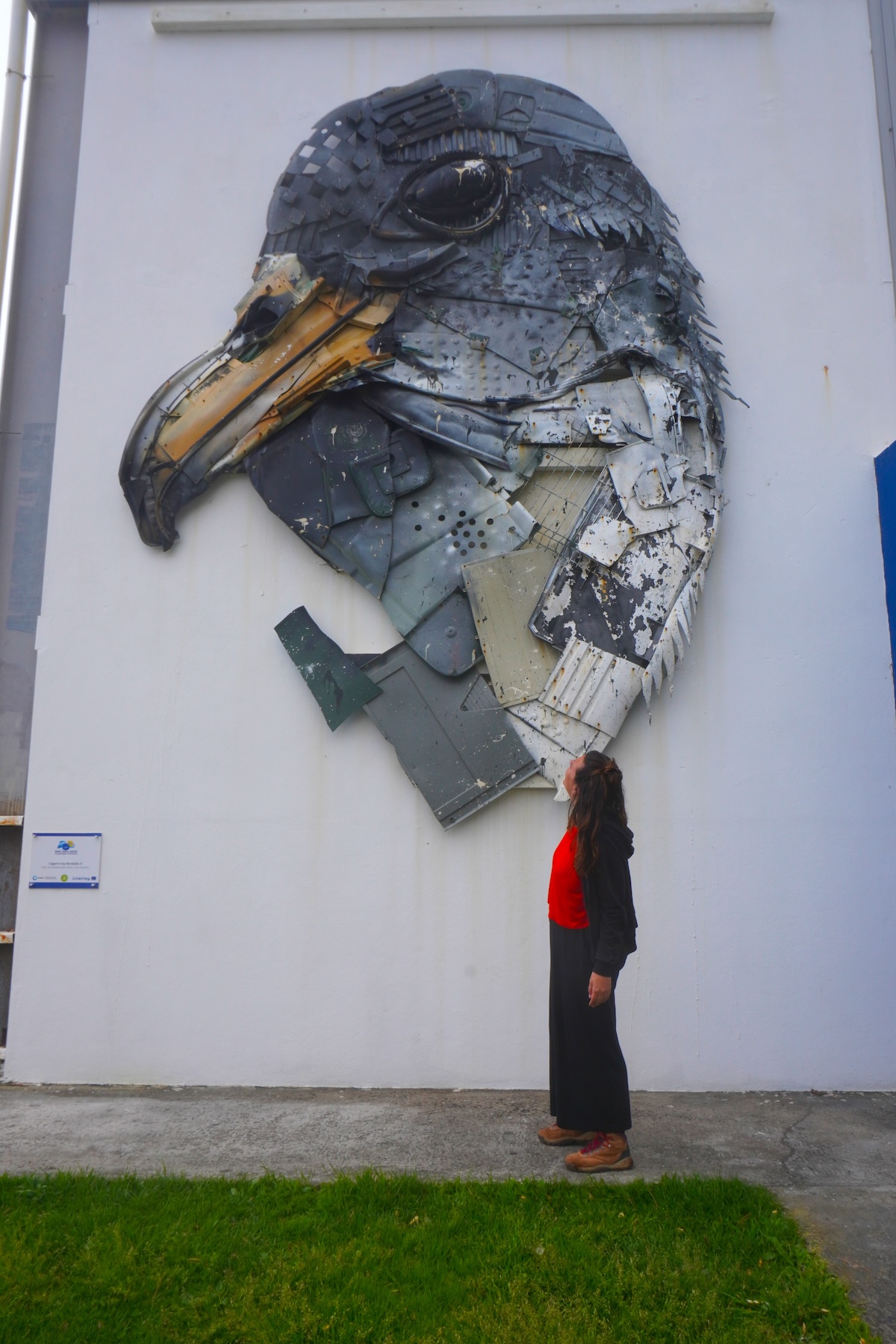
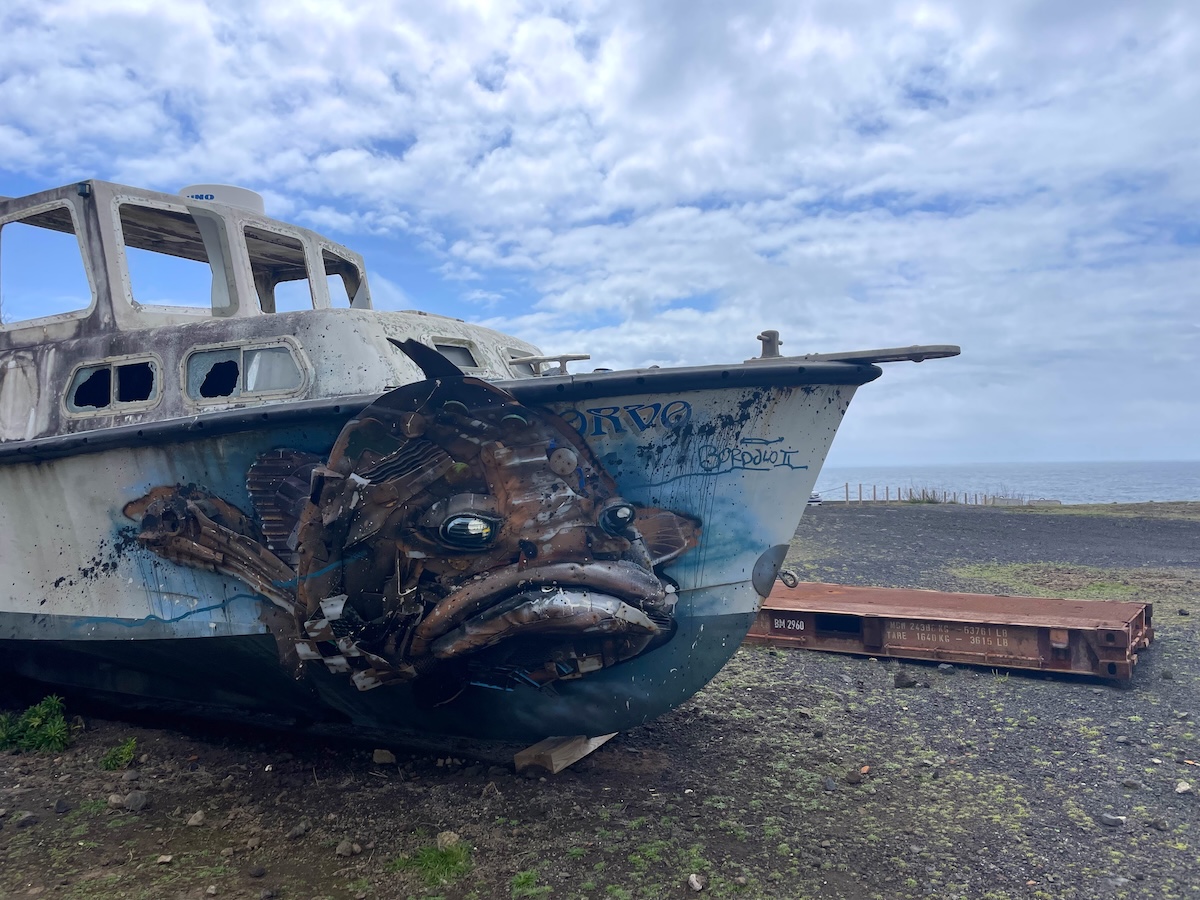
The famous Portuguese artist Bordalo II also visited the island of Corvo, where he created two works of art: a shearwater and a grouper, both of which you can easily see while strolling through the village.
Diving in Corvo: Caneiro dos Meros
If you are a certified diver you will not want to miss the Caneiro dos Meros, about 150 meters from the coast, in front of the port of Vila do Corvo and the only Voluntary Reserve of the Azores. It is known as one of the best dive sites in the Azores and where there is the greatest abundance of groupers, where you can have a dive in the company of up to a dozen.

In addition to groupers, there is also a large concentration of marine life, both deep water and pelagic species. The dive takes place between lava flows with some sandy clearings, at a depth of 18 to 25 meters.
Get inspired with our Instagram stories from our trip to Corvo.
If you want to get inspired by our live adventures, we have saved on our Instagram stories (do you follow us yet?), under highlights, a selection of what we did during the days we spent in Corvo
If you click on this link, you can watch the videos we recorded at several of the spots we recommend in this guide during our first trip, and here are the ones from our second. Are you curious?
Where to stay in Corvo
Recommending accommodation in Corvo is easy as there is only one hotel on the island, the Hotel Comodoro, where we stayed and loved it.
The hotel has 13 rooms with private bathroom, TV and wifi. The buffet breakfast is delicious and, best of all, the charming Rita family that manages it, especially Reneé Rita, to whom we are especially fond of. As a curiosity, the hotel was created by her father, the former president of the city council of Corvo, Manuel Rita, who passed away a few years ago. After emigrating to the United States between 1973 and 1990, Manuel Rita won the local elections the following year and left his name linked to some works that contributed to the development of his island, such as the construction of the road between the town of Corvo and its main natural attraction, Caldeirão, the installation of basic sanitation or the network of solar panels.


Book your room at Hotel Comodoro. Booking Photos
Some rooms have a sea view and the hotel’s website is as honest as it is transparent: “Some rooms face the east side of the village, where you can see a bit of the Atlantic sea, others face north, where you can see the hills surrounding the small village, these eight rooms have their own terrace. And there are two other rooms to the west, with little or no view, and the triple room on the second floor only overlooks the entrance to the residence.”
The history of Corvo Island is reflected in objects, photographs and items scattered throughout the hotel so staying here really is much more than just staying in accommodation, as with everything on Corvo Island.

Book your room at Hotel Comodoro here. Photo by Randomtrip. All rights reserved.
You also have the option of local accommodation, the Joe & Vera’s Place
Another option is the free Corvo campsite, located right next to the beach.
Best restaurants in Corvo
Caldeirão: a restaurant that operates on a buffet (self-service) basis at lunchtime to streamline service for the many people who come for a quick meal (or, as they say in Portuguese, “toca e foge,” roughly meaning “grab and go”)—those who stop by just to visit Caldeirão, eat, and then head back to Flores. There are three dishes to choose from each day (the best is usually the fish of the day) and a selection of homemade desserts. In the evening, they serve à la carte.

BBC: Don’t let the name scare you if you go with your hiking boots after coming down from the Caldeirão, the acronym BBC stands for Bar dos Bombeiros do Corvo (Corvo Firemen’ s Bar) and this is where the island’s population (not only the firemen) gathers to have a drink, play darts, watch concerts, watch sports broadcasts or eat a bifana or francesinha. Don’t expect the same quality as in Porto or Lisbon, after all you are in the middle of the Atlantic Ocean, but maybe that’s why it tasted good for us. The owner of the BBC is also the distributor of Super Bock on the island, correspondent of RTP Açores and SATA ground handling operator. We already mentioned that nobody has only one job in Corvo, right?

Corvo itineraries
As you will have seen if you have read our guide, the island of Corvo is much more than its Caldeirão and we recommend you to spend at least two days and one night and if you can spend more you will not regret it. As we do not always have so much time and you will probably visit Corvo together with the neighboring Azorean island of Flores, you can book your tour to Corvo from Flores here. In this section you will find suggested itineraries for 1, 2 and 3 days in Corvo.
Things to do in Corvo in 1 day
If you are short on time and decide to go on a typical day trip from Flores, your itinerary will probably be the following, where you will see most of Corvo’s points of interest:
- Arrival by boat from Flores
- If it is clear, go by local car to the Caldeirão to admire the views, and if you feel like it, take the trail to the interior of the Caldeirão.
- Return to the village (if you have time, you can even go back along the “Cara do Índio” trail), walk around the village and have lunch before returning to Flores.
Contract the one day tour with round trip transfers from Flores Island.


Things to do in Corvo in 2 or 3 (or more) days
If you have more days and, as in our case, decide to stay overnight in Corvo, you can make the same plans of the one-day itinerary more calmly, visit the Ecomuseum and the tourist post and, above all, try to interact with the people of the island.
You can also, if the weather is good, take a boat trip along the coast of Corvo with Paralelo 39 (with the possibility of spotting cetaceans), or try to climb to the highest point of the Caldeirão crater, with incredible views of the caldera and the cliff to the sea.
Transportation in Corvo
There are no rental cars in Corvo, so the only transportation options are on foot or with one of the tourist cars that take you to the Caldeirão (or wherever you need):
- Carlos Reis: +351 964 577 765
How to have internet in Corvo?
To always have internet on your smartphone during your trip to the Azores Islands, the easiest and most convenient way (if your phone supports eSIM) is to buy an eSIM from Holafly, which has unlimited data (you get a 5% discount with the code RANDOMTRIP), or to buy an eSIM from Airalo, cheaper but with limited data (15% discount with the code RANDOMTRIP15). We tested Holafly’s eSIM card in our last trip to the Azores and it worked like a charm. You can read about our experience with Holafly here
The other option, cheaper but more cumbersome, is to buy a local SIM; Meo, Vodafone and Nos are the main companies in Portugal, all of them work perfectly in the Azores Islands.
More info about buying an eSIM or local SIM card for your Azores trip here:
How much does it cost to travel to Corvo?
As always, giving a generic budget is very difficult as it depends greatly on your travel style. What we can do is to give you an orientation of prices and that you calculate your budget with them:
- Flights/Boat: From Flores you can go to Corvo for 50€ approx. round trip by boat or flight.
- Lodging: from 75€/night for a room with private bathroom at Hotel Comodoro
- Restaurant meals: between €10 and €25 per person at Caldeirão or BBC
In total, as a guideline, a 2-day trip to Corvo can cost between 65€ and 80€ per person, not including the flight to the Azorean archipelago.

Recommendations to visit Corvo as a responsible tourist
- Watch the documentary “É na Terra Não é na Lua“ (It’s the Earth Not the Moon) where Gonçalo Tocha (the director) and a sound technician arrive on the island willing to know the maximum of corners and the almost 400 inhabitants. It was because of this documentary that my curiosity for the island grew and one of the main reasons to get to know the smallest island of the Azores.
- Respect other people and the island: don’t play your music loud in the public areas (if you want to listen to music, bring headphones), don’t leave trash, don’t throw cigarette butts, etc. Leave the place better than you found it (if you find plastic, pick it up).
- In some areas bathing can be dangerous due to strong currents. Don’t be brave.
- Never try to touch or feed a wild animal – don’t be an accomplice to animal abuse!
- Do not allow the disturbance, pollution and destruction of seabird nesting habitats. The “cagarros“ (shearwaters) are a migratory bird that nests in the Azores and that on your trip to the Azores will sound to you by their particular song of “awa awa” as if they were singing the chorus of the song of The Buggles Video Killed the Radio Star. In order to avoid situations where young shearwaters are captured or run over on the road, the Government of the Azores promotes the annual SOS Cagarro Campaign, which we recommend you to get to know when you arrive in the archipelago.
- Remember that sometimes you may encounter jellyfish (aguaviva) or a Portuguese Caravel in Corvo waters, whose sting is painful and dangerous. The good thing is that the latter float and are easily detectable, but in case you see one, get out of the water immediately and warn others of its presence. In case you have been stung by either of them, it is very important that you follow these official recommendations: do not scratch the area of the sting (to prevent the venom from spreading); do not clean with fresh water or alcohol, clean only with sea water and very carefully; and in the case of a Portuguese Carabela sting, seek medical attention as soon as possible.
- Do not buy handicrafts made from sea animals or extracted from the sea (e.g. dolphin teeth, turtle shells, shark jaws, sperm whale ivory, …). The ivory trade, currently the only valuable product of the sperm whale, is still an argument for hunters. Buy local handicrafts made of alternative materials such as wood, stone or vegetable ivory. Instead, you can buy a Barreta do Corvo hand-woven by the artisan Rosa Mendonça or one of the famous Corvo’s wooden locks.
- Always travel with travel insurance: medical expenses, theft or problems with your plane on a trip can cost you a lot of money, so the ideal thing is to take out travel insurance. At Randomtrip we always use IATI and we recommend it. If you purchase your insurance through this link you have a 5% discount.

Checklist: what to pack in your backpack/suitcase for Corvo
Here is a list of must-haves you can’t forget to take with you on your trip to the island:
- A reusable water bottle like one of these to carry water with you all the time and void single-use plastic.
- A good camera to register your adventures. At Randomtrip we carry a Sony ZV-E10 and a Gopro Hero12 Black (for underwater pictures)
- A Power bank: taking so many pictures will drain your batteries, so it’s always a good idea to carry a good powerbank. At Randomtrip we travel with these 2 (Anker 20000 mAh and Anker 10000 mAh), which allow us to charge both our phones and our cameras.
- Water Shoes like these ones, ideal for not hurting your feet when entering the water or not touching the ground. Keep in mind that in the Azores you will find lots of volcanic rock pools or pebble beaches so you will want to carry your water shoes at all times to make it easier to enter the water.
- Hiking shoes because the best way to get to know the Azores is by hiking the trails. At Randomtrip we use these Columbia ones.
- Snorkel kit (mask and tube) like this one, a must to take on this trip to contemplate the seabed.
- Water proof dry bag like this one, very useful for keeping your camera equipment, cell phone and wallet safe from getting wet on any boat trip (or even if the tide comes in on the beach).
- Sun screen: always look for a Coral Friendly Sunscreen, i.e. one that protects your skin without harming marine ecosystems by avoiding ingredients such as oxybenzone and octinoxate, which are harmful to corals. Nor that it has been tested on animals.
- Mosquito repellent: like this one, it should have at least 15% deet
- Fast drying towel like this one which doesn’t take a lot of space in your luggage
- A hat or a cap (like this one) and sunglasses to protect yourself from the sun
- Windbreaker waterproof jacket: like this one, to protect yourself from the sudden weather changes in Azores
- First aid kit: In our first-aid kit there is always a medicine against seasickness (such as biodramine for seasickness on boats), antibiotics, anti-diarrhea medication (and a probiotic to recover more quickly), antihistamines, painkillers and antipyretics
- Travel insurance: always travel with travel insurance. We collaborate with different travel insurance companies so that you can get a discount with some of them:

[PT] “Corvo, Ilha do Corvo, no meio do Oceano Atlântico, Açores. Uma ilha de 7km por 4km ou 6km x 4km, habitada na costa sul, numa única aldeia, 440 habitantes ou 450, já teve 900, já teve 300, uma cratera vulcânica, o Caldeirão, uma estrada, uma Câmara Municipal, um avião três vezes por semana, um posto médico, uma escola, um porto, uma igreja, um restaurante, 2 cafés, 3…
Excerpt from the beginning of the documentary “É na Terra Não É na Lua“, Gonçalo Tocha, 2011.
Vamos filmar tudo o que conseguirmos. Vamos tentar estar em todos os sítios ao mesmo tempo e não perder nada, vamos filmar todas as caras, todos os serviços, todas as casas, todas as estradas, todos os trabalhos e cantos da ilha. Todas as vacas, todos os porcos, toda a música, toda a noite. Da ilha do Corvo também se vê a Lua. O Corvo é na Terra, não é na Lua”.
[EN]“Corvo, Corvo Island, in the middle of the Atlantic Ocean, Azores. An island of 7 km by 4 km or 6 km x 4 km, inhabited in the extreme south, in a single village, 440 inhabitants or 450, once had 900, once had 300, a volcano crater, Caldeirão, a road, a town hall, a plane three times a week, a medical center, a school, a port, a church, a restaurant, 2 cafes, 3…
Excerpt from the beginning of the documentary “É na Terra Não É na Lua“, Gonçalo Tocha, 2011.
We will film everything we can. We will try to be everywhere at the same time and not miss anything, we will film all the faces, all the services, all the houses, all the streets, all the jobs and corners of the island. All the cows, all the pigs, all the music, all the night. From Corvo Island you can also see the Moon, Corvo is on Earth, not on the Moon.”

The most remote and the smallest Azorean island hides several treasures inside. One is Caldeirão, another is its people, and so many others that are there to be discovered if you give it the time and curiosity that Corvo deserves. Até breve, Corvo. Impossible to say goodbye to you without thinking of coming back.