

Home swapping through platforms like HomeExchange is more popular than ever (especially since the pandemic), as it’s an affordable way to travel. After all, a large portion of your travel budget goes toward lodging, and thanks to this type of exchange, you save a lot of money since your lodging is free (or almost free).
In our case, we’ve been using the HomeExchange platform for a few years now—probably the most common and popular option—and after several exchanges, we tell you everything you need to know. If you sign up through our link, you’ll receive 250 extra Guest Points in your first year, that is, a total of 750 Guest Points (including the 500 you’ll get when you pay the annual fee), which will already cover a few nights’ stay.
Is it reliable? Can I really host for free? Will people respect my home? What are Guest Points? What if someone breaks something in my home? In this article, you’ll find the answers to all those questions and much more, including the pros and cons of this platform, based on our real-life experience with several exchanges.

What is HomeExchange?
HomeExchange is an online home-exchange platform. The platform allows you to travel by staying in other people’s actual homes (without paying anything) in exchange for hosting other travelers in your own home (without being paid either). This drastically reduces one of the biggest expenses of any trip (lodging) and gives you the opportunity to experience the destination in a more authentic way, by staying in the home of someone who, in principle, lives there.
Home exchange has existed as a concept since the 1950s, although in the past it was only simultaneous (you had to find someone with whom to exchange homes reciprocally, that is, stay at the home of the person coming to yours on exactly the same days), but with plataforms like HomeExchange, which allow for non-reciprocal and non-simultaneous exchanges, many more possibilities have opened up, enabling more people to use the service.

How does HomeExchange work?
HomeExchange acts as a mediator or marketplace, where each person, after paying a fee, can list their home, including its features and availability, and search for the availability of other homes on the platform.
What kinds of home exchanges are possible?
There are two types of exchanges in HomeExchange:
- Reciprocal exchange: This is the “classic” exchange, where you and another person swap homes. It can be simultaneous (on the same dates, you stay at the other person’s home, and the other person stays at yours) or not (you host the other person on certain dates, and you stay at the other person’s home on different dates).
- Points-Based Exchange (Guest Points): This is the platform’s true “revolution”. If you can’t find a reciprocal exchange that meets your needs, HomeExchange has a points system. You can host someone in your home without ever staying at theirs, earning a certain number of Guest Points in the process, and you can then use those points to stay at someone else’s home. This makes it much easier to find options and allows the platform to be used by more people.
What are Guest Points?
Guest Points are the points that HomeExchange uses to facilitate non-reciprocal exchanges. Thanks to them, you can host people in your home when you’re away in exchange for Guest Points, and use those Guest Points to stay at other people’s homes anywhere in the world.
How many Guest Points is my house worth?
Guest Points are calculated by an algorithm from HomeExchange based on various criteria (the size of the home, its capacity and number of beds, the location, and amenities or services such as a pool, garage, etc.).
When you list your home on the platform, you’ll need to enter all that information, and the platform will assign you a certain number of Guest Points per night. You can increase or decrease the value assigned by the platform up to a maximum of 30 Guest Points (GPs).

If you sign up through our link, you’ll receive 250 extra Guest Points in the first year, that is, a total of 750 Guest Points (including the 500 you’ll get when you pay the annual fee), which will already cover a few nights’ stay.
Can I trust it? Reviews from the accommodations and guests
One of the main fears when home-swapping is whether you can trust the people who will be coming to your home, or whether you can be sure that the home you’re going to is exactly as described. While there’s no way to guarantee anything, HomeExchange allows both parties in each exchange to rate each other by leaving a review.
This way, before accepting any exchange, whether reciprocal or not, or before proposing an exchange to someone, you’ll be able to view their profile and reviews, both from other people they’ve hosted and from guests who’ve stayed at their home (and/or about their home). You’ll also be able to see other information in their profile that they’ve written to introduce themselves, as well as how long they’ve been on the platform.
In addition, you can also verify your personal information, your phone number, and your home address to provide greater assurance to others, and to use the platform, you must pay an annual fee.
In our experience, there is an excess of “do-goodism” in the reviews; you rarely come across negative reviews, and it seems that people would rather not leave a review at all than leave a negative one, since the exchanges are “free”.
RandomTIP: We recommend that you check to see if there are several stays without reviews. In other words, if the person you’re going to host in your home (or the home you’re going to stay at) has several exchanges where guests chose not to leave a review, based on our own experience, this can be a red flag. Of course, this doesn’t necessarily have to be the case – it could just be a string of forgetful people who missed the 40-day deadline for leaving a review, but in our experience, it’s a bad sign.
All of this simply helps/makes it slightly easier to trust other people and their homes to some extent, although, as we’ve said, it doesn’t guarantee anything, and it’s important to take other precautionary measures, which we’ll discuss below

Is it easy to get your exchange requests accepted?
Based on our experience using the platform:
- It’s generally very difficult to get accepted for your first few exchanges as a guest, since you don’t have any reviews. For our first exchange as guests (4 nights in Madrid in September), we sent out more than 300 requests before finally being accepted by one host.
- It’s generally quite difficult to find a reciprocal exchange, unless you’re very flexible and/or live in an area with high demand. So far, we’ve done 10 exchanges, and all of them were through Guest Points.
- Once you get positive reviews as a guest, it’s easier to get accepted for exchanges. In our case, we send an average of about 40–50 requests to secure each exchange as guests.
- If your home is in a popular area (cities and/or tourist destinations), you’ll have no trouble finding guests to stay at your home and earning Guest Points (or even arranging reciprocal exchanges)
Ultimately, it’s important to be patient and take your time, and to understand that you need to submit many requests to secure exchange opportunities.

How much does HomeExchange cost?
To use the platform, you must pay an annual fee, which is currently 175€/235$ per year. The fee allows you to use the platform and make unlimited exchanges during that year.
The membership fee includes 500 Guest Points for the first year, which is enough for about 2–4 nights’ stay, depending on where you go. If you sign up through our link, you’ll receive 250 extra Guest Points for the first year, that is, a total of 750 Guest Points.
Renewing your annual membership fee is more economical, since you receive a discount that varies based on your length of membership as a way to reward user loyalty, plus a bonus of 250 Guest Points and an additional year on your loyalty badge (a badge that appears on your profile showing your length of membership on HomeExchange, the more badges you have, the longer you’ve been on the platform).

And are the exchanges free?
Yes, once you pay the fee, you can make as many exchanges as you want, and it is not allowed to charge a fee for the exchange.
The only expense allowed on the platform, and one that can be included in the listing, is charging a cleaning fee (note: if you decide to charge a cleaning fee, you must mention it both in the listing and before accepting the exchange to avoid misunderstandings). In our opinion, we prefer a cleaning fee both when hosting in our home and when staying at someone else’s, since cleaning standards can vary greatly from person to person, and hiring a trusted cleaning service ensures there are no problems or misunderstandings in that regard.
Cleaning fees do not have a set amount; each person lists whatever they deem appropriate in their listing, and each person is free to accept or decline the exchange based on that amount.

HomeExchange Insurance and Guarantees
As explained, the platform simply connects people who want to swap homes, acting as a mediator, and offers some verification tools and the ability to leave reviews so you can decide whether or not you trust the other person to let them stay in your home or to stay in theirs.
In addition to this, HomeExchange lists certain guarantees as follows on the page explaining what the annual fee includes, which, as we will show below, are not entirely true:
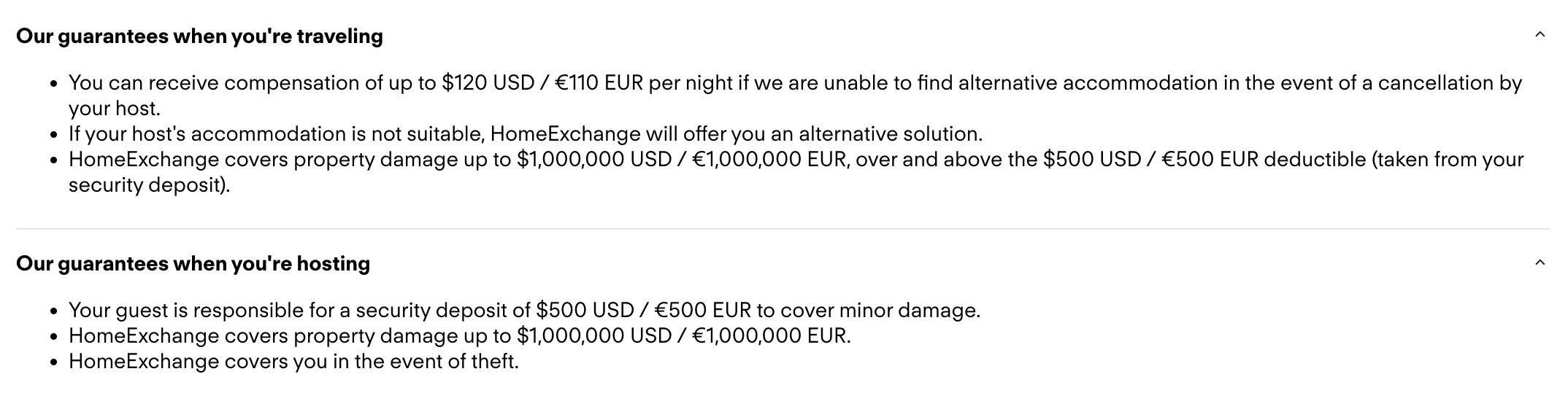
In other words, as someone staying at someone else’s house, they say:
- If the other person cancels the exchange, they’ll find you an alternative exchange or pay you up to 120$/110€ per night if no alternative is available
- Covers damages up to 1,000,000$/1,000,000€ (with a 500$/500€ deductible that you are responsible for)
And as someone who hosts guests in your home, they say:
- If there is minor damage, the person staying at your home is required to pay a €500 deposit (the security deposit) to cover those minor damages
- HomeExchange covers up to 1,000,000$/1,000,000€ in property damage
Unfortunately, as we’ll explain in more detail below, there’s a lot of fine print that isn’t included there, so the sense of security you’re left with (and that we were left with in our case) when you read these warranties doesn’t match reality when a real problem arises and you have to make use of those warranties.
Our Real-Life Experiences with HomeExchange
We started using HomeExchange a few years ago, and since then we’ve completed 10 exchanges, all using Guest Points: 6 where we stayed at other people’s homes, and 4 where we hosted people at our home. 9 of those 10 exchanges went very well:
- The 6 houses where we stayed were exactly as advertised; communication was smooth; the house rules were clearly explained; and they even left us a little gift (and we also left a little gift for the person who hosted us); the houses were clean, and we left them clean as well (while still paying the cleaning fee); and all of this led to positive reviews for us in all of those exchanges
- The first three exchanges we hosted at our home also went well: communication was smooth; we shared our house rules, which they read and followed; we left a small gift and a note (and they left small gifts for us in return); they stuck to what we’d agreed upon; and they left the house just as they found it.
Unfortunately, our tenth exchange (the fourth time we hosted guests in our home) in the summer of 2026 was a disastrous and poorly managed experience, which has caused us to lose a great deal of confidence in HomeExchange.
Our First Bad Experience with HomeExchange
We’re still trying to work out a solution with HomeExchange, and we’ll update this information once (hopefully) it’s finalized, but here’s a summary:
- We accepted this exchange (our 4th exchange hosting guests in our home) for 4 people, for 16 days.
- They had several positive reviews of their home (that is, from people who had stayed at their home), and only one positive review as guests (none of the other stays they had as guests had resulted in a review – from experience, we realized this could be a red flag).
- After accepting the exchange, communication was very disjointed (which, in our opinion, could be another red flag): We sent a message with the instructions and house rules, but they didn’t reply, so we had to follow up on WhatsApp. They didn’t read the instructions and rules (so on the day of the exchange, they asked us questions about how to get to the house, information that was clearly in those instructions), which meant we had to keep checking our phones.
- After they left, we found that:
- Our couch had a huge stain, like grease, that wasn’t reported. After talking to the person, they admitted it was theirs and that it was body oil. We paid for an extra upholstery cleaning to try to remove the stain, but it was impossible, so we had to buy a new couch (a total cost of €700 for the purchase, shipping, and the repair attempt). Honestly, we still don’t know what the stain was from, but it was huge, visible, and impossible to remove. Since this is our primary residence (and even with an eye toward future home exchanges), it gave the place a dirty feel, in addition to detracting from the living room sofa’s appearance.
- We received a complaint from our neighborhood association because there were 7 people in the community pool instead of the 4 we had approved—something that is not allowed in our housing complex and is strictly prohibited by the HomeExchange code of conduct. They also admitted this in a conversation with HomeExchange once it was reported, that they had indeed hosted more people in our home and used the common (and private) areas of our community without informing us and without our approval.
- The condition of the house when they left was a disaster: the mats on our outdoor hammocks were covered in charcoal stains and footprints, the refrigerator had a very strong seafood odor and there were seafood scraps in the freezer, the window tracks on the outside were covered in ash from the barbecue, and several kitchen utensils were stored in their respective cabinets with food scraps and/or grease on them.
- Faced with this situation (which was particularly serious given that more people than agreed upon were staying there and the irreparable damage to our sofa), we went to review HomeExchange’s terms and conditions, where we saw that in the event of damage, we had 10 days from the check-out date to report it to HomeExchange, and we filed a claim, confident that, given such a serious problem, HomeExchange would help us cover the cost of the new sofa (with its coverage of up to 1,000,000€) and take action regarding the violation of the rules.
- From that point on, we began to face the harsh reality that the guarantees aren’t as great as they seem and that HomeExchange’s customer service has quite a few shortcomings (not to mention that it’s terrible):
- We sent a list of all the issues, as well as photos (of the sofa before and after the exchange), receipts (for the old and new sofas), screenshots of the conversation with the person who admitted to causing the stain, as well as the receipt for the extra upholstery cleaning to try to remove the stain from the sofa, which didn’t come out, and even photos of the sofa after that attempt (and the rest of the mess we found in the house when we returned).
- Since everything was clearly documented (photos of the sofa before and after the exchange, proof that the stain wouldn’t come out, a document from the store stating that the sofa couldn’t be repaired, and the person’s admission of fault), we were completely confident that this would be resolved quickly.
- Nothing could be further from the truth; the HomeExchange customer service representative’s attitude began to take on a strange tone, casting doubt on our evidence, making basic mistakes when reviewing the documentation we sent, and asking us again for evidence we had already submitted, demonstrating a lack of attention to detail as well as a lack of empathy toward a platform user who had just suffered damage to their primary residence and faced a complaint from their neighborhood association due to an exchange arranged through the platform. We responded patiently and with attention to detail at all times, without ever disrespecting anyone, even though at one point they implied that we were being disrespectful (of course, we have saved all the emails to prove otherwise).
- After many emails and many days of working on this, and following several serious mistakes, this person from HomeExchange offered us:
- First, they added 500 Guest Points to our account as a “gesture of goodwill”, explaining that it was “just a cleaning stain” and not irreparable damage to the sofa.
- Second, after many emails and after proving that the stain wouldn’t come out and couldn’t be repaired, they suggested that they would ask the person for €229 (out of the more than €700 we spent). They derived this figure from the invoice sent for the new IKEA sofa; since the sofa consisted of three parts or pieces, the invoice listed three items with three different amounts. They chose one of them at random and suggested they would ask the person for that amount.
- Later, after we pointed out the error on their end, which they didn’t understand, and following several days of emails trying to clarify something so basic, they told us they were going to ask the person 60% of the original price of the sofa, due to depreciation (10% depreciation per year, since the sofa was 4 years old), which would amount to €377.40.
- When we expressed our disagreement and explained that, in addition to the sofa, we had to pay for shipping (€30) and a bill for the attempt to remove the stain (€80), they then told us that we had to choose between 60% of the value of the old sofa (€377.40) or the cost of the attempt to remove the stain (€80), but that we could not claim both.
- It’s important to note that, at this point, what HomeExchange’s customer service team was doing was negotiating the amount they would ask the person to pay (supposedly taken from their €500 security deposit) to compensate us. In other words, it’s not even that HomeExchange is going to cover any monetary amount under that supposed guarantee of up to €1,000,000; it’s simply the amount they’re going to propose that the person who caused the damage to the sofa pay.
- It is also important to note that this amount applies only to one of the damages (the sofa), while the remaining damages (the fact that there were 7 people instead of 4 and the condition in which they left the house) are completely excluded from the process and do not give rise to any possibility of compensation or action against the other person’s profile on the platform.
- After seeing that the customer service representative wouldn’t listen to reason and was ignoring our requests (we asked, following several errors, that the case be transferred to someone else, but received no response to three consecutive emails), we proceeded to look for an alternative way to contact them: the official HomeExchange Facebook groups. These groups are managed by the company, and to join, you must verify that you have a HomeExchange active account. When we tried to explain our problem in the groups, both in the Spanish and the English ones, our post was not accepted (since, according to their policies, they do not accept personal cases, only general information), and they messaged us privately saying they would pass the information on to the customer service team. A comment we left on a post that HomeExchange had just published that same day, marketing their guarantees, which they were failing to uphold in our case, was also rejected. We also tried to raise our issue on the official forum, with the same result (our post was not approved, and our forum profile was blocked). Faced with the inability to highlight a case of poor customer service “in public” on HomeExchange’s official channels, we proceeded to post our case in another generic Facebook group about home exchanges and on Reddit, where, to our growing concern, we received many comments from other people who had had similar dismal experiences with HomeExchange’s customer service. When everything goes well, the platform is wonderful, but the moment a problem arises and you contact customer service, the experience is terrible and very poorly handled. Furthermore, the company’s attitude seems to be to silence anything that isn’t positive about the platform.
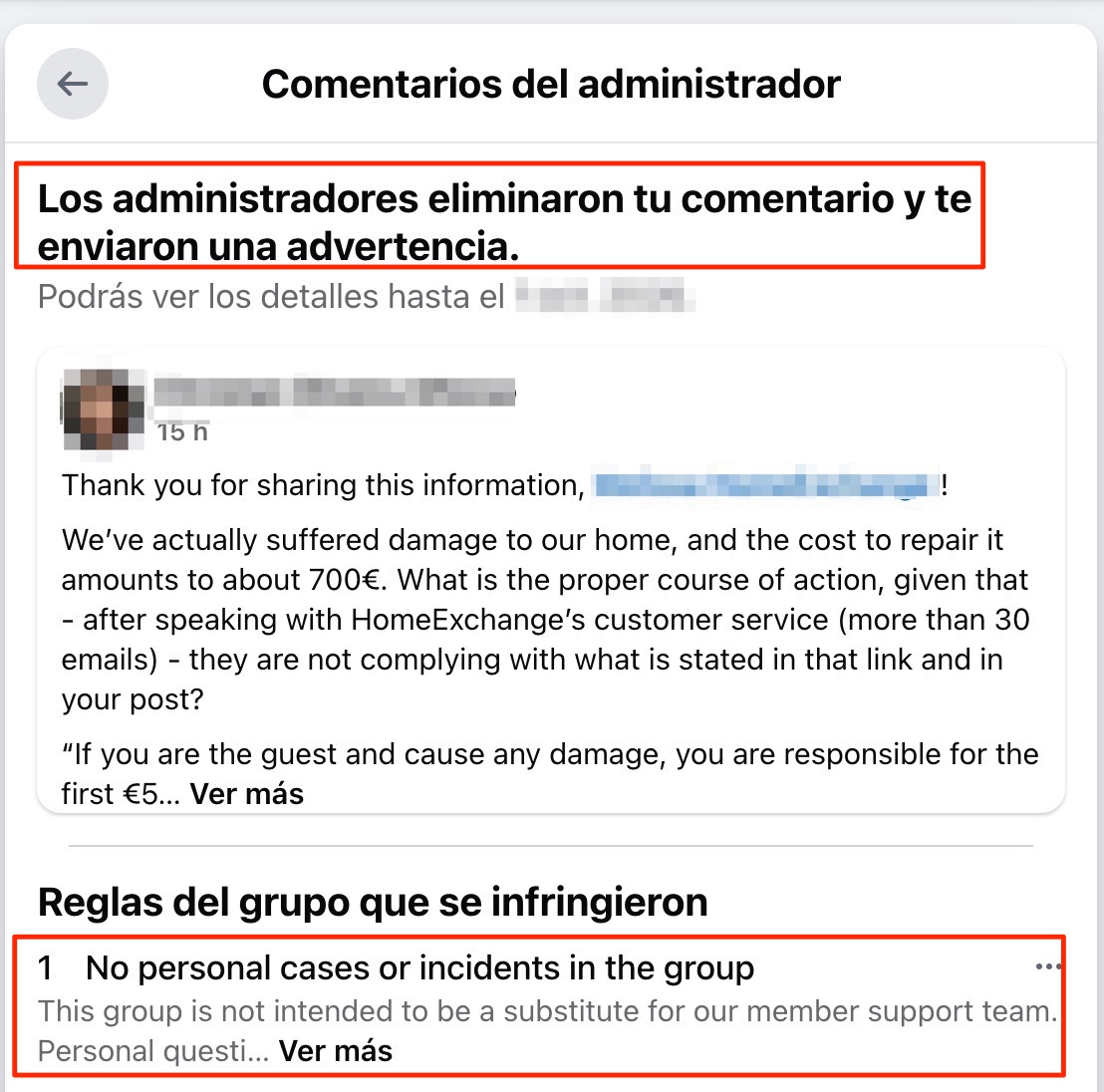
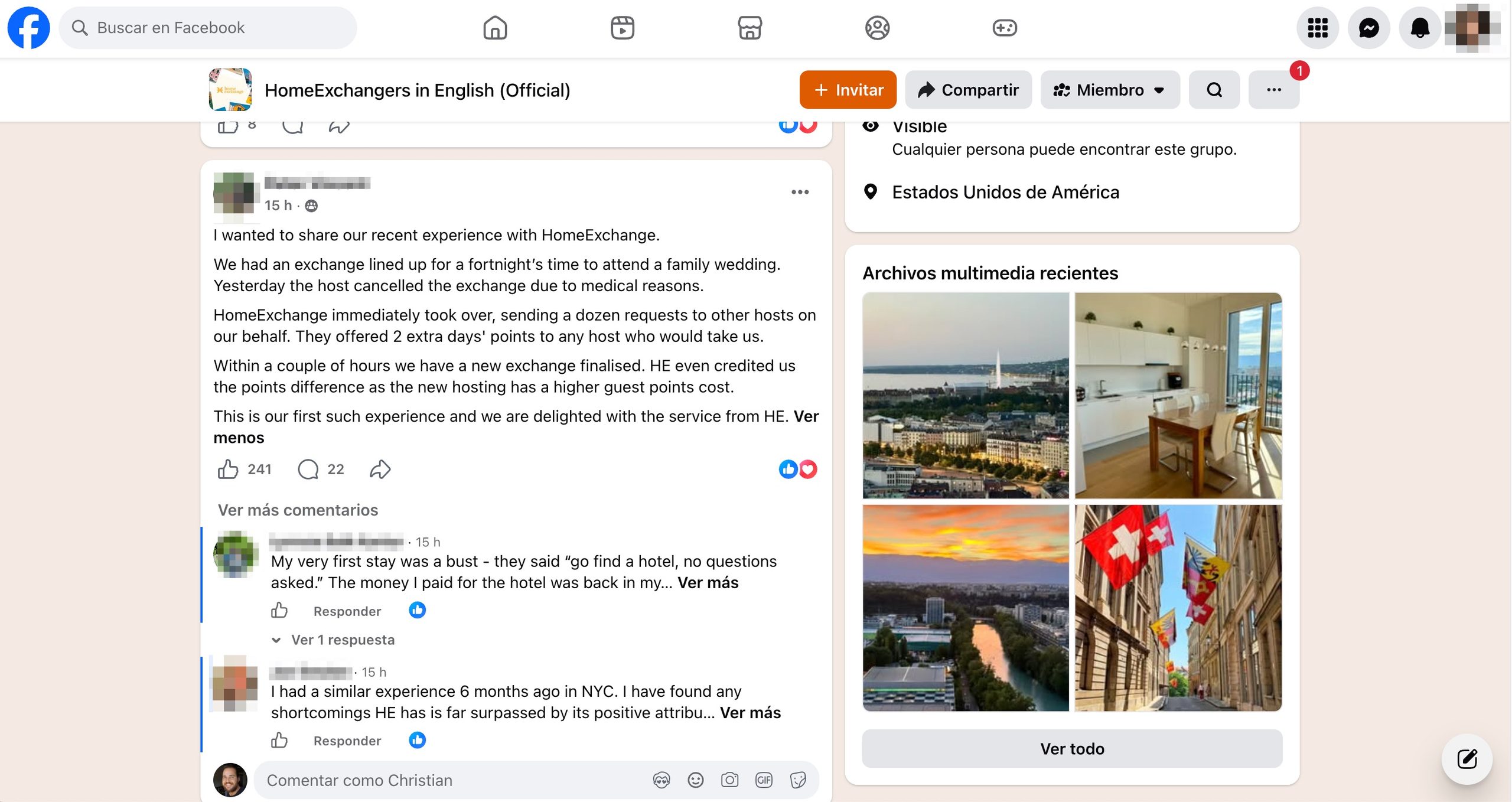
- After these steps, we received a phone call from another HomeExchange customer service representative, who apologized and told us that, of course, the shipping cost for the new sofa (30€) and the cost of the stain removal attempt (80€) would also be covered, but that the value of the sofa would have to account for depreciation. We expressed our disagreement and explained that, in addition to the sofa, there had been a violation of the rules (by hosting more guests than agreed upon) and various issues with the cleanliness of the house. They also indicated that after speaking with the guest, the guest acknowledged that on some days, there had been more people than agreed upon, both in our home and in the common (and private) areas of our housing complex, without having informed us or obtained our approval, and that HomeExchange would issue “a warning” to the user’s profile, though without explaining what that entails in practical terms. Since we were unable to reach an agreement over the phone, they insist on sending us the new proposal via email (which, we reiterate, simply concerns the amount to be proposed to be charged to the person).
- The new customer service representative sent us an email in which they clearly hadn’t thoroughly reviewed our previous conversations, and made another mistake regarding the price of the new sofa, choosing a different one of the three Ikea sofa components to offer, once again, a lower price. Our frustration is at its peak right now, given all the time we’ve spent on emails and on the phone, only to receive this kind of treatment that lacks empathy and attention to detail. We resend everything and explain the different invoices once again, and now this person tells us that the depreciation value is calculated based on the value of the new sofa, which is cheaper than the old one (on top of that!), so instead of €377.40, it would be €359.40. At this point, it’s no longer a matter of money; it’s a matter of a lack of transparent, rational, and consistent criteria. We remind and insist once again that HomeExchange isn’t going to pay us any of these amounts; it’s simply going to request them from the person to deduct them from their €500 deductible.
- We express our frustration and despair, and calmly proceed to list the damages and mistreatment we received from the guest and from HomeExchange’s customer service, and we also request clarification and a link to the documentation or fine print explaining where that amount comes from, whether it applies to the old product or the new one, and why they have been applying different amounts to us in different emails, questions to which they have been unable to provide an answer.
- In the next exchange, we receive a message from yet another person, who offers no clarification or additional information, and our emails begin to be ignored. We don’t receive a response for 2, 3, or 4 days, leaving us completely in the lurch
In other words:
- In a home exchange, the guests staying at our house violated the platform’s rules and, on top of that, left the house in a very dirty condition, damaged a piece of furniture (the sofa), resulting in an expense of over €700, a complaint from the homeowners’ association, and a significant number of hours of our free time spent cleaning and dealing with the aftermath
- The platform we pay to protect ourselves against these kinds of situations, after much insistence, evidence, and negotiation, is offering us the option to request that these guests pay an amount less than what we had to spend to replace the sofa, and the rest of the issues and breaches are being swept under the rug (they tell us they issued “a warning”, but we still don’t know what that means or what real consequences it has)
- The guest’s profile remains online and available on the platform, and they can use it without any restrictions.
This has led to a huge loss of trust in the platform, and a much greater reluctance to accept exchanges at our home, since, unless we’ve been extremely unlucky and there’s been a mistake in analyzing and processing our case, any damage caused to our home as a result of an exchange with HomeExchange will inevitably result in financial costs for us.
The announcement of the guarantee of up to 1,000,000€ sounds like pure misleading marketing, since in this case, where we’re also talking about a small amount compared to that figure (700€), they are haggling over every cent regarding the amount to be requested from the guest, applying different criteria as the process progresses, and causing a waste of time for both us and the customer service representatives in handling a clear and straightforward case.
We can only imagine what an ordeal it must be if it’s not so easy to prove the damage, or if those responsible for the damage don’t admit to it, or if we don’t have receipts for the damaged items. In our case, we have photographs and receipts for everything, and the people we hosted also admitted to all the damage and breaches of contract they caused in our home, and even so, it’s still a nightmare.
Based on how HomeExchange advertises itself, we expected that in a clear-cut case, once the cause of the damage had been proven, HomeExchange would cover the cost and penalize those responsible, but the reality could not be more different.
For now, we’re still using the platform, since we have some Guest Points saved up and our annual fee is paid through July 2027, but we’re taking many more precautions and, of course, considering canceling our subscription once the points run out.

HomeExchange Reviews
In general, HomeExchange has a lot of positive reviews, since most people who pay the fee and use the platform are serious, responsible, and take good care of other people’s homes. Therefore, your experience using the platform will most likely be a good one. The problem is that when you end up with one of those few people who aren’t as responsible or don’t take as good care of the homes, the platform’s protection fails miserably, as customer service is slow, inefficient, and offers solutions that don’t live up to what the platform promised when you signed up.
Positive reviews: What’s great about HomeExchange
As we mentioned, most experiences on the platform are positive, so most reviews speak highly of HomeExchange. As of the time of this writing, HomeExchange has a 4.7 rating on TrustPilot, with nearly 40.000 reviews.
Here are, in our opinion, the positive aspects of HomeExchange:
- It allows you to save a lot of money on lodging while traveling.
- In most cases, you can have a more authentic local experience and contribute less to the gentrification of the place you’re visiting by not staying in a hotel or a vacation rental
- If you’re flexible, you can discover new places through reciprocal exchanges
- In some cases, you can stay in spectacular accommodations that you might not be able to afford if you had to pay the equivalent amount, and even visit destinations you wouldn’t normally consider precisely because of the cost of lodging.
- It makes it easy to find exchange opportunities anywhere in the world, and being able to read other people’s reviews helps you narrow down your options
- The annual fee is affordable, and, in principle, staying just a few nights through the platform already pays for itself compared to what you’d spend on a hotel or apartment.
- It makes exchanges with its Guest Points system much easier.
- For families with young children, this is a particularly attractive option, since you can stay with another family, whose home is likely to be better suited for children, with toys and other amenities, something that’s much harder to find in a rental apartment or a hotel.
- In general, if you have people stay at your house while you’re away, your home will be better protected and taken care of (if you have plants, you can ask them to water them for you, for example)

Negative Reviews: The Downsides of HomeExchange
As we explained, even though most experiences with HomeExchange are positive, the platform handles the few negative experiences very poorly: when something goes wrong, the platform’s guarantees fall short of expectations, and the customer service doesn’t live up to the expectations.
Here’s a summary of what we consider to be the downsides of HomeExchange:
- If something in your home gets damaged, the process for filing a claim for reimbursement is tedious, slow, and offers no guarantees. Furthermore, you won’t receive 100% of the cost, since they’ll apply a depreciation value and you’ll only be entitled to a portion of the total value.
- In the event of serious violations of the rules (such as having more people staying at your home than agreed upon, for example), the platform does not take any real, noticeable action. In theory, they “issue a warning” to the other account, but that account can continue to use the platform, which puts the rest of the users, who are unaware of that “warning”, at risk (they might read any negative reviews the profile has, but of course, not everyone leaves negative reviews on HomeExchange).
- In general, the coverage advertised (up to €1,000,000 for damages) is pure (misleading) marketing, and when it comes time to file a claim, it’s a bureaucratic maze, which, combined with slow customer service and a lack of attention to detail, creates an enormous sense of abandonment and frustration when something goes wrong.
- At first, it’s very very difficult to get an exchange approved as long as you don’t have any reviews. For our first exchange, we had to send more than 300 requests
- You open your home to strangers, along with your personal belongings, clothes, etc. While in most cases nothing happens, if you’re unlucky enough to have someone who doesn’t respect your privacy or your belongings, you could have an unpleasant experience.
- Extra effort is required both when hosting others and when staying with others: you’ll have to prepare your home to welcome guests (and it’s customary to leave a note and a small welcome gift), and the same goes when you stay at someone else’s home, you have to be careful and leave the place just as you found it, and it’s also customary to leave a small gift. It therefore requires more time than if you were staying in an apartment or a hotel.
- There is an excess of “do-goodism” when it comes to leaving reviews. Since reviews are very important on the platform, exchanges are “free”, and most reviews are positive, people are less inclined to complain or comment on a review when something didn’t go so well. This undermines the value of the reviews and the platform, since they lack sincerity.
- Because of this, screening homes and guests is not foolproof, so there is no way to guarantee that you are making a good choice when approving an exchange.
- If you live in an area that isn’t very touristy/demanded, you’ll have a much harder time using the platform. If you want to go to a very touristy area, it can also be difficult or even impossible to find a swap (in cities like Rome or New York, for example).
- If your exchange as a guest is canceled, HomeExchange’s guarantees are unfair and insufficient: the first step will be to find you an alternative, which may not be equivalent in terms of quality or conditions, and worst of all, it may be up to 50 km away from the original accommodation (while this might make sense in some cases, if you’re visiting a specific town or city, having to travel 50 km is not a valid alternative). If there is no alternative (and if there is, you’ll have to accept it or be left with nothing), they may reimburse you up to 110€/120$ per night (you’ll have to provide receipts showing your expenses for the same travel period); while this may be helpful in some cases, in many cities today it’s impossible to find accommodations at that price, especially if you’re a family or a group of several people.
In short, there are quite a few downsides, so if you’re going to use the platform, you should keep them in mind and be prepared for them, have a Plan B, and so on. Even so, the vast majority of our experiences were positive, and it also allowed us to stay in cities for more days than our budget would have otherwise allowed.
Our tips if you want to use HomeExchange
Based on our experience with various exchanges using HomeExchange, here are our tips if you decide to use the platform, now that you know the pros and cons, to help you get the most out of it:
Tips for Hosting Guests in Your Home
- Install padlocks or locks on some of the cabinets or drawers in your home, where you can store your most personal items and/or valuables. If someone breaks your favorite glass, a special mug you were given as a gift, or a piece of clothing you really love, even if you manage to get them to pay for a replacement, it will never be the same. Therefore, minimize the chances of something like that happening.
- Make room for your guests: Try to leave some space in closets, the refrigerator, etc., so your guests can store and organize their belongings.
- Have a trusted person who lives near your home: for handing over the keys, in case any problems arise, and especially to check on the house after the exchange (particularly if you have two or more exchanges in a row or won’t be returning right away, which may be common, especially in the summer), it’s very helpful to have someone you trust nearby (it could be a neighbor, a friend, a family member, etc.).
- Create a “handbook” for your home: In it, you can include important information (the address, emergency phone numbers, etc.), explain how things generally work (heating, air conditioning, hot water, Wi-Fi…), as well as your house rules or things to keep in mind. It’s important to share this with your guests well in advance so they can read it at their leisure, ask questions if they have any, or, if they disagree, so you can modify or cancel the exchange before their arrival. It’s also important to make it clear what you expect them to do during their stay and upon checkout (for example: upon checkout, take out the trash, leave all used kitchen utensils clean and put away, and leave used sheets and towels on the bathroom floor).
- Find a reliable cleaning service: While you can ask your guests to clean the house before they leave, everyone has different standards for cleanliness, which can lead to misunderstandings. Plus, sometimes it won’t be possible to do everything (they might have an early morning flight, or there might not be enough time to wash sheets and towels, for example). In our opinion, whether we’re staying at our own home or at someone else’s, we prefer to have a cleaning fee that covers basic housekeeping (sweeping, mopping, cleaning the kitchen and bathroom, washing sheets and towels, making the beds, etc.) to ensure a consistent standard of cleanliness and to return home to the same standard.
- Leave a note and a small gift: After all, this is about people exchanging experiences, not a business, so it’s appreciated if you leave a welcome gift and a note to make your guests feel at home.
- Set up your calendar properly and keep it up to date: Make your available slots visible as far in advance as possible, choose whether or not you want to receive requests for unavailable slots, and try to respond to all requests you receive. One of the biggest frustrations for people who are new to the platform is that many requests don’t even get a response, so keeping your calendar up to date and properly configured will help you limit the number of requests and ensure you can respond to all of them.
- Over-communicate: in other words, communicate more than necessary. Communication is extremely important for ensuring that exchanges go smoothly: don’t take anything for granted or assume that your guests will know or figure things out on their own; double-check important details (dates, cleaning fee, rules, check-in or check-out times, etc.); ask during their stay if everything is going well, etc.
- Before accepting the exchange, check the reviews on the profile and be wary if that person has hardly any reviews as a guest from previous exchanges (we learned this the hard way). It might be a coincidence that, out of all the exchanges that person has had, they’ve always forgotten to leave a review and missed the 40 days deadline, but if this happens multiple times, be wary, precisely because of the “do-goodism” that characterizes the platform, as we mentioned earlier…

Tips for Staying at Someone Else’s House
- Send lots of requests: At first, you’ll likely use the platform the same way you use other lodging platforms like Booking.com or Airbnb, where you analyze each listing in detail, read reviews, etc., to decide which one to “book”. While it’s also important to research and choose carefully on HomeExchange, you should understand that your request will most likely be rejected or you might not even receive a response, even if the listing appears available on the calendar. So, yes, search, filter, make sure it meets your needs, and read reviews, but be sure to send out plenty of requests to increase your chances of finding someone who’s a good match for your request.
- Repeat your search every X days: People frequently update their calendars (or sign up), so it’s possible that new options will appear a few days after you’ve done your search and sent out requests. It’s important to be consistent and patient, and to repeat the search several times to find more options and increase your chances of finding an exchange.
- Be transparent from the very beginning: specify your dates, estimated arrival and departure times, how many people will be staying (if you plan to have additional guests or visitors, let them know and ask for permission), and ask any questions you may have.
- If you receive a pre-approval for a swap, respond quickly: When you receive a pre-approval for a swap, you have 4 days to accept, and the home remains reserved for those dates in the meantime. While you can wait those 4 days, out of respect for the other party, respond as soon as possible; if you’re not sure yet because you’re exploring other options or waiting to confirm something, respond and let the other person know so they’re aware.
- Over-communicate: Just as with the tips for hosting guests, the same applies when you’re staying at someone else’s home, over-communicate. Double-check important details (dates, cleaning fee, arrival times, etc.) and ask any questions you may have (but first, carefully review the listing and the messages you’ve already exchanged, as well as any information they’ve sent you, the answer to your question might already be there, and asking again can leave a bad impression on the other person). Let them know as soon as you arrive at the property, express your gratitude (especially if they’ve left you a small gift and/or a note), check in during your stay to make sure everything is going well, ask if you have any questions, let them know if you damage or break anything and offer to replace it or compensate them, confirm your checkout time, and let them know when you’re leaving.
- Be punctual: especially if you’re handing over the keys in person, be on time for the agreed-upon check-in and check-out times, and if anything unexpected comes up, contact them immediately.
- Treat the house better than you treat your own: try to leave it cleaner than you found it, and handle things with extra care to avoid damaging or breaking anything. Something we always do when we stay at someone’s house is, upon arrival, take a video and photos of the entire house, so that when we leave we can see how the house was when we arrived and try to leave everything the same (for example, if we move something out of place, or if we don’t remember whether a certain item was there). It will also serve as proof if your host claims you’ve broken or damaged something when you haven’t.
- Read the rules carefully and follow them: Generally, your host will give you or send you the house rules. It’s important to read them carefully, ask questions if you’re unsure, and follow them to the letter.
- Avoid using items from the house: Even if you have access to food, drinks, etc., at the house because they’ve left everything accessible for you, try not to use them. You can use a little oil, salt, or detergent if you only need a small amount, but if you’re going to be cooking a lot, doing a lot of laundry, etc., buy your own supplies, unless you’re told otherwise. Of course, if you use something up, replace it.
- Report any issues or damage: If you break something, something stops working, something strange happens, whatever it is, report it immediately to the host. It’s much easier to resolve issues by talking directly and taking the initiative than by having to involve HomeExchange, especially if the host discovers a damage that you didn’t report.
- Leave a small gift and a thank-you note: Before you leave, it’s a nice custom, and much appreciated, to leave a small gift (such as a local product from where you come from) and a thank-you note for the person who let you stay at their home.
- Before submitting your exchange request, read the reviews on that person’s profile as a host from previous exchanges to confirm that, in exchanges prior to yours, the home matched the listing, was clean, communication with the host was smooth, etc.

Conclusion: Is HomeExchange worth using? Is it reliable?
As you’ve probably noticed if you’ve made it this far, home swapping in general, and HomeExchange in particular, is an excellent solution for traveling more affordably, more locally, and in a more sustainable way, especially in highly touristic areas where there’s a housing shortage. Plus, HomeExchange’s points system and its reasonable annual fee make it much easier to use this option for your trips instead of other rental or hotel booking platforms.

However, all that glitters is not gold, and despite HomeExchange’s marketing efforts (largely through influencers and content creators who recommend the platform on social media), the platform has serious shortcomings in terms of security, guarantees in the event of problems, and, above all, the quality of its customer service.
In our opinion, we currently have mixed feelings about the platform for all the reasons explained in this article: the guarantees sound good from a marketing perspective but are not easily applied when it comes down to it, people who abuse the platform are not removed or penalized in a clear and exemplary manner, and therefore, our trust in the platform is much lower, and we take many more precautions when using it.
Even so, we believe it’s always worth it as long as you prepare your home well (and secure your valuables), carefully screen the exchanges you accept, maintain good communication (frequent and open) with your exchange partners, and exercise patience and persistence when looking for options.
Above all, it’s important to assess your personal situation: if you have expensive furniture or items with great sentimental value, if the thought of something getting damaged causes you fear or stress, or if you can’t afford the expense of something breaking in your home, think twice. If, on the other hand, you aren’t particularly attached to your belongings and you accept that something might happen during one of your exchanges and that you might have to pay out of pocket, the possibilities the platform opens up for you to stay anywhere in the world are immense.

We hope this article has helped clear up any questions you may have had before using HomeExchange—or even allowed you to share your frustrations if you’ve ever run into any problems. If you’d like to share your questions or experiences, leave us a comment, and we’ll get back to you!
Have a great trip!
x
