

Two days and one night of camping amid the lush green of tropical forests and the turquoise blue of palm-fringed coves in this Colombian gem on the shores of the Caribbean: Tayrona National Park.
We got lost among centuries-old trees, watched blue-tailed lizards, admired butterflies with the most stunning patterns, and saw birds that answered our whistles. We chose to enter via Calabazo – a longer and more challenging hike – but one that passes through Pueblito, a sacred site for the indigenous peoples living in the park, where they connect with Pachamama. We spent the night at the Cabo San Juan campground and exited through the main entrance (Zaino), stopping along the way to enjoy the idyllic beaches that soothe all our aches and pains.

This post is a comprehensive guide where we tell you everything you need to know to visit Tayrona National Park on your own, with several possible itineraries (or, at least, everything we would have loved to find in one place!). If you think any information is missing, or if something has changed since we published it, let us know in the comments. You can also check out our featured stories by clicking here or visiting our Instagram.
How to get to Tayrona
To get to Tayrona National Park, you’ll first need to travel to one of the nearby cities or towns, the most common being Santa Marta and Palomino.
How to get to Santa Marta from Cartagena
The most common route is to travel from Cartagena to Santa Marta, where you’ll base yourself, and from there visit Tayrona.
To get to Santa Marta from Cartagena, the most common and convenient option is to travel with Marsol, a private minibus company that operates along Colombia’s Caribbean coast.
They say it takes about 3 hours, but in reality it depends a lot on the day: in our case, they picked us up first, at 9:00 a.m., at our hotel in Cartagena, and it took an extra hour (until 10:00 a.m.) to pick up the rest of the passengers in Cartagena. We also stopped to drop off and pick up passengers in the Barranquilla area, made a stop at a small roadside stand to buy drinks and/or snacks, and arrived at our hotel in Santa Marta at 2:30 p.m. (in other words, the trip took 5 and a half hours).
Another option is Copetran’s super-comfortable buses (we took them on another route, from Santa Marta to Riohacha). They cost 40,000 COP per person (11€) and take 4.5 hours. You can buy tickets online on their website. There are also other companies we didn’t try, such as Unitrasco and Expreso Brasilia, starting at 26,000 COP per person (7€).
Santa Marta also has an airport, and there are flights from Colombia’s major cities.

How to get to Tayrona from Santa Marta
By local bus
The cheapest way to get to any of the Tayrona Park entrances is by local bus, which runs from Santa Marta to Palomino and back. They cost 9,000 COP per person (about €2.20), take about an hour, and you can find them at Calle 11 and Carrera 9, bus number 17 (in our case, it was white and green). They leave every 30 minutes starting at 6 a.m.
By private taxi or boat
Other ways to get there include a private taxi (50,000–60,000 COP, 13–16€) or by boat from Taganga (100,000 COP, 22€). Taganga is a beach town near Santa Marta; we didn’t visit it, but it’s another option for where to stay if you want to take the boat.
The boat from Taganga takes about 40 minutes and drops you off right at Cabo San Juan, so it’s the ideal option for those who just want to enjoy the beach with minimal effort. It’s also an option for the return trip.

How to get to Tayrona from Palomino
The bus that connects Santa Marta with Palomino also runs in the opposite direction, so if you’re in Palomino, you can easily get to Tayrona as well.
To do this, choose any bus that runs the Palomino – Santa Marta route (Marsol is also an option) and tell the driver you’re going to Tayrona (you can ask at your lodging for directions on where to catch the bus).
As you’ll see below, there are three park entrances, so depending on which one you choose, you’ll need to get off at the corresponding stop.

How much does it cost to enter Tayrona National Park (2026 Prices)
To enter Tayrona Park, you must pay an entrance fee and a mandatory daily insurance fee. Prices are current for 2026 and are as follows (they vary depending on high and low season):
During high season (December 1 – January 31, June 1 – July 31, Holy Week, national holidays, and long weekends):
- Foreigners: 96,500 COP (22€)
- Colombian nationals, foreign residents in Colombia, or CAN members between the ages of 6 and 25: 30,500 COP (7€)
- Colombian adults, CAN members, or foreign residents of Colombia over 25 years of age: 43,000 COP (10€)
- Born in Santa Marta (under 25 years old): 30,500 COP (7€)
- Born in Santa Marta (over 25 years old): 43,000 COP (10€)
During the off-season (the rest of the year):
- Foreigners: 81,000 COP (19€)
- Colombian nationals, foreign residents in Colombia, or CAN members between the ages of 6 and 25: 27,500 COP (6€)
- Colombian adults, CAN members, or foreign residents in Colombia over 25 years of age: 36,500 COP (8.5€)
- Born in Santa Marta (under 25 years old): 13,500 COP (3€)
- Born in Santa Marta (over 25 years old): 18,000 COP (4€)

The mandatory daily insurance costs 7,000 COP per day per person (1.50€). If you plan to stay in the park for several days, you must pay this amount for each day of your stay.
Where do you buy the ticket?
The easiest and most common way is to pay at the park entrance you’re using (note: you must show your passport!). That’s what we did, and we had no problems.
Since the number of people allowed into the park each day is limited (maximum 6,900 people per day), if you’re visiting during peak season, it might be a good idea to buy your ticket in advance to ensure you can get in.
You used to be able to buy tickets online as well, but for several years now, tickets have only been available for purchase in person upon entering the park. Since 2025 there is an option to pay the Tayrona Park entrance fee online (you can access it here); however, that payment does not guarantee a ticket reservation – it’s only to make it easier to pay online – so you’ll still need to try to arrive early to ensure you’re among the 6,900 people admitted per day. You can find more information about the payment process here

How long is the ticket valid?
The admission ticket is valid only for entering and leaving the park once. In other words, if you stay two nights, you pay for admission only once (you enter on the first day and leave on the third).
However, it does not allow you to re-enter, which is a problem, for example, if you want to visit the most popular area (Cabo San Juan and others) and then go to Playa Cristal the next day: in that case, you would have to pay the entrance fee again.
Tayrona park entry and exit hours
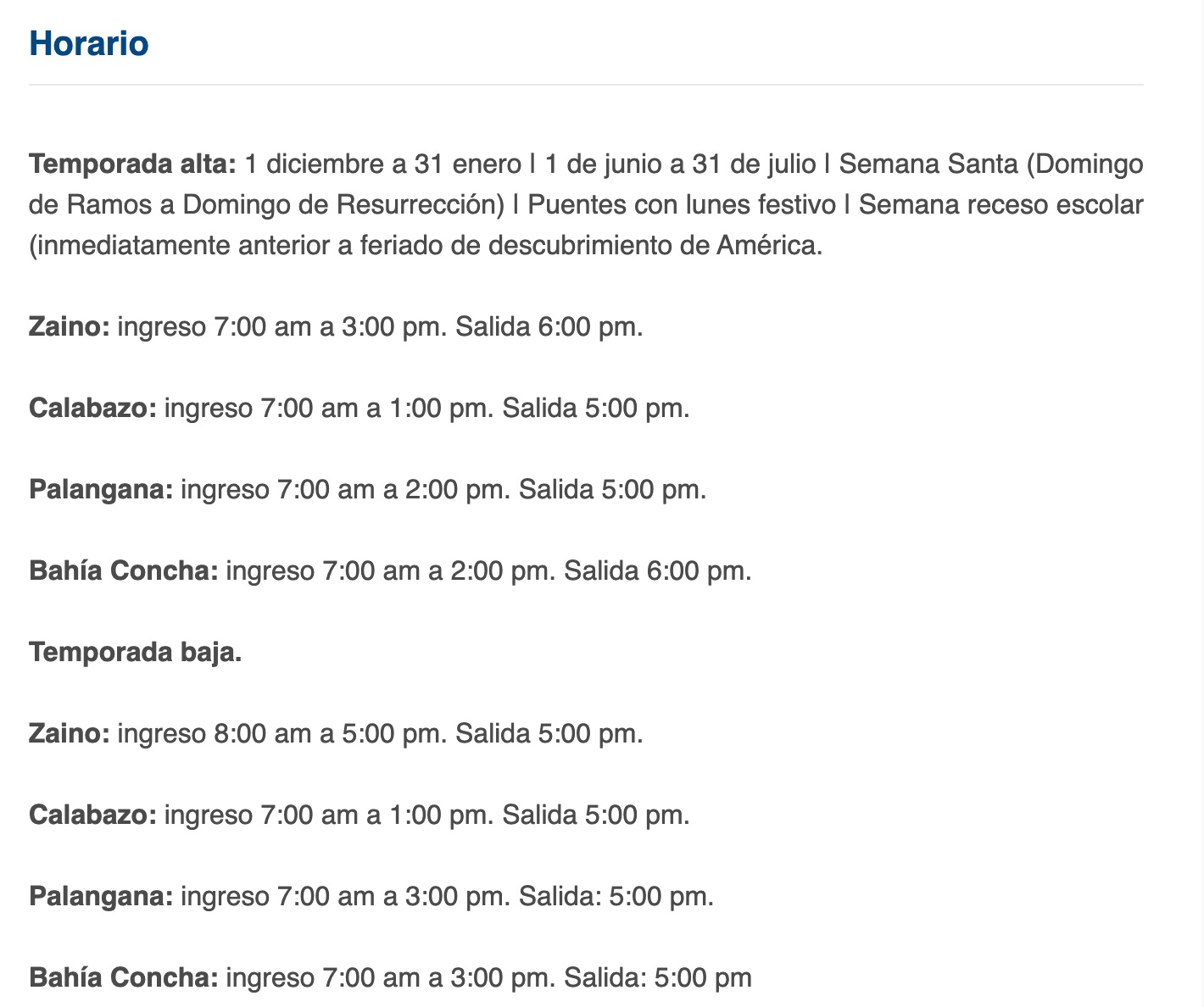
Tayrona Park’s entry and exit times vary depending on the entrance point and the season. Here you can see the 2026 schedule, published on the park’s official website:
When to visit Tayrona
You can visit Tayrona Park year-round except during three periods each year, which are usually in February, June, and October. These closures are typically announced in advance, so be sure to check the schedule carefully so you don’t arrive only to find the park closed.
Tayrona Park closure dates in 2026 (#respiraTayrona)
The closure dates for Tayrona Park in 2026 have already been confirmed, and they are the same as in previous years:
- February 1–15, 2026 (During the Kugkui shikasa season)
- June 1–15, 2026 (During the Saka Juso season)
- October 19–November 2, 2026 (During the Nabbatashi season)
These park closures, during which Tayrona cannot be visited, are the result of an agreement (called #RespiraTayrona) between the National Parks Service and the indigenous communities living in the park. Tayrona temporarily closes to “let the park breathe” and allow its biodiversity to recover.
As for the rest of the year, although Tayrona can be visited year-round, the best time to enjoy the beaches is when the weather is nice – the main issue being rain. Due to climate change, it’s difficult to predict when it won’t rain. The “rainy” season in this area runs from May through October, and the dry season from November through April.
We visited the park in November, and although the first day started out a bit cloudy, we had spectacular weather both days we were there.

We recommend visiting the park outside of peak season, and if possible, on a weekday that isn’t a holiday: Tayrona, along with the island of San Andrés, is one of the top beach destinations for Colombians, so it tends to get quite crowded during Christmas break (Dec. 15–Jan. 30), Holy Week, holidays, and weekends.
How long to stay in Tayrona
Most people visit the park for just one day, arriving early and leaving to spend the night somewhere else nearby. We don’t recommend this because:
- The park opens at 8:00 a.m. and closes at 5:00 p.m., so the time you’ll have there will be quite limited
- Since most people go for just one day, you’ll have to share the beaches with all those other visitors. If you stay overnight, you’ll be able to enjoy the beaches when they’re much less crowded from 7:00 a.m. to 9:00 or 10:00 a.m. and from 3:00 p.m. onward.
- Sleeping at the campground, stargazing, and waking up to the sound of the ocean is part of the magic of Tayrona.
If you have no other choice, you can go and return the same day, but if possible, we recommend staying at least two days and one night. If you’d like to and can stay longer, you can visit more beaches, stay somewhere different each night, and hike the 9 Stones trail.

Guide to exploring Tayrona Park
Tayrona Park has several entrances and areas to visit; we’ll detail them below.
Which entrance to use for Tayrona
Tayrona has 3 main entrances (all open from 8:00 a.m. to 5:00 p.m.):
- Palangana: This is the first entrance coming from Santa Marta and the least used one. People who want to go to the beaches in that area (Playa Neguanje or Playa Cristal, for example) use this entrance.
- Calabazo: This is the second entrance coming from Santa Marta, and it’s also rarely used. From here, you can reach Pueblito (more info below), and from there, you can continue toward Playa Brava and/or Cabo San Juan – one of the park’s most popular tourist spots – and then continue along the beaches to exit at Zaino. This route is more physically demanding.
- Zaino: the last entrance coming from Santa Marta and the one most people use (and therefore where you’ll have the most company on the hike). From here, you can access most of the beaches and reach Cabo San Juan. From the entrance, there’s a long stretch that can be covered by van (5,000 COP per person).
Below, we’ve included a highly detailed map with all the points of interest so you won’t have any doubts and won’t get lost
In our case, we decided to enter through Calabazo, heading first to Pueblito, then to Cabo San Juan, and from there taking the beach trail until we reached Zaino – which is what we recommend if you’d prefer to avoid the crowds (at least for part of the trip).

Where can I leave my backpack/suitcase/bag to visit Tayrona?
As we recommend in this guide, it’s best to travel light to Tayrona, since you’ll have to carry your luggage during the hike, and there’s no point in bringing a lot since you don’t need much to enjoy the park.
There are several options depending on your itinerary: whether you return to your previous stop from Tayrona or continue in the opposite direction.
- Going back to the previous point: if you’re visiting Tayrona from Santa Marta or Palomino and plan to return to the same place after your visit to the park (which was our case), the easiest option is to ask your lodging to store your luggage for you. In our case, they did so without any problems and took very good care of it for us in Santa Marta, at the Hotel San Miguel Imperial. Check with your lodging in advance to find out if it’s possible to store your luggage while you’re away and where it would be kept (whether it’s a secure location, if there are cameras, etc.).
- If you’re not returning to the previous stop: If, after visiting Tayrona, you’re not returning to the previous stop (because you’re coming from Santa Marta and continuing on to Palomino/Riohacha/Cabo de la Vela, etc., or vice versa), then you have two options:
- Store your luggage at the Zaino entrance: From what we’ve been told, they offer a luggage storage service at the Zaino entrance. It costs 5,000 COP per day per piece of luggage.
- Store your luggage at a lodging near the park entrance you’ll be using: instead of staying in Santa Marta or Palomino, you can spend the night before entering the park at a lodging near one of the entrances (here are some options) and ask them to store your luggage for you.
If you know of another option for storing luggage during your visit to Tayrona, let us know so we can include it here.
Things to see and do in Tayrona
Below are the highlights you’ll see in Tayrona
Pueblito (Chairama)
Update: Since 2019, it is no longer possible to pass through Pueblito (Chairama). This closure was requested by the four indigenous communities living in the park (Arhuacos, Kogui, Wiwa, and Kankuamos), along with the closure of some beaches not listed in this guide, because these are sacred sites for them and were in a state of disrepair.
The hike from Calabazo to Cabo San Juan can still be done, but the route changes slightly since, by not passing through Pueblito, you must take a parallel trail that leads to the Nudist Beach, and from there to Cabo San Juan.
You can visit the indigenous villages (Taycu) with a guide and by booking in advance. For example, you can arrange this through La Cima Tayrona (120,000 COP for up to 3 people) at least 2 days in advance
Pueblito is an archaeological site where, according to theory, the Tayrona people lived long ago (the same people who inhabited the now-famous Lost City, inhabitants of Colombia many years before Spanish colonization), and where today the Kogui – presumably their descendants – live alongside the Wiwa, the Arhuacos, and the Kankuamos.

You’ll be able to see the round houses where they lived (an estimated 4,000 people) and learn more about the culture of these indigenous peoples, who view the earth as a living being and strive to live in harmony with nature. You’ll likely run into some Kogui people; please respect them and don’t take their photos without asking for permission first.


Playa Brava
From Pueblito, you can head toward Cabo San Juan or toward Playa Brava. We didn’t visit Playa Brava, but we’ve read that it’s a large, empty beach, not suitable for swimming. It has bungalows and hammocks for sleeping.
Nudist Beach
This beach is very close to Cabo San Juan and is, in theory, a nudist beach. We didn’t visit it, though we’ve read that you’ll find all kinds of people there, and that the sunsets are really beautiful – though you’ll have to make your way back to Cabo San Juan at night.
Cabo San Juan
The most famous spot in Tayrona and probably one of the most visited and crowded. Here you’ll find several lodging options, a restaurant, and best of all: a beach where swimming is allowed! In any case, the waves are usually strong, so be careful when going in.
When we went (November 2018), there weren’t many people staying overnight, and day-trippers usually leave around 3:00 p.m., so after that time the beach gets much less crowded. The same goes for early in the morning.


La Piscina Beach
For us, this is the best beach (suitable for swimming) in this part of Tayrona. It’s large, and the water is super calm because it’s protected by a stone barrier further out. We went early, after spending the night in Cabo San Juan, and there were very few people, so we spent a couple of hours enjoying the ocean there.

Arenillas Beach
It’s right after La Piscina, also suitable for swimming, a bit smaller, and not crowded if you go early.

Arrecifes Beach
The other main “hub” in Tayrona, with restaurants, a campground, etc. The beach isn’t suitable for swimming (in fact, the ocean here is quite rough), but it’s very beautiful and large. We stopped here on our departure day, on the way to Zaino, to grab a bite to eat and have a beer.

9 Stones Hike
Between Arrecifes and Cañaveral, there’s a turnoff for the 9 Piedras hike, which we didn’t do due to time constraints but which is said to offer the best views of Tayrona. Very few people go there, so if you want to escape the crowds, this is the place.
Here’s a link to the exact route for the 9 Stones hike on Wikiloc, in case you want to do it.
This beach is the closest to the Zaino entrance, and it’s where the famous – and extremely expensive – Ecohabs are located. We didn’t visit it.
The best beach in Tayrona: Playa Cristal or Playa del Muerto
The beach that’s supposedly the best in Tayrona (we didn’t visit it, so we can’t say for sure, though in the photos and videos you can find online, it looks incredible!) isn’t in this part of the park – it’s further west.

To get to this beach, you have (as far as we know) three options:
- Enter Tayrona through the first entrance (Palangana), go to Playa Neguanje, and from there arrange a boat ride to Playa Cristal. From the bus stop to the ticket office is 3 km, and from there to Playa Neguanje is 15 km; this route can be traveled by motorcycle (according to Germán Darío in the comments, 50,000 COP per person round trip). From Playa Neguanje to Playa Cristal, take a boat that seats 12–14 people; the fare is 10,000 COP per person.
- Go to Taganga and negotiate a boat ride from there directly to Playa Cristal (Germán Darío mentions in the comments that they charge about 100,000 COP per person for a round trip).
- Book a tour from Santa Marta or Taganga that takes you there. For example, this tour from Santa Marta to Playa Cristal costs 80€ and includes all transportation and park admission (meals not included).
This beach can only be visited during the day (you can’t stay overnight there), and as far as we know, visiting it is incompatible with exploring the rest of the park on the same day or staying overnight.
If you want to visit it, you’ll have to set aside an extra day or skip visiting the other part of the park.
Map showing locations and distances between them
Here’s a Google Maps link with the locations marked so you can save it to your phone and have all the points of interest at your fingertips: from the Santa Marta bus stop to the Tayrona park entrances, the beaches, and more.
This other map provides a clearer overview of the locations and the approximate walking time between them, so you can plan your route and determine how much time to spend at each spot.

We recommend downloading the Maps.me app with offline maps onto your smartphone, since – for Tayrona, for example – it shows much more information than Google Maps (hiking trails, restaurants, etc.) and will help you find your way around the park more easily.
Where to eat in Tayrona
For breakfast, lunch, or dinner in Tayrona – if you’re not bringing your own food – there are options at all the campsites. Prices are a bit higher than in Santa Marta, but in our opinion, not high enough to make it worth lugging food around if you’re staying overnight.
Eating in Cabo San Juan
In Cabo San Juan, the most touristy spot in Tayrona, there’s a fairly large restaurant that serves breakfast, lunch, and dinner.
You can see the prices and menu in this document about Cabo San Juan (4,500 COP = approximately 1€) and in the image below:
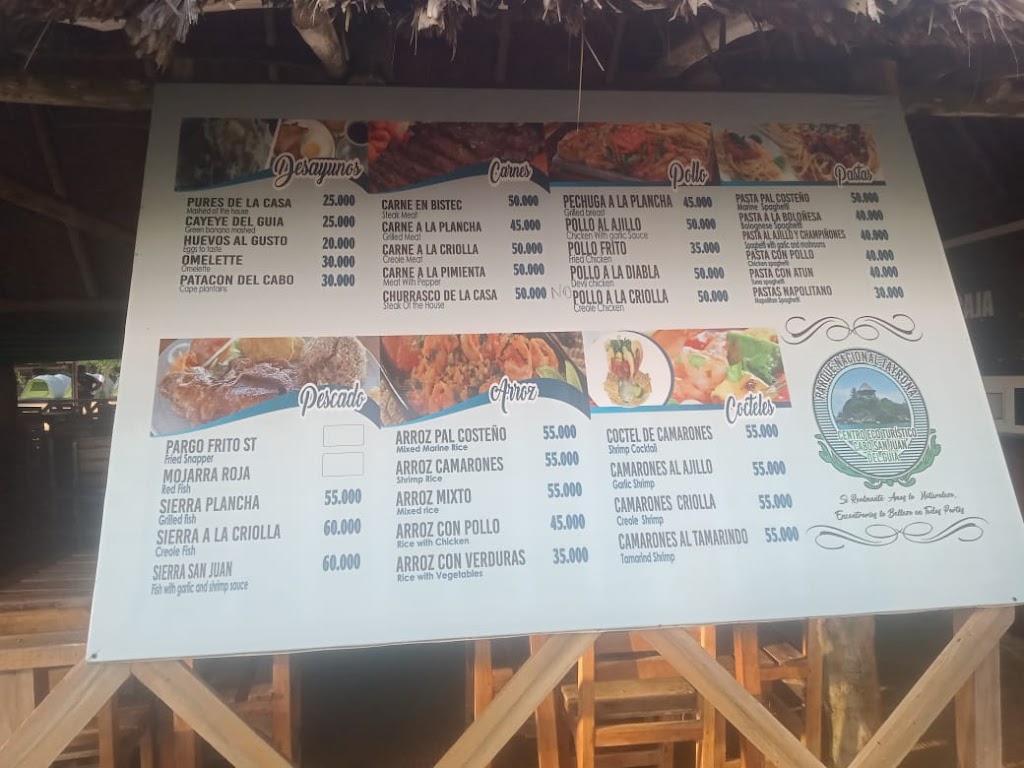
We had lunch and dinner here on the first day, and breakfast on the second day.
Eating in Arrecifes / Arenillas
In Arrecifes (and Arenillas, which is right next door), you have several dining options:
- A fairly large restaurant located at the main campground.
- You can’t leave without trying the legendary pastries from Panadería Bere: the most famous ones are the chocolate ones (which we couldn’t try because they were already sold out), but they have many others – all homemade and absolutely delicious!
- Fabi’s Corner serves breakfast and lunch
- A arepa stand on the beach (we saw the sign advertising it, though we didn’t go to try it since we’d already eaten)


Eating on the road from Calabazo to Cabo San Juan
If you enter Tayrona via Calabazo, you can grab a bite to eat along the way before reaching Pueblito, at La Cima Tayrona. Here are the approximate prices:
- Breakfast: 15,000
- Lunch: 20,000
- Moringa and Coca energy drinks: 3,000
Where to stay in Tayrona
There are different options for lodging within Tayrona National Park; here’s what you need to know:
Staying in Cabo San Juan
Cabo San Juan is the most popular tourist spot in Tayrona and the place most people choose to stay overnight, since its beach is suitable for swimming. There are several options for staying in Cabo San Juan (here are all of them, with photos and prices):
Staying at the campground in a tent: There are plenty of pre-pitched tents available, equipped with mattresses (though cleanliness is sorely lacking), which cost 140,000 COP (30€) per night for two people.

Sleeping in hammocks:There are also several areas with hammocks (one of them atop the rocks that separate the two beaches) where you can sleep for a mere 40,000 COP (9€) per person (60,000 COP for those at the top, at the lookout point, 13€). The price has gone up a lot in recent years (we read on some blogs that it used to be around 5,000 or 10,000 COP (less than 3€)).
Staying in a cabin: in the area separating the two beaches – where there are also hammocks – you can stay in a private double room for between 250,000 and 400,000 COP (between 55 and 90€), depending on whether it has a fan or air conditioning, right above the ocean. They’re very basic and don’t have a bathroom (the bathrooms are located near the campground and the restaurant, so you’d have to come down from up there and walk along the beach).
If there are two of you, we definitely recommend the tent (which also protects you from mosquitoes), and if you’re traveling alone, we’d almost recommend it too – unless you love sleeping in a hammock.
There are several restrooms and showers, but when it’s crowded, there are long lines to shower, and the cleanliness leaves a lot to be desired.
To store your belongings, you can leave them inside the tent or in the lockers (locker access hours: 7:00 a.m. to 9:30 p.m.). Remember to bring your own padlocks!
Can you reserve a tent or hammock at Cabo San Juan?
In theory, yes, you can make a reservation by contacting this number (WhatsApp): +573112589907
Staying at Playa Brava
Playa Brava is the beach you can see on the far left of the map; you can get there from Pueblito instead of heading toward Cabo San Juan. It’s a beach where, in theory, you can’t swim because of the waves.
We didn’t go there, but we read that it’s the perfect spot if you want to avoid the crowds, since practically no one goes there.
Plus, you have the option to rent a beach bungalow (you can book in advance through Booking)starting at around 45€.

We read that there’s also a hammock option for about 25,000 COP (7€) per person, but we don’t have any firsthand information. You can contact the accommodation by email:pbravatayrona@gmail.com, by phone:+57 315 2300818, or through their Facebook page:https://www.facebook.com/teyumakke/
If you’re only staying one night, I don’t think this is the best option because of the walk you’ll have to take to get to Cabo San Juan, but if you’re staying two nights, you can spend the first one here.
Staying in Arrecifes
Update November 2021: The information about the Arrecifes campground below refers to the former concession managed by Aviatur, which is no longer in effect. To stay in Arrecifes now, some options include Camping Don Pedro and Camping Los Bermúdez
The Arrecifes area has options similar to Cabo San Juan, although its beach isn’t suitable for swimming. In any case, La Piscina Beach is about a 10-15 minute walk away. The campground and hammocks look better than those at Cabo San Juan, and the prices are the same:
Staying at the campground in a tent: They also have pre-pitched tents, and the price (Aviatur) was 59,000 COP (€17) for two people.
Staying in hammocks:there’s a fairly large area with hammocks

Staying in a cabin: Finally, they have cabins that can accommodate up to 5 people
Just like in Cabo San Juan, we’d opt for the tent.
Staying halfway between Calabazo and the beaches
If you decide to enter the park through the Calabazo entrance, you have the option to sleep surrounded by nature atLa Cima Tayrona. They offer pre-pitched tents for 50,000 COP for two people, or hammocks for 20,000 COP per person.
You can also talk to them to arrange a guided tour of the indigenous communities. You can contact La Cima Tayrona at these numbers:+573106444453 / +573205061990 or via their Instagram: lacimatayrona
If you want to treat yourself to a real luxury and/or have money to spare, you can choose to stay at the Ecohabs in the Cañaveral area. Keep in mind, though, that they cost more than 300€ per night. You can book the Ecohabs here
Where to stay before or after visiting Tayrona
Depending on what you plan to do in Tayrona, there are different options for where to stay before or after your visit to the park:
Staying in Santa Marta
This was the option we chose (we also used the city as a base to work for a few days). There are plenty of places to stay in Santa Marta. For example, the Masaya Hostel looks great and is very reasonably priced: starting at 41€ for a double room with a private bathroom and breakfast included. It has two pools, a rooftop terrace, and is very well located:


We stayed for several days at the Hotel San Miguel Imperial (76,000 COP / 21€ per night for a double room with a private bathroom and breakfast included), which we really liked. The room is basic but great value for the price, and the staff were lovely the whole time. They gave us recommendations on what to do in the city, told us how to get to Tayrona on our own (since the bus route had changed), and stored our backpacks for us while we were at Tayrona.

Other options we considered or came across once we were there that we liked in Santa Marta:
- La Calzada del Santo: starting at 60€/night for a double room with a private bathroom and breakfast included.
- La Mulata: starting at €27/night for a double room with a private bathroom and breakfast included. It’s a fairly modern and well-decorated hostel in a great location.
- Republica Hostel Santa Marta: starting at €60/night for a double room with a private bathroom and breakfast included

Staying near the park entrances
Both near Calabazo and near Zaino, there are lodging options to suit every taste. Staying in these areas is a good option if you’re not interested in Santa Marta and want to maximize your time in the park, since that way you can enter first thing in the morning (and don’t have to get up as early).
If you enter through Calabazo:
- La Casablanca Tayrona House: an excellent option with a pool where you can relax after returning from the park. A double room with a private bathroom and breakfast costs 37€/night
- Manigua Tayrona Hostel: a very appealing place to stay with plenty of options, ranging from a cottage with a double bed, private bathroom, and breakfast included for 33€ to a suite with a whirlpool tub and garden views – also featuring a double bed, private bathroom, and breakfast – for 90€, in case you want to treat yourself


If you enter through Zaino:
- Hotel Jasayma Parque Tayrona: Right on the road leading to the park’s entrance in Zaino, this is one of the options we recommend. Double rooms with a private bathroom and breakfast included starting at 60€ per night.
- Eco Hostal Yuluka: Another option, located on the main road and just a few meters from the road leading to the park, with a pool where you can relax after your visit to Tayrona. Double rooms with private bathrooms and breakfast included starting at €45/night.

Staying at the first beach after the park
We’ve read good reviews about this lodging and the beach right in front of it: Tayrona Tented Lodge. It’s located just past the park, so you’d be relatively close to the Zaino entrance. Prices start at 60€ per night for a double room with a private bathroom, including breakfast, lunch, and dinner.

Internet / Electricity at Tayrona
Facilities inside the park are limited, so don’t count on reliable Wi-Fi or guaranteed electricity.
In Cabo San Juan, next to the restaurant, there’s an area with outlets available for limited hours where you can charge your devices, though of course, you’ll have to stay right there – otherwise, no one will watch over the items left there. We recommend bringing a good power bank so you can charge your devices overnight in your tent, or whenever you need to if you carry it with you.
On the other hand, if you want internet access – both in Tayrona and in Colombia in general – the best option is to buy a Claro SIM card (which has the best coverage). In Cabo San Juan, Claro had some signal – weak but sufficient for basic use (WhatsApp, Google searches, etc.).

Budget for a trip to Tayrona
As you’ve seen, there are different options for visiting Tayrona, and your budget will vary depending on which one you choose.
Here’s a breakdown of our budget – what we spent for two days and one night in Tayrona (prices per person) – in 2019:
- Transportation: 17,000 COP
- Bus from Santa Marta to Calabazo (Tayrona): 7,000 COP
- Van from Zaino entrance/exit to the main road: 3,000 COP
- Bus from Zaino (Tayrona) to Santa Marta: 7,000 COP
- Admission: 53,500 COP
- Insurance: 5,000 COP (2,500 x 2 days)
- Lodging: 30,000 COP (60,000 COP for 2 people in a tent)
- Meals: about 78,000 COP (lunch on day 1 + dinner on day 1 + breakfast on day 2 + lunch on day 2)
- Total: 183,500 COP = 52€
On top of this, you’ll likely spend at least one night in Santa Marta at one of the other places we mentioned earlier.

Trekking Difficulty
According to our RandomTripper scale of difficulty (for people like us who aren’t in top shape but are up for anything), here’s how difficult the hikes we did in Tayrona were:
- Hike from Calabazo to Cabo San Juan: this was the route we took on the first day. It took about 4 hours and 30 minutes, and we rated it as Intermediate with some sections of High difficulty (where we had to jump between rocks or do some light rock climbing with ropes to descend). On this route, there isn’t a very well-defined path in some sections, nor are there wooden platforms marking the way, and it’s easy to get lost in the final stretch.
- Hike from Cabo San Juan to Zaino: This was the route we took on the second day, stopping at the beaches along the way. We rated it as “Easy, ” since it’s very well marked, with many sections featuring wooden walkways; there aren’t many steep inclines; there are beaches where you can stop for a well-deserved swim; and there are even areas with amenities like drinks and food.
Safety: precautions, prohibitions, and tips in Tayrona
When it comes to safety, there are a few things to keep in mind:
- Swimming is prohibited on many beaches due to strong currents. Don’t try to be a hero – or as they say there, “More than 100 people have drowned on these beaches. Don’t become part of the statistics.” Shortly before writing this post, some tourists drowned. If you want to swim, do so at Cabo San Juan, La Piscina, or Arenillas.
- It’s a tourist spot, so always keep your belongings locked up and/or within your line of sight. Theft isn’t that common, but it can happen. Bring your own padlocks, leave your things in lockers, and keep valuables (passport, electronics, etc.) with you at all times.
- There are wild animals in the park whose behavior is unpredictable and which can be dangerous. It’s not common to see them, but they do show up sometimes. For example: a caiman appeared in the middle of a group of tourists in January 2019.
- If you haven’t already, get the yellow fever vaccine. It is NOT mandatory, but it is recommended, and for your own safety, you should get it. Plus, it’s good for life.
- Always travel with travel insurance: medical expenses, theft, or flight issues while traveling can cost you a fortune, so it’s best to get travel insurance. We always use IATI and highly recommend it (for this 7-month trip through Latin America, we purchased the IATI Estrella Premium plan). If you purchase your insurance through this link, you’ll get a 5% discount
The above is for your own safety. Also, keep the safety of others in mind:
- If you see any animals: don’t touch them, hurt them, scare them, or feed them. Respect the local flora and fauna.
- The park offers the option to do parts of the trail on horseback. We strongly recommend and urge you NOT to do this, as it’s yet another example of animal abuse. In fact, in March 2019, reports emerged that several of the horses offered in Tayrona are malnourished and mistreated. If you want to explore the park, do so on foot. If you can’t, you have the option of taking a boat from Taganga directly to Cabo San Juan. Don’t be complicit in animal abuse!
- Respect other people and the park: don’t play loud music on the beach or in other public areas of the park (if you want to listen to music, use headphones), don’t leave trash in the park, don’t throw cigarette butts on the ground, etc.
Possible / Recommended Routes
Here is a list of possible itineraries you can follow depending on how much time you spend in the park:
1-Day Tour of Tayrona
If you only have one day, we recommend one of the following options.
Option 1:
- Take the boat from Taganga as early as possible; it will drop you off at Cabo San Juan.
- Hike from Cabo San Juan to the Zaino entrance/exit, stopping at the beaches along the way, just as we did on our second day.
- Leave via Zaino and return by bus to Santa Marta (remember that you must leave the park before 5:00 p.m.) or head to Palomino, depending on your next destination.
You can also do this in reverse (take the bus and enter through Zaino, hike to Cabo San Juan, and return by boat to Taganga)

Option 2:
- Enter via Zaino as early as possible and hike to Cabo San Juan.
- Retrace your steps, stopping at the beaches along the way, just as we did on the second day.
- Exit via Zaino again and take the bus back to Santa Marta or head toward Palomino, depending on your next destination.
Since the park closes at 5:00 p.m., it’s important to enter as early as possible to make the most of your time in Tayrona. The hike from Cabo San Juan to Zaino takes about two hours.

2-Day Hike Through Tayrona
This is the option we chose and the one we recommend (Option 1). You also have plenty of other options; here are two of them.
Option 1:
- Take the bus from Santa Marta to the Calabazo entrance
- Enter the park through Calabazo, visit Pueblito, and reach Cabo San Juan.
- Pay for the tent, leave your belongings in the lockers, have lunch, and enjoy Cabo San Juan Beach in the afternoon. Have dinner and go to sleep.
- Wake up early, have breakfast at Cabo San Juan, and hike the trail, stopping at the beaches along the way, all the way to Zaino, then take the bus back to Santa Marta or head toward Palomino, depending on your next destination.


Option 2:
- Take the bus from Santa Marta to the entrance of Zaino.
- Enter via Zaino, hike the trail to Cabo San Juan, stopping at the beaches along the way.
- Spend the night in Cabo San Juan.
- Wake up early, hike back to Zaino, stopping at the beaches along the way. Take the bus back to Santa Marta or head to Palomino, depending on your next destination.

3-Day Tayrona Hike
This is what we would have done if we’d stayed two nights in Tayrona
Day 1:
- Take the bus to Calabazo, hike to Pueblito, and from there to Playa Brava, where you’ll check in at your lodging.
- Drop off your things, have lunch, and enjoy Playa Brava in the afternoon
- Dinner and sleep
Day 2:
- Wake up early, hike to Cabo San Juan, where you’ll check in
- Drop off your things and enjoy Cabo San Juan for the day, stopping for lunch. You can also head to La Piscina Beach, which is better and larger than Cabo San Juan’s.
- Have dinner and go to sleep
Day 3:
- Wake up early, have breakfast, and enjoy Cabo San Juan when it’s empty
- Head out toward Zaino, stopping at the beaches as you please
- If you’re up for it, you can hike the “9 Stones” trail
- Have lunch in Arrecifes
- Head out through Zaino, and return to Santa Marta or head toward Palomino.

Checklist for Tayrona: What to pack?
Below is a list of the items we wrote down to make sure we didn’t forget anything. This checklist is for a 2-day/1-night trip:
- Food and drinks:
- At least 2 liters of water per person
- Snacks for the hike (energy bars/nuts/fruit…)
- If you don’t want to eat at the park’s restaurants, bring your own food/sandwiches
- For sleeping/hygiene/safety:
- Sleeping bag liner (we use this one from Decathlon – it takes up no space, weighs almost nothing, and comes in handy when you have to sleep in places with “limited hygiene”)
- Flashlight (Decathlon also sells simple headlamps)
- Mini first-aid kit: Band-Aids/Compeed, Betadine, acetaminophen, antihistamine in case of allergies
- Mini bottles of shampoo and body wash
- Toothbrush and toothpaste
- Toilet paper
- Padlocks (one for a locker, another for a tent)
- Waterproof bag (we bought a 5L one in Vietnam that’s still holding up. On Amazon, for example, you can find this 5L one for €12)
- Insect repellent
- Sunscreen: Be sure to buy one that’s “Reef-Friendly” (meaning it doesn’t contain chemicals that harm the environment) and isn’t tested on animals.
- Clothing and footwear
- 2 extra T-shirts
- 2 extra pairs of underwear
- Lightweight, long-sleeved clothing for the evening (to keep mosquitoes away)
- Swimsuit
- Microfiber towel
- Havaianas and hiking shoes/boots
- Sunglasses
- Technology
- Camera
- Power bank (there are public chargers in the park, but they’re only available during certain hours). We recommend buying a large one for the trip in general – for example, this 20,000mAh Xiaomi model. We use it to charge our phones and cameras
- Money and documents
- Cash (plan accordingly for meals, admission tickets, etc.); there are no ATMs in the park.
- Passport
- Vaccination record (in case you’re asked for your Yellow Fever vaccination)
We brought all of this, each of us carrying a 10L backpack from Decathlon plus a waterproof bag for our electronics. We left our large backpacks at our hotel in Santa Marta, where they stored them safely for us (for free!).
Once inside the park, we left the 10L backpacks in the lockers and carried the waterproof bag with our important items (electronics, passport, etc.) with us everywhere we went. It’s important not to carry too much so you can enjoy the hike and the beaches more.

Summary of our experience in Tayrona (2D/1N)
Day 1: Entry via Calabazo, Pueblito, and Cabo San Juan
- We woke up early to leave Santa Marta on the 8:00 a.m. bus. It takes almost an hour to reach the Calabazo entrance.
- We walked a bit and paid the Tayrona entrance fee and insurance.
- It’s 9:00 a.m.; we start the climb up to Pueblito and arrive at 11:25 a.m. (it took us 2 hours and 30 minutes).
- We took in the view of Pueblito and snapped a few photos.
- We began the descent to Cabo San Juan. It’s a bit tough because there’s a steep, rocky descent (in some places there are ropes to help).
- We got lost near the end, but some local kids helped us out. We arrived at Cabo San Juan at 1:50 p.m. (it took us about 2 hours and 10 minutes).
- We’ll check in and pick out our tent (if you can, check beforehand which one you want – some are in poor condition [with holes]), pay, change clothes, and store our things in the lockers.
- We’ll eat at the restaurant and then head to the beach to relax and enjoy the afternoon.
- We’ll watch the sunset, then take a shower, have dinner, and go to sleep.

Day 2: Cabo San Juan, beach tour, and exit via Zaino
- We’ll wake up early (around 7:30 a.m.), take a walk along the (empty) Cabo San Juan beach, take some photos, and have a leisurely breakfast.
- At 8:50 a.m., we check out and head off with our things to start our beach tour.
- In 25 minutes, we arrive at La Piscina, which is almost empty – and, for us, the best beach in this part of the park. We spend a couple of hours here: we go for a swim several times and just relax. New groups of tourists start arriving – they entered the park at 8:00 a.m. via Zaino.
- We kept walking for 10 minutes to another beach, Arenillas. We took some photos but didn’t go for a swim.
- Another 10-minute walk and we arrived in Arrecifes. Here we went to the famous Panadería Bere, and even though they were already out of their famous chocolate breads, we tried some others.
- There we stopped for a beer at the campground restaurant, and we went to see the huge beach at Arrecifes, which, although not suitable for swimming, is really beautiful.
- We continued on toward the park’s exit, passing a few more beaches and scenic spots along the way.
- When you reach the park’s entrance/exit, there’s a 3–4-kilometer stretch of road that’s not particularly interesting; you can walk it or wait a little while (we had to wait about 15 minutes) for shared vans that’ll drop you off at the main road for 3,000 COP per person (less than 1€).
- From there, we bought a ticket for the bus to Santa Marta (there’s a booth there; they give you a ticket that you then hand over on the bus), and a few minutes later the bus pulled up, we got on, and arrived back in Santa Marta.

Tayrona reminded us that every effort (physical, in this case) has its reward. And what a reward! If you’re on the fence about whether to go or not, we hope this post makes your decision clear. Enjoy your swims!

