

A visit to La Pedrera (as Casa Milà is known) is a must for anyone wishing to immerse themselves in the world of the famous architect Antoni Gaudí in Barcelona. It’s also like taking a unique stroll through a forest of stone, colors, and animals right on Passeig de Gràcia.
Get 5% off the Adult Essential Ticket with the promo code: PEDRERASUMMER5 – Valid until September 13 (for reservations up to the end of the year)
Strolling through this Gaudí-inspired forest and taking in the views of the city from its rooftop is a very popular activity, so it’s best to buy your ticket as soon as possible in the official website. In this guide, we’ll tell you everything you need to know to plan your visit to La Pedrera/Casa Milà (ticket types, hours, and discounts) as well as fun facts so you can enjoy and learn as much as possible about this architectural gem by Gaudí.

Book your tickets to visit La Pedrera (Casa Milà) on the official website.
Why visit La Pedrera (Casa Milà)?
La Pedrera, as the Casa Milà building is known, was Gaudí’s last civil work before devoting himself body and soul to the Sagrada Familia until his death. It is considered, therefore, his culminating work because here he concentrated decades of experience, techniques, trial and error experiments and was able to synthesize and apply (almost) everything he had learned. It is, for this reason, considered the architect’s most mature and refined work .

The beauty, nature and spirituality of La Pedrera not only made Gaudí have a special sensitivity for this work where he reflected his knowledge, it also meant the triumph of the curved line and there are even those who argue that La Pedrera brought modernity to Barcelona. All this meant that in 1984 it was considered a Unesco World Heritage Site.
As if these reasons were not enough, you should know that, according to the scientific community, La Pedrera is considered one of the most beautiful buildings in the world due to the golden ratio between its forms and structures.
And if you’re a Star Wars fan, know that La Pedrera is rumored to have inspired George Lucas in his famous fictional universe. More specifically, the photogenic Azotea de Los Guerreros… Take a look at the rooftop chimneys and now think of the stormtrooper helmets. See the similarities?

Book your tickets for La Pedrera (Casa Milà) on the official website here
Ticket types and discounts at La Pedrera (Casa Milà)
There are several types of tickets available for visiting La Pedrera (Casa Milà) in Barcelona: tickets for the daytime tour (La Pedrera Essential) and special tickets (such as La Pedrera Night Experience or La Pedrera Sunrise).
Daytime Tour Ticket:
- La Pedrera Essential (from €25/person): With this ticket, you can explore the interior of La Pedrera without queuing on a self-guided tour with an included audio guide (available in 11 different languages) that tells you the history and interesting facts about each spot you pass through in Casa Milà: the Butterfly Courtyard, the Warriors’ Rooftop, the Whale Attic (Gaudí Exhibition), the Residents’ Floor, and the Flower Courtyard. This was the ticket we chose on Randomtrip, and you can buy it here. In addition to skipping the lines, with this ticket you save money compared to buying a ticket at the ticket office.
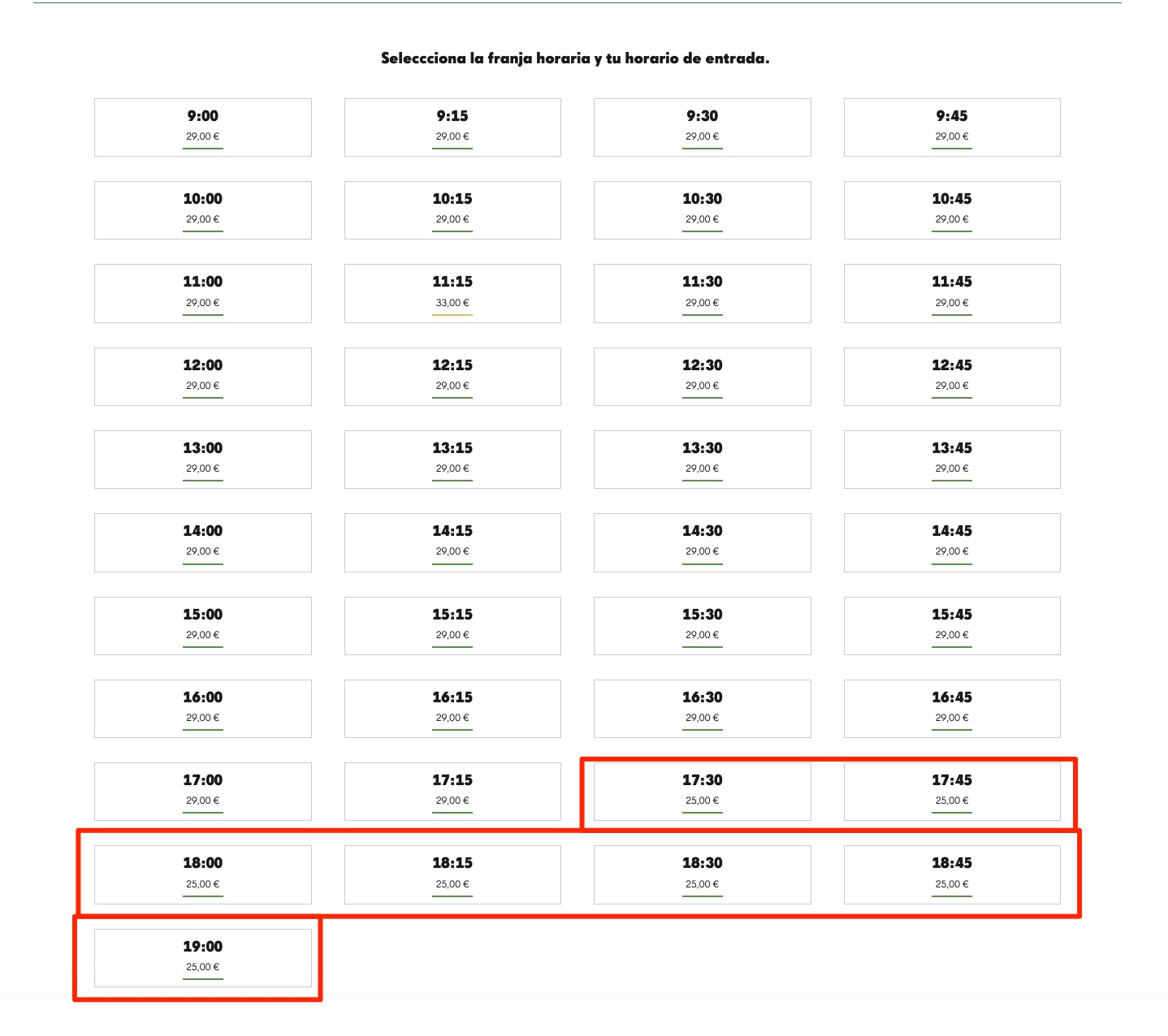
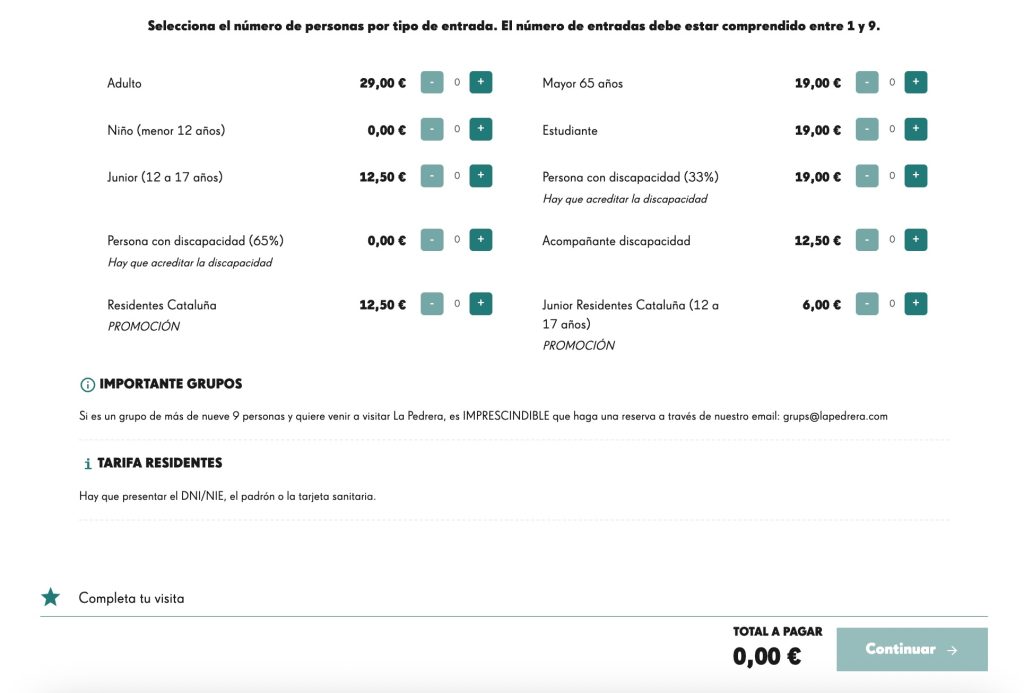
This ticket currently offers a 50% discount for residents of Catalonia (€12.50 per person). This ticket also offers discounts for juniors aged 7 to 17 (€12.50/person), junior residents aged 7 to 17 (€6/person), children under 7 (free admission), seniors over 65 (€19), students (€19), and people with disabilities (€19). In addition, a variable price (between €25 and €34) applies depending on how far in advance you book and the time slot, so it’s best to book in advance and be flexible with your time slot (it’s easier to find cheaper tickets in the afternoon). We’ll tell you all about it in the Discounts section.

Special Tickets:
- La Pedrera Night Experience (€39.50/person): This ticket includes a guided night tour of La Pedrera (the residents’ apartment is not included in this tour) in Spanish, Catalan, and English, culminating in a visual show featuring multiple projections, a glass of cava on the Warriors’ Rooftop, and sweets in the Butterflies’ Courtyard. Hours: 9:00 PM to 11:00 PM, with last admission at 11:00 PM.
This ticket currently offers a discount for residents of Catalonia (€22 per person). It also offers discounts for children aged 7 to 17 (€19 per person) and resident children aged 7 to 17 (€11 per person). You can find all the details in the Discounts section.

- La Pedrera Sunrise (€39.50/person): If you want to explore La Pedrera before anyone else, with just a few other visitors, and enjoy the first light of dawn on the rooftop, this ticket allows you to enter at 8:00 a.m. (before the doors open) for a guided tour in English. Times: entry at 8:00 a.m.
- La Pedrera Open Date (€45/person): With this ticket, you can basically enter La Pedrera on the day and at the time of your choice, without prior notice and without waiting in line (valid for up to 6 months from the date of purchase). This upgrade from the La Pedrera Essential ticket gives you the freedom to go whenever you want, deciding at the last minute instead of buying for a specific date and time, but the tour and what’s included are the same. Hours: 9:00 AM to 8:30 PM, with last entry at 7:00 PM.
- La Pedrera & Sant Pau Modernist Complex (€42/person): A combined ticket to explore two masterpieces by two of the most important Catalan Modernist architects: Antoni Gaudí’s La Pedrera (via the La Pedrera Essential ticket) and Lluís Domènech i Montaner’s Sant Pau Modernist Complex, both UNESCO World Heritage Sites. Hours: 9:00 AM to 8:30 PM (last admission at 7:00 PM)

Discounts on tickets to La Pedrera-Casa Milà
- 50% discount for residents of Catalonia on the La Pedrera Essential ticket: La Pedrera is currently offering a special promotion exclusively for residents of Catalonia (this promotion is also valid for tickets for children aged 7 to 17). To get the discount, all you have to do is select the date and time you want to visit, choose the number of “Catalonia Residents” or “Junior Catalonia Residents (ages 7 to 17),” and don’t forget to bring proof of residency when entering La Pedrera
- 40% discount for residents of Catalonia on admission to La Pedrera Night Experience (this promotion is also valid for tickets for children aged 7 to 17). To get the discount, all you have to do is select the date and time you want to visit, choose the number of “Catalonia Residents” or “Junior Catalonia Residents (ages 7 to 17),” and don’t forget to bring proof of eligibility when entering La Pedrera
- Up to 25% off depending on how far in advance you book and the time slot: For tickets to La Pedrera Essential, the official La Pedrera website offers dynamic pricing ranging from €25 to €34, depending on how far in advance you book and the time slot (it’s easier to find cheaper tickets in the afternoon). So it’s worth booking in advance and being flexible about your visit time:
- Children under 7 years old: Free Admission
- Buy tickets online: At the box office, some tickets incur an additional “service” fee. We recommend that you always buy your tickets online on the official website

Free entrance to La Pedrera (Casa Milà)
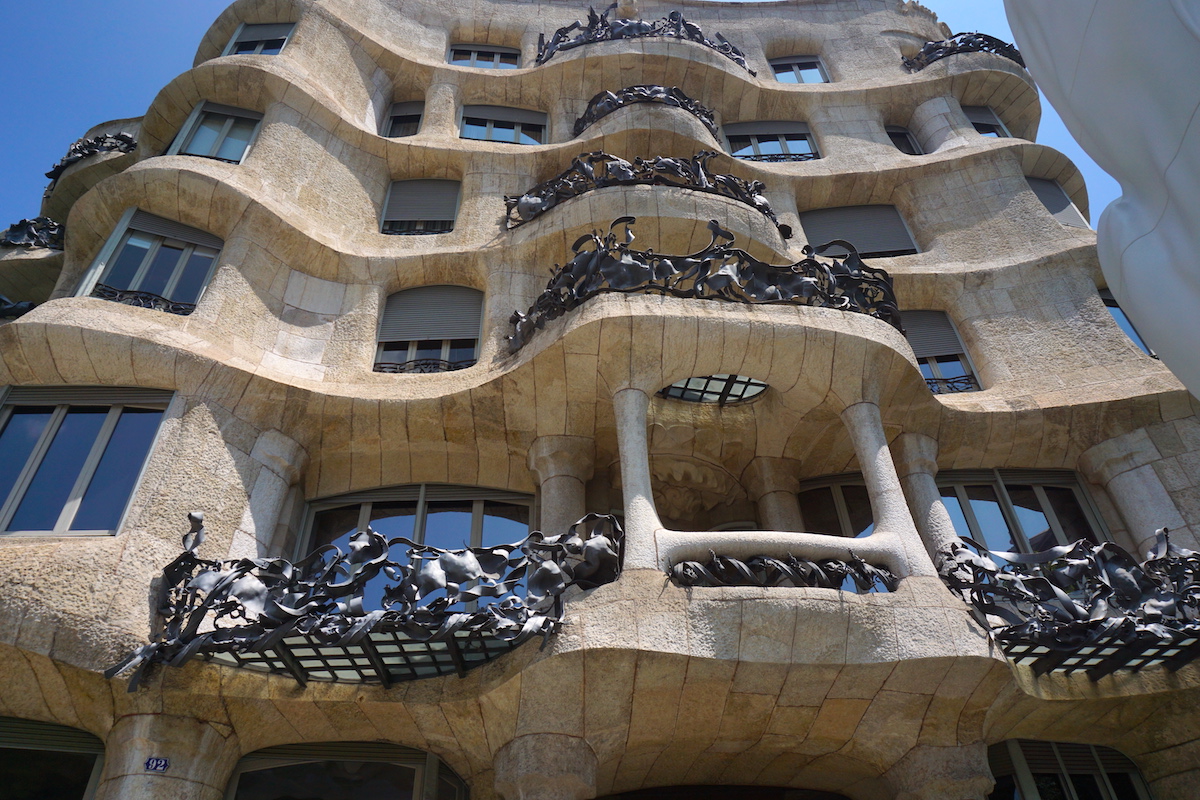
Unfortunately, visitors over the age of 7 cannot enter La Pedrera for free, as the only part you can see for free is its impressive facade at Passeig de Gràcia, 92.
Special Events and Exhibitions at La Pedrera (Casa Milà): Talents Jazz, Christmas, and a wide range of cultural offerings
Every summer, the Azotea de los Guerreros features a very special soundtrack on warm summer nights thanks to “Talents Jazz a La Pedrera,” a series of jazz and modern music concerts. There are more than twenty live concerts with views of the city taking place between early June and mid-August, every Thursday and Friday at 8:00 p.m. If you’re visiting the city in the summer and want to know who will be providing the soundtrack for some nights on the rooftop of La Pedrera, click here to view the schedule and buy your ticket if you’re interested in any of the concerts during your visit to the city.

In addition to rooftop concerts and the family Christmas workshop, La Pedrera offers a wide range of activities at its Cultural Center (the building houses the headquarters of the Catalunya La Pedrera Foundation, which donates ticket proceeds to social and cultural causes), designed for both children (various family workshops) and adults, with a diverse selection of exhibitions. We recommend checking the calendar of events by date here.

RandomTip: Always buy your tickets online. Not only does this guarantee you a ticket (which isn’t always the case if you try to buy one on-site, especially during peak season), but you’ll also skip the line and, most importantly, save money! If you buy your tickets at the box office at La Pedrera, you’ll be charged an extra “service fee.” This applies to La Pedrera (Casa Milà) and most attractions in Barcelona, so you know what to do: buy online, on the official website, and as far in advance as possible.
Visiting hours to La Pedrera (Casa Milà)
La Pedrera (Casa Milà) is open every day of the year from 9:00 AM to 8:00 PM, with the last admission for the La Pedrera Essential ticket at 7:00 PM, unless you purchase a ticket for La Pedrera Night Experience (tickets from 9:00 PM to 11:00 PM) or for La Pedrera Sunrise (entry at 8:00 AM). The tour lasts approximately 1.5 hours.

How to get to La Pedrera (Casa Milà)
Barcelona is a city in which it is very easy to move around the center walking or by public transport and being La Pedrera in one of its main arteries, Passeig de Gràcia, it is very easy to get to it. In fact, it is only a 15-minute walk from the central Plaça Catalunya.
- Metro: The metro stop that is two minutes walk from La Pedrera (Casa Milà) is Diagonal station and you can reach it through the metro lines L3 and L5.
- Bus: If you prefer to arrive by bus, you also have several options depending on where you are coming from. The bus lines stopping at Passeig de Gràcia 104 are V15, V17, H10, H8, 7, 22, 24, 6, 33, 34.
- Train: If you prefer to travel by train (or the train station is the one closest to the accommodation) you should know that Passeig de Gràcia station is connected to the Rodalies service (Renfe commuter train) and is a 6-minute walk from La Pedrera (Casa Milà). If, on the other hand, you are traveling by FCG (Ferrocarrils de la Generalitat de Catalunya), ideally you should exit at Provença station and walk 5 minutes (400 meters) to La Pedrera (Casa Milà).
- Barcelona Bus Turistic Hop on Hop Off: If you have bought the Barcelona Bus Turistic Hop on Hop Off of Barcelona, you should know that both the red and blue lines pass through here and the stop where you should get off is La Pedrera. Buy here your tickets for the tourist bus

How is the visit to La Pedrera (Casa Milà)?
If you buy your tickets online (which we recommend, since buying them at the box office will incur an extra “handling fee”), you’ll receive them by email and can show them directly from your phone to enter. When purchasing tickets, you’ll need to select a date and time, and it’s important that you arrive at the selected time (there is a 15-minute grace period), as otherwise entry is not guaranteed. The tour lasts about 1 hour and 30 minutes, and we’ll go over the details below.
Attention, from this point begins the tour of La Pedrera narrated by Randomtrip so if you don’t want spoilers of the interior of Casa Milà and what you will see on the tour, skip directly to the point Where to stay or, in case you get hungry, Where to Eat near La Pedrera where we recommend some of the places near walking that we tried around there and loved

Brief History of La Pedrera (Casa Milà)
The couple consisting of Roser Segimon (known as Doña Rosario, a businesswoman and heiress to a fortune from her first marriage to Josep Guardiola) and Pere Milà (a lawyer, industrialist, member of parliament for the Conservative Party, and later a supporter of Primo de Rivera) was part of the Catalan bourgeoisie, although he, Milà, “had more pedigree than money,” as mentioned on the official La Pedrera website. In 1905, they married and purchased (well, she purchased it with her fortune) a plot of land at number 92 on the prestigious Passeig de Gràcia, featuring a tower and a garden spanning 1,835 square meters. Her idea was to build a building where she would live on the main floor and rent out the other floors, a common practice among the bourgeoisie of the time that we also saw, for example, in Casa Batlló. As a fun fact, the building, although it bears the surname of Pere Milà (Casa Milà), was always owned by Roser Segimon.


Photos from La Pedrera
The couple decided to commission the project to one of the most sought-after architects of the time to design their building, Antoni Gaudí, who by this point had already established himself as a renowned architect with a distinctive style (in fact, the incredible Casa Batlló, one of our favorite architectural works by Gaudí, was completed in the very same year that construction on this building began). Construction on Casa Milà (La Pedrera) began in 1906 and was completed in 1912, with significant turbulence in between—both in terms of financing and legal issues—that kept it constantly mired in controversy.

It seems that what happened with La Pedrera is something most of us experience when we have to do home renovations at some point: the project went over the estimated time frame and the initial budget… In addition to architect Gaudí’s changes to the building from the original design, it turns out that La Pedrera also failed to comply with municipal ordinances, such as the fact that one of the facade’s pillars encroached on the sidewalk of Passeig de Gràcia. This led to a complaint filed by the city council and left the Segimon-Milà couple with two options: either tear down the rooftop and attic or pay a fine of 100,000 pesetas to legalize the construction. The couple took Gaudí to court, and, given that in 1909 the Eixample Commission certified that the building had monumental status and did not have to strictly comply with regulations, the courts ruled in Gaudí’s favor, forcing the couple to mortgage Casa Milà to pay the architect 105,000 pesetas (which, incidentally, he donated to a convent).

In 1910, Gaudí completed work on the main floor, and in 1911, the Milà-Seguiman couple obtained permission from the City Council to move in, so they did so, even though the rest of the building was still under construction. The following year, in 1912, Gaudí certified the completion of the work—over 300 square meters, including the main living area and the service area—but apparently he did not finish the building as he had intended. For example, among the various disagreements he had with the Milà-Seguiman couple, one was that Gaudí wanted to include a large sculpture of the Virgin Mary at the top of the building, and the couple did not agree (or could not afford it).
Since then, Casa Milà has housed the Milà-Seguiman family on the main floor, while the other floors have been home to several distinguished guests (including a prince and his entourage!), a couple of hotels, a consulate, corporate offices, shops (the first shop was a tailor’s in 1929), and even a bingo hall!
During the Civil War (1936–1939), the Milà-Seguiman couple fled Casa Milà, and the building was confiscated by the Unified Socialist Party of Catalonia (PSUC). After the war ended, the couple returned, but sold the building a few years later, in 1946, to the Provenza Real Estate Company, although they continued to live in the main apartment until their deaths—Pere Milà in 1955 and Roser Segimon in 1964.
Casa Milà was designated a National Historic-Artistic Monument in 1969, and in 1984 UNESCO included it in the “Works of Antoni Gaudí” World Heritage Site, along with the Güell Palace, Park Güell, and the crypt of Colonia Güell—one of the first sites from the industrial era to be included on the list of the world’s most exceptional places.

In 1986, Caixa Catalunya purchased the building from Inmobiliaria Provenza, and restoration work began the following year, concluding in 1996. In 2013, the Catalunya La Pedrera Foundation was established; the building serves as its headquarters, and the foundation allocates its ticket revenue to social, environmental, educational, and cultural projects.
As a fun fact, as of now, La Pedrera (Casa Milà)—in addition to serving as the Foundation’s headquarters and cultural center with various exhibitions, being open to tourists for day and night tours, and renting out spaces such as ground-floor shops and some offices—is still home to three tenants! Yes, there are still residential rental units at La Pedrera with people who have lived there for over seventy years. Can you imagine meeting someone who invites you over for a meal and suddenly you’re at Passeig de Gràcia 92? Molt fort!

If you enjoyed the story of Casa Milà and would like to learn more about it, you can check out this timeline, and—even better—in the Fun Facts section, you’ll find plenty of documents and stories covering more than 100 years of the building’s history.
Buy your ticket for La Pedrera here, on the official website
Why is Casa Milà called La Pedrera?
The nickname “La Pedrera” (which means quarry in Catalan) comes from its striking stone facade (and balconies). Although at Randomtrip what struck us most was the fact that it’s called Casa Milà, considering that its owner was always Roser Segimon and not Pere Milà, from the purchase of the land in 1905 until its sale to Inmobiliaria Provenza in 1946, so we believe it makes much more sense for it to be called Casa Segimon or Casa Roser. In our opinion, the Catalunya La Pedrera Foundation still has time to rectify this historically sexist decision.
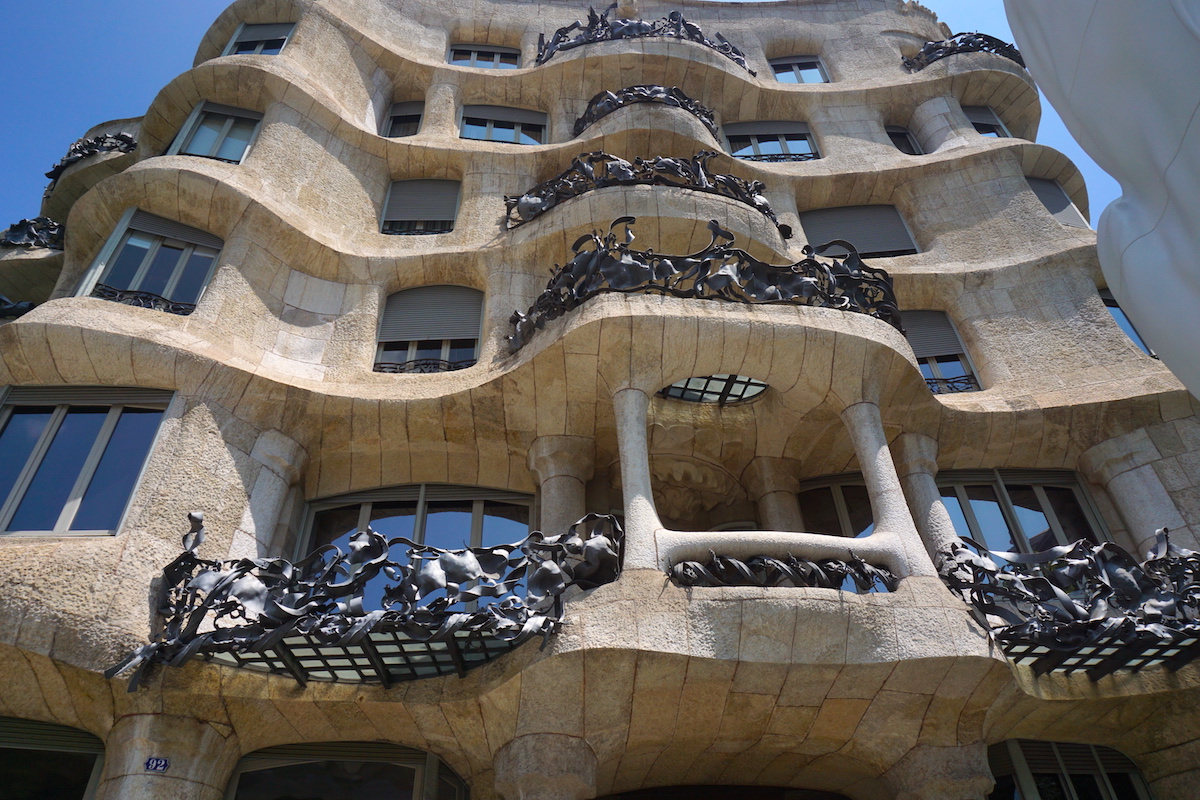


The façade of La Pedrera (Casa Milà)
Gaudí wanted to bring the sea to Barcelona’s L’Eixample neighborhood, and to do so he created the building’s façade (well, actually, if you look closely, there are three façades that appear to be one), featuring 6,000 stone blocks carved in undulating shapes reminiscent of ocean waves. In total, there are 150 windows and 32 wrought-iron railings, all with different shapes to adapt to the facade’s unique contours and featuring abstract sculptural elements that transport us to elements of nature—in this case, perhaps to an underwater world covered in seaweed swept along by the imposing waves of the sea.
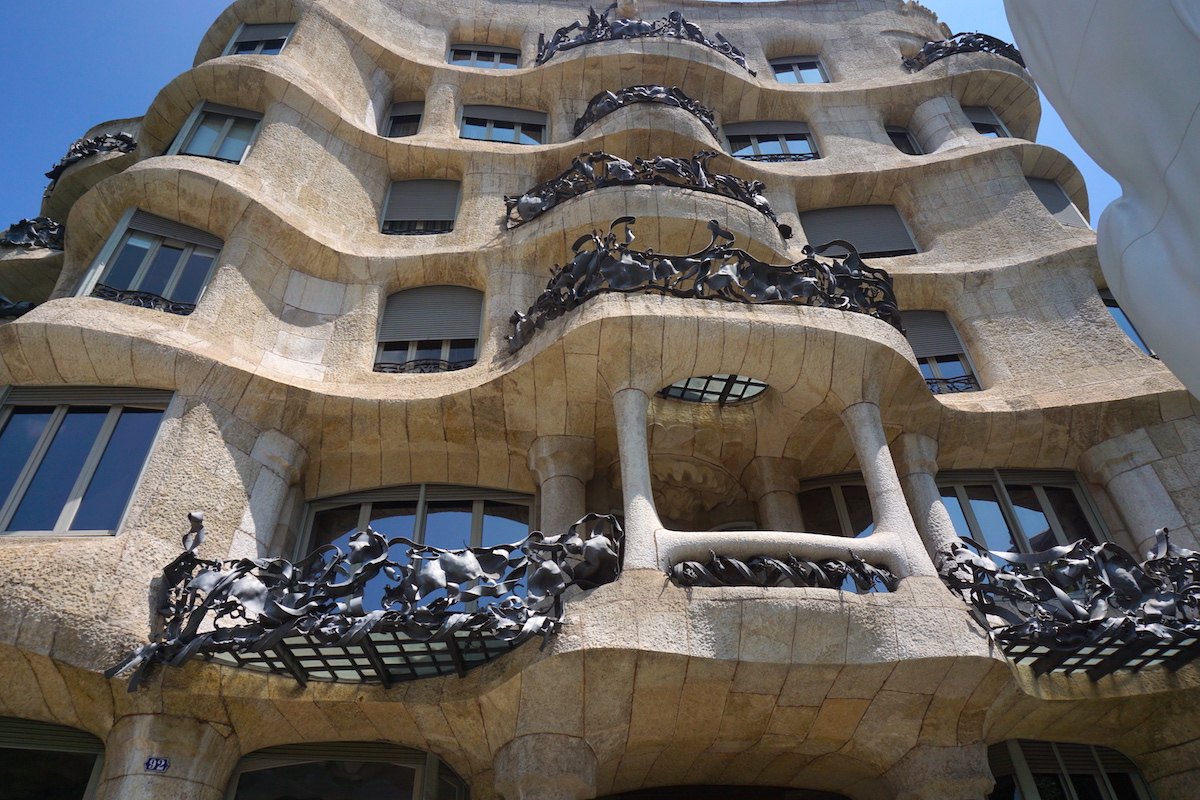
To design such an original façade, Gaudí had to devise a solution in which the façade would function as an exterior cladding attached to the interior structure (via iron struts) rather than serving the building’s typical load-bearing function. In other words, the façade supports itself with an independent structure attached to the building via iron beams embedded in the stone. Pretty impressive, right? In fact, the interior skeleton of La Pedrera has no load-bearing walls, allowing the architect to shape it however he wanted—there isn’t a single load-bearing wall in the entire building, just open spaces supported by a framework of beams and columns! A creative solution by Gaudí that ended up serving as a precursor to the solutions employed by the father of modern architecture, the Swiss architect Le Corbusier.

On the stone balustrade of the façade, we can read the inscription “Ave – Gratia – M – Plena – Dominus – Tecum”: Ave Maria, Gratia Plena Dominus Tecum means Hail Mary, full of grace, the Lord is with you and were, according to the Gospel, the words that the archangel Gabriel spoke to Mary at the time of the Annunciation and the Immaculate Conception. Instead of María, Gaudí chose to use an M and added a rose in homage to the name of the house’s owner, Roser (Rosario).

When we visited La Pedrera, an exhibition by the Catalan artist Jaume Plensa (Barcelona, 1955) titled “Jaume Plensa: Poetry of Silence” was on display, featuring more than 100 of the artist’s works, including the piece “Flora,” located right on Passeig de Gràcia, in front of La Pedrera’s façade. You can read more about the artist and this exhibition here.


The Casa Milà Neighbors’ Flat (La Pedrera)
La Pedrera has six floors, a basement with a garage, an attic, and the famous rooftop terrace—probably its most recognizable feature, along with its façade. As a fun fact, La Pedrera was the first building on Passeig de Gràcia to have underground parking for carriages.
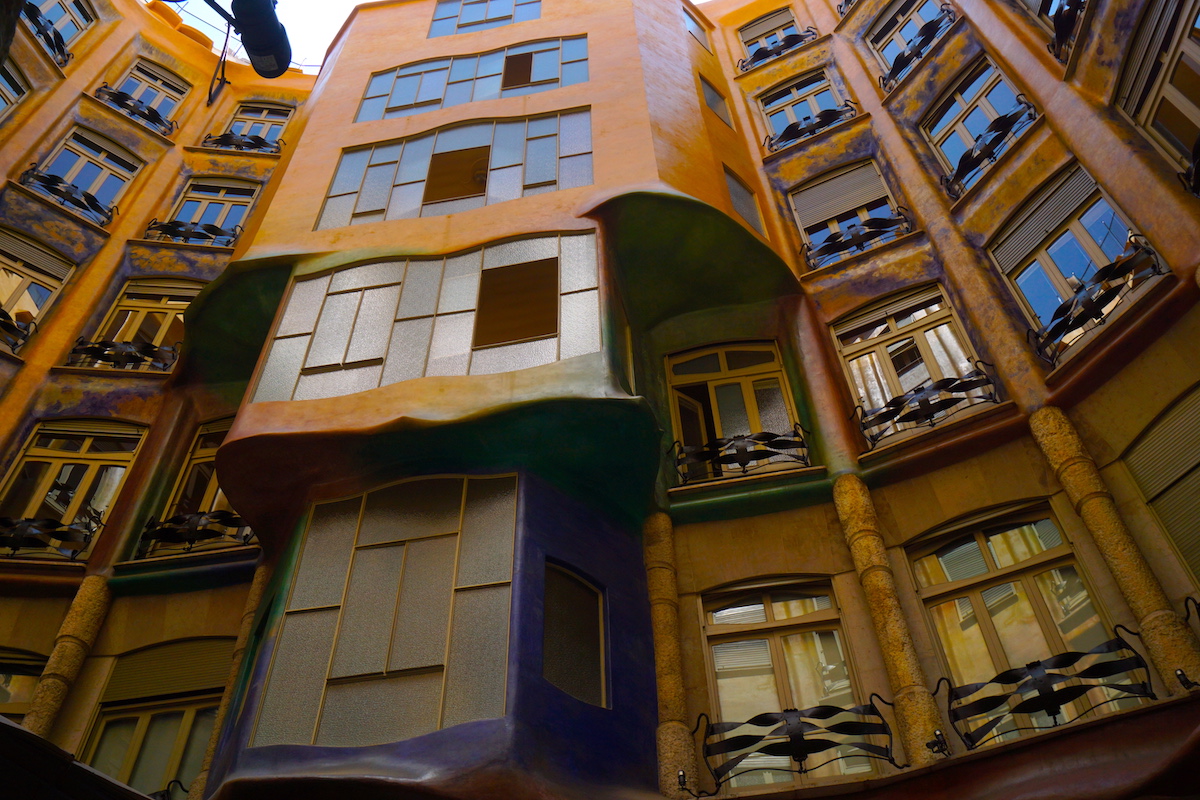
Each of these six floors features four apartments built around the two interior courtyards (the Butterfly Courtyard and the Flower Courtyard), with each apartment connected by a hallway that links the various rooms. It is precisely one of these apartments, on the fourth floor of the building, that you will see during your tour of La Pedrera’s interior—the apartment that recreates the daily life of one of the Milà-Seguimon family’s distinguished neighbors. As we mentioned earlier, it was very common at that time for the bourgeoisie to live on the main floor of a building and rent out the other floors. We saw this at La Pedrera and also during our visit to Casa Batlló (though in that case, we were able to enter the Batlló family’s apartment with the Gold ticket). If you’re curious or considering visiting this architectural gem by Gaudí as well, know that it’s also located on Passeig de Gràcia, and in this link we share our experience at Casa Batlló.


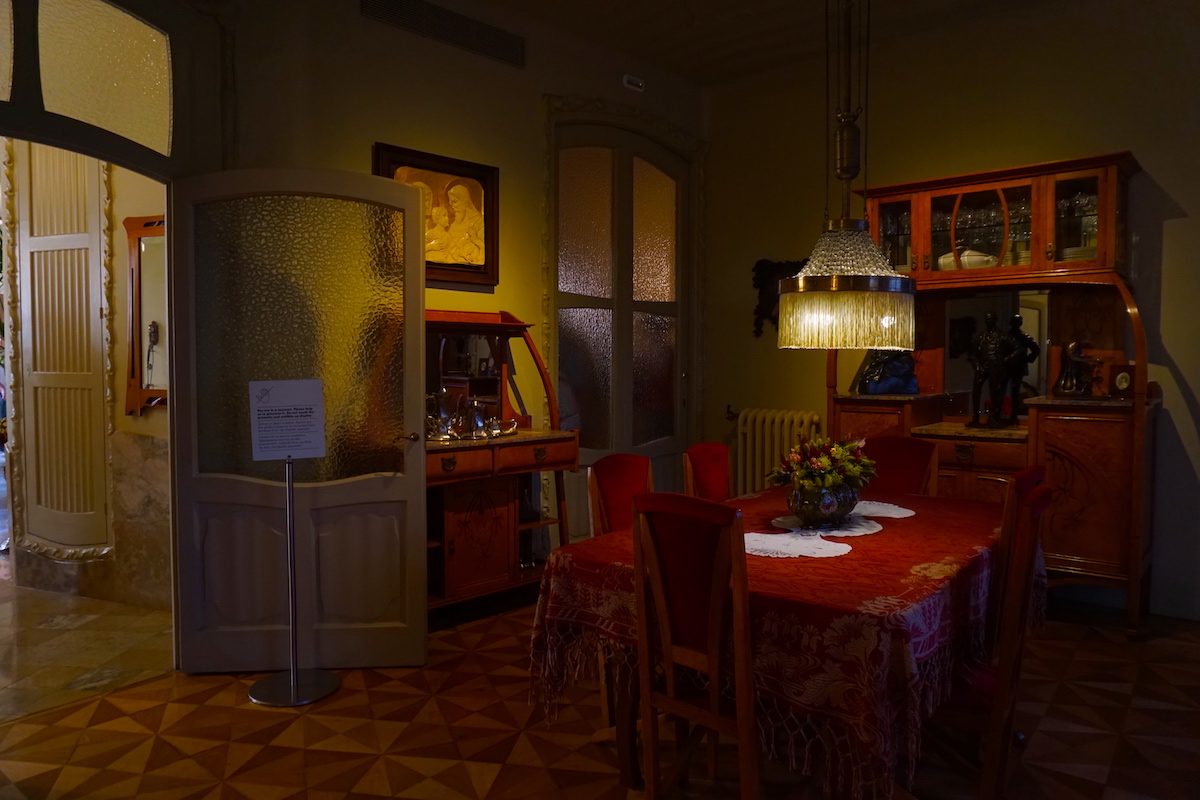
During the tour of Casa Milà, which transports us to the daily life of a bourgeois Barcelona family in the early 20th century, we first visit the children’s room, where they slept next to the room of the woman who cared for them. Both the floor and the wainscoting are made of marble, which is the material used throughout this area of the house.


The kitchen in the apartment is divided into two areas by sliding doors: on one side is the kitchen itself, and on the other is the area where the servants ate.


The tour then takes us through the office, which gives us a sense that not just anyone could rent one of the apartments at La Pedrera and share the building with the Milà-Segimon family. In this office hangs a portrait of the “neighbor” of none other than the famous Catalan Modernist painter Ramón Casas.

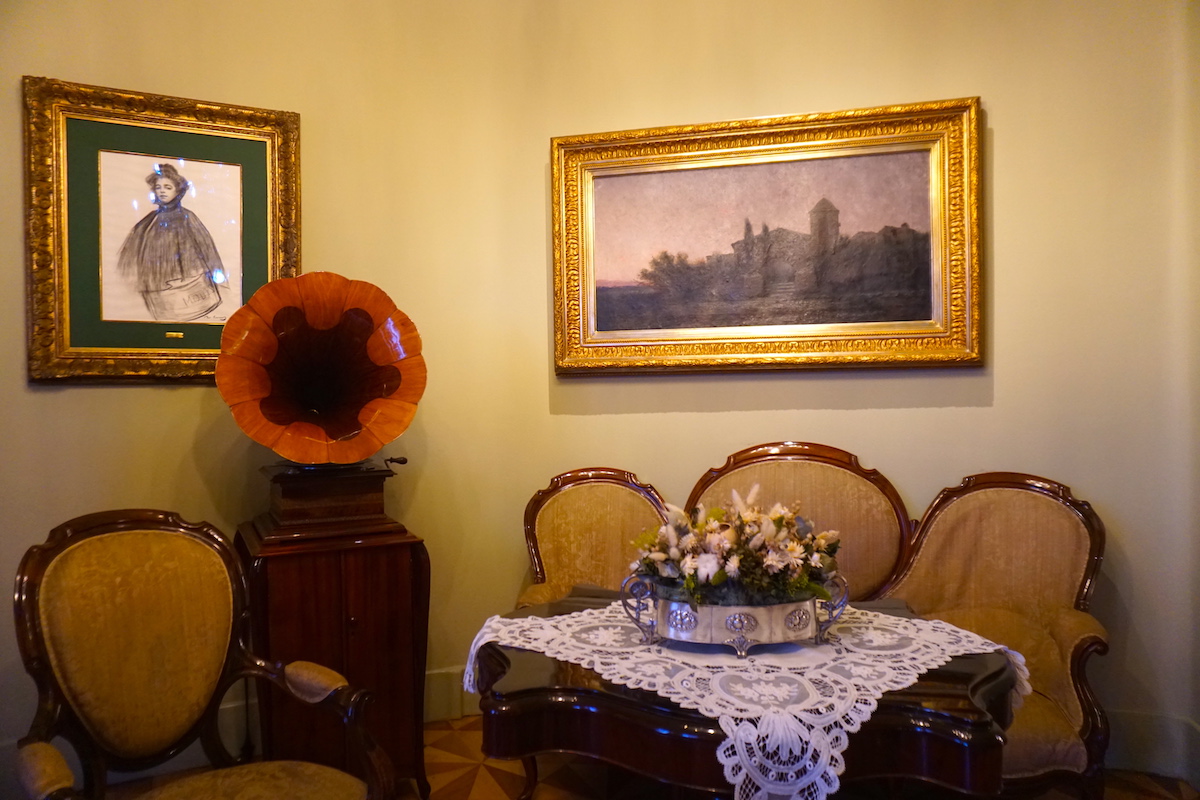
The dining room is the most elegant area of the apartment, featuring Empire and Elizabethan-style furniture alongside Modernist pieces. We’ll tell you more about the furniture at Casa Milà below in the section Furniture at La Pedrera. You’ll also find works of art and pieces reflecting the latest trends of the era—all original objects that help transport us on this journey into the past.
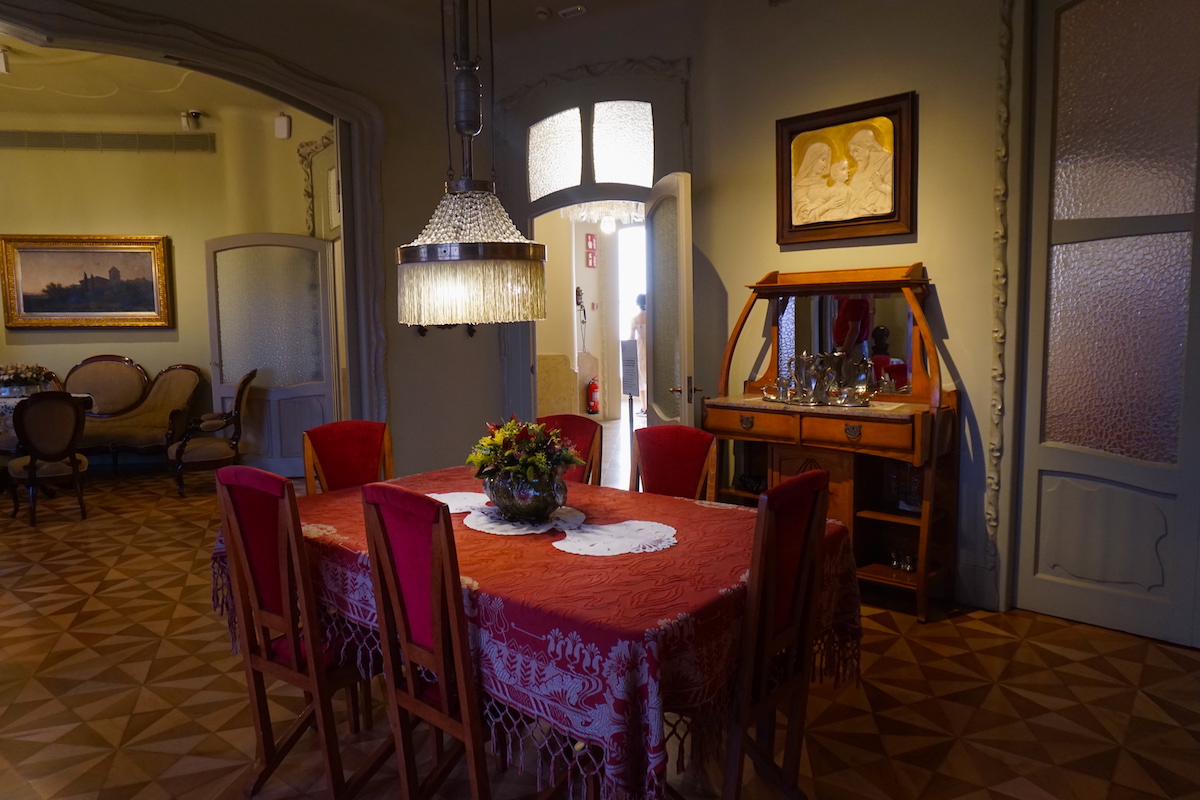
The hardwood floor in the dining room flows seamlessly into that of the living room. Although they are separate rooms, the sliding doors designed by Gaudí create the impression of an open space.

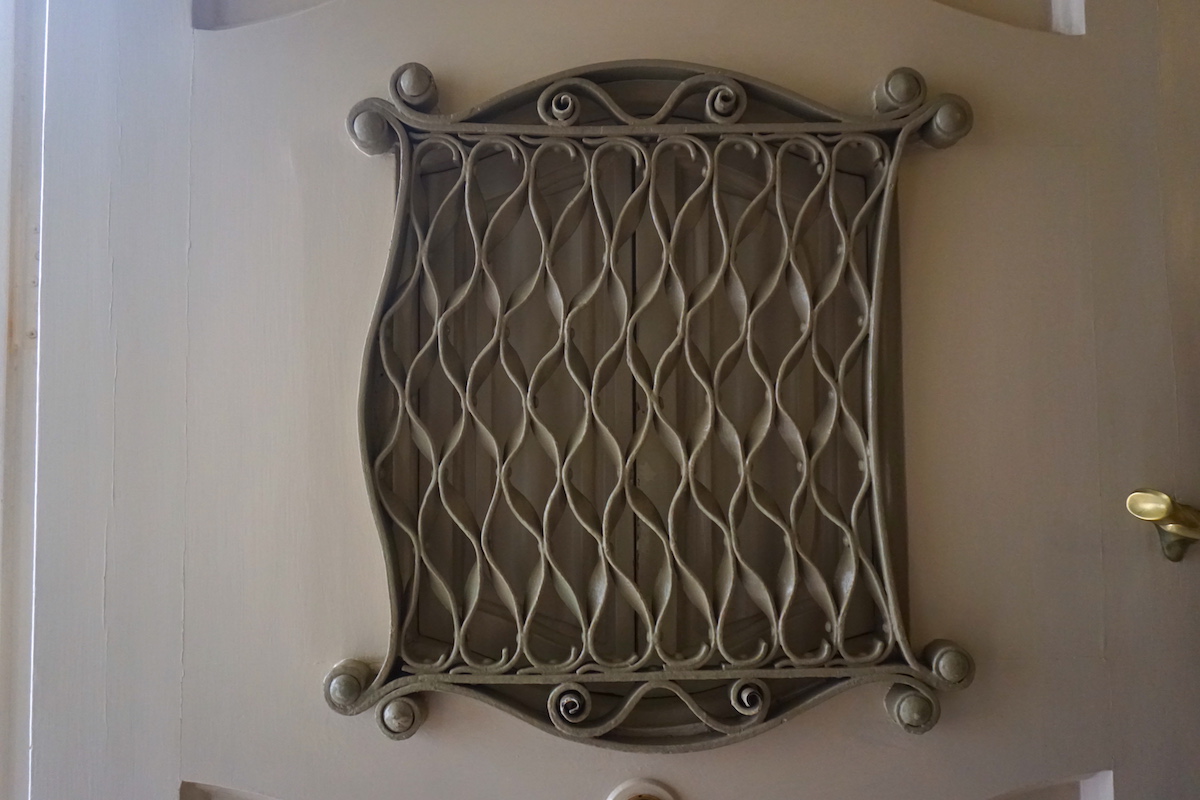
In the entryway, there is a peephole in the front door that allowed you to see who was at the door without opening it, while also making it possible to leave mail.
Buy your ticket to La Pedrera on the official website.
The furniture in La Pedrera (Casa Milá)
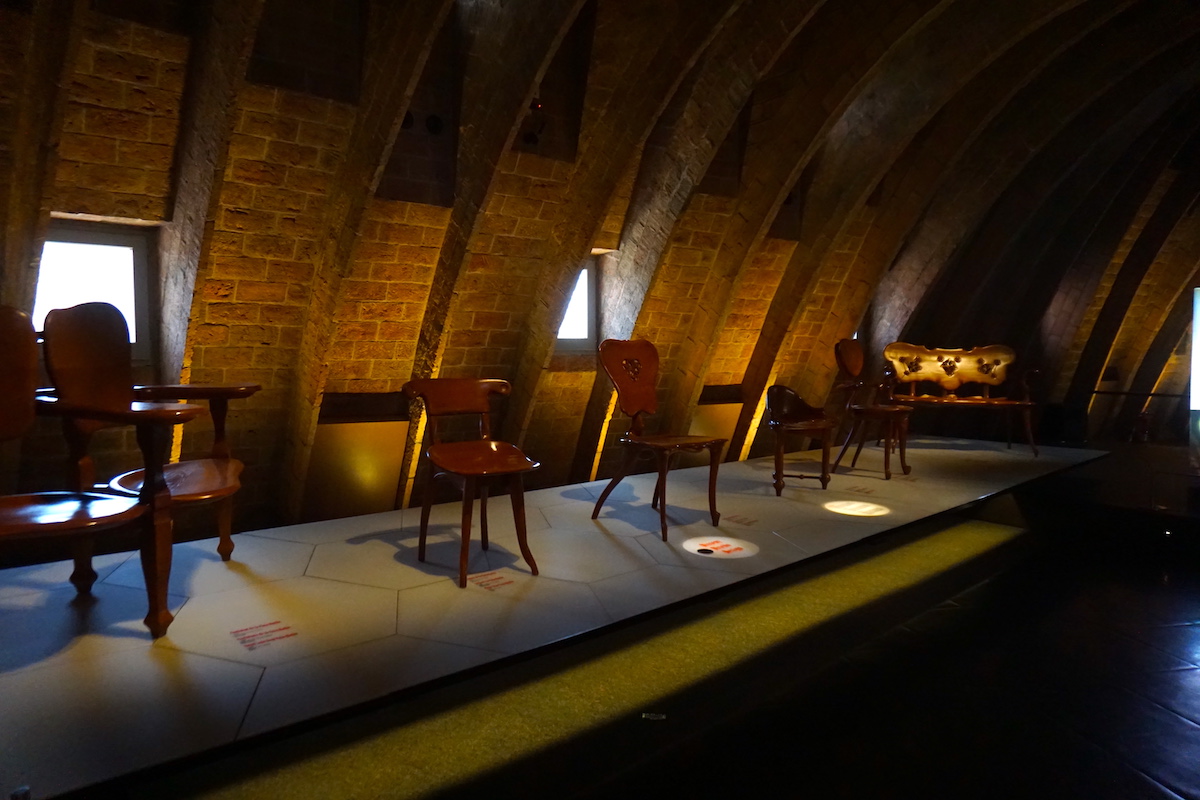
The furniture at Casa Milà was in keeping with the building’s forms and lines, inspired by nature, yet always ergonomic and functional, or it would not have been designed by Gaudí. To create a doorknob, for example, Gaudí would take a piece of clay or plaster and shape it by hand so that the result would be the most natural (and functional) way to open a door, while also being original and distinct from all other doorknobs.

But over time, Gaudí increasingly embraced simplicity, as can be seen, for example, in the furniture he designed for Casa Calvet or Casa Batlló, where the older pieces feature more decorative motifs and the newer ones are more streamlined.
Lighting and ventilation in La Pedrera (Casa Milà): Gaudí’s efficient innovations
From the large windows of the Casa Milà residents’ apartment (from the dining room, we can gaze out at the bustling Passeig de Gràcia through the wrought-iron railings of the balcony) and the glass doors designed to let natural light in to the courtyards, we realize that nothing is left to chance in Gaudí’s works, and the architect’s concern that beauty always be linked to functionality.


The large windows in Gaudí’s buildings feature a highly modern shutter system that ensures optimal lighting and ventilation. Just as we saw at Casa Batlló, all the rooms at La Pedrera are brightly lit around the interior courtyards, because both lighting and ventilation are priorities in Gaudí’s work.


The design of the two central courtyards also played a role, as this is where most of the air enters; thus, the courtyards help retain heat in winter and provide ventilation in summer. We’ll tell you more about the courtyards at Casa Milà in the following sections on the Butterfly Courtyard and the Flower Courtyard.
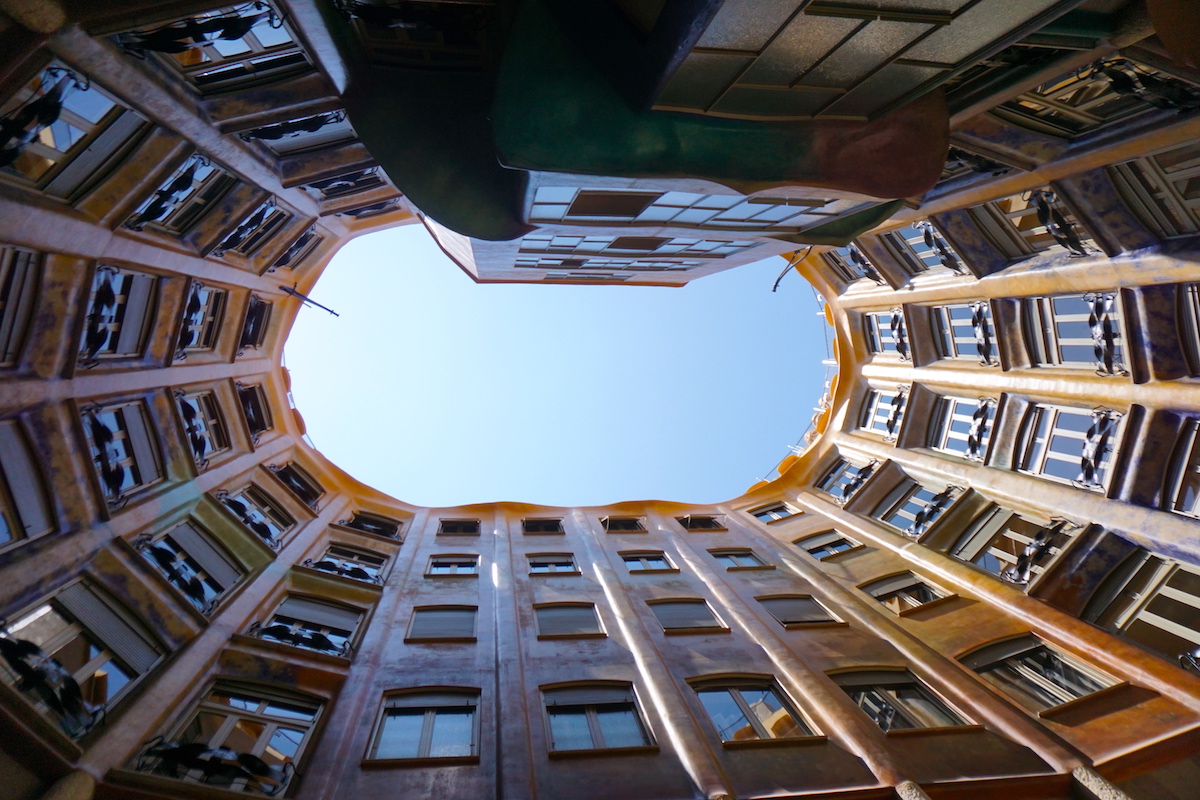
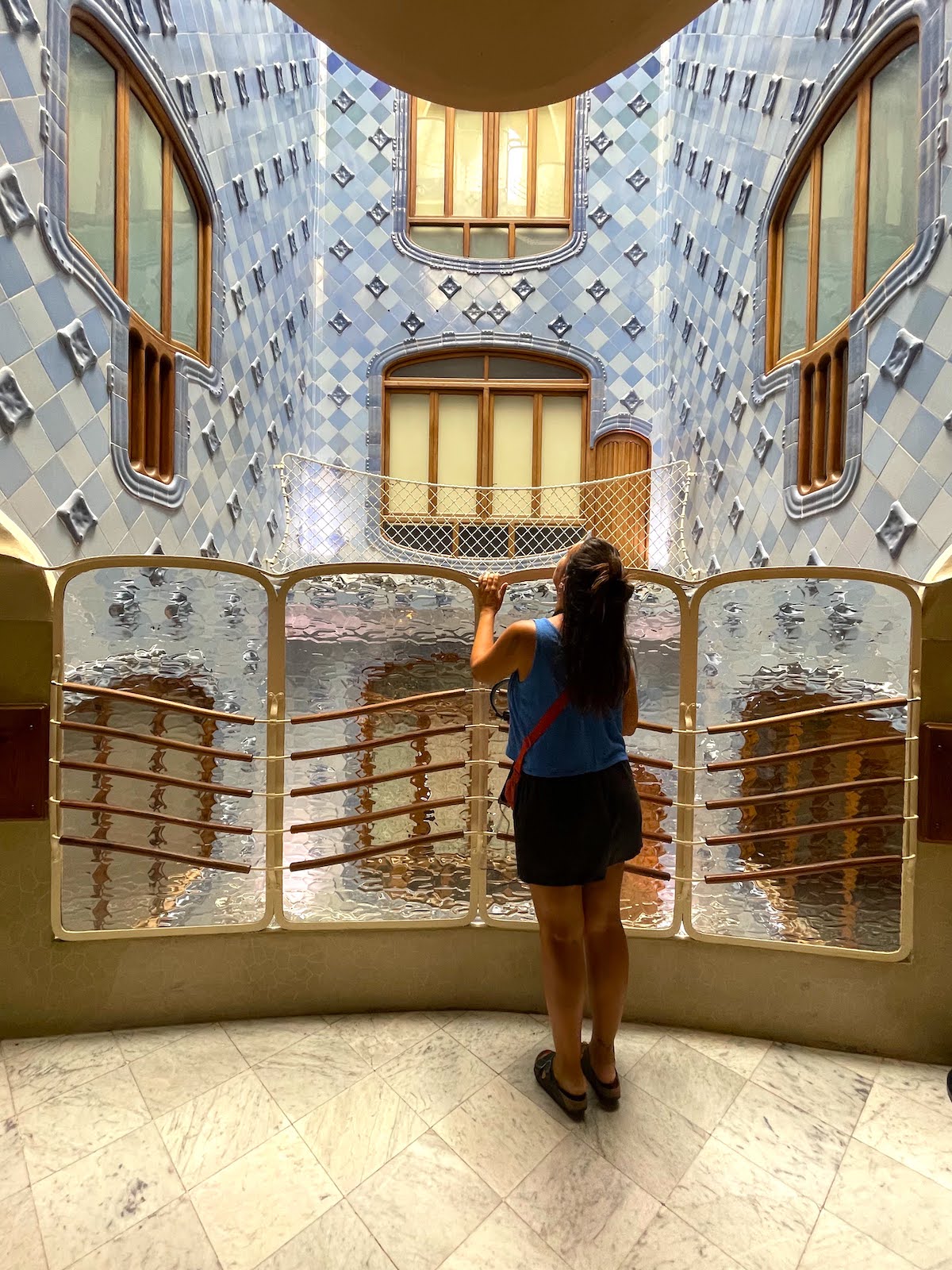
The Butterfly Courtyard (or the Courtyard of Provence Street)
The Butterfly Courtyard is one of the two interior courtyards created by Gaudí around which La Pedrera is structured. As we mentioned earlier, lighting and ventilation were priorities in the architect’s designs, and the courtyards were designed to allow light to flood into the space and ensure optimal ventilation through the flow of air.
In this Butterfly Courtyard, one of the two staircases that allowed the Milà-Seguimon family to access their home on the main floor stands out, although both the family who owned the building and the other tenants used the elevator to get to their homes, as there were a couple of them—a novelty for the time. This staircase, like all the elements that evoke the natural world of Casa Milà, reminds us of a giant root climbing up the building and covered by an insect’s wing. Furthermore, the butterfly-shaped entrance (which gives the courtyard its name) is a statement of intent by the architect: whoever passes through it leaves behind reality as they know it and enters a fantastic natural world of vivid colors and intense light.
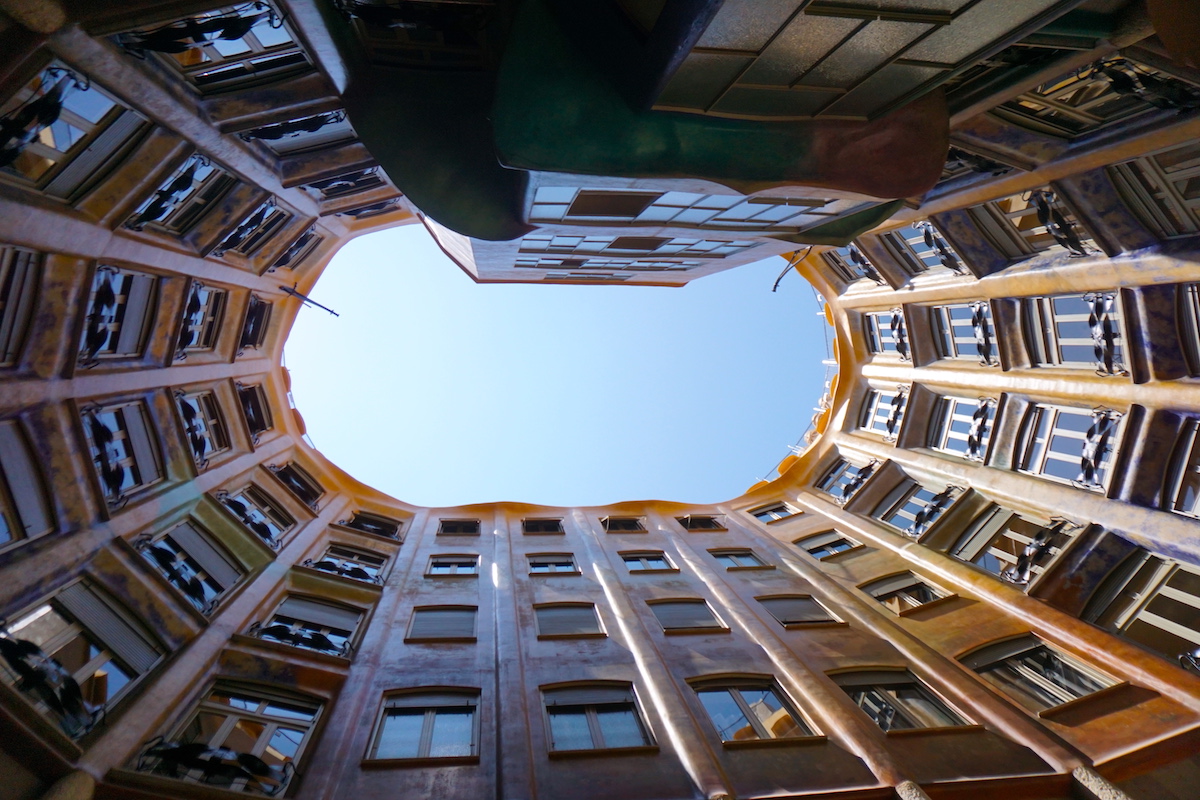
Light has always played a central role in Gaudí’s works, and he consistently employed various techniques to use it as the raw material of a changing world: nature is transformed into color on the ceilings and walls of the Butterfly Courtyard thanks to the light. As we were told during the tour of La Pedrera: “the colors climb like ivy up the courtyard’s facade, seeking the light of the sky, as if we were in a forest clearing and the columns were the trees surrounding it.”
Patio de las Flores (or Passeig de Gràcia’s Patio)
The Patio de las Flores, which is accessed through a large translucent door from Passeig de Gràcia, was where carriages used to enter and, later, cars (remember that La Pedrera was the first building on Passeig de Gràcia to have underground parking, accessed via a ramp from this courtyard); Gaudí was always at the forefront of innovation.
The colorful murals in the courtyard, featuring floral motifs, and the hundreds of flowers peeking out from the ceiling of the staircase give it its name and origin—or rather, the monumental staircase was the other staircase that the Milà-Seguimán couple could use to access their home, although at that time they really only used it when hosting a party, since they usually took the elevator.


The interior of the elevator, paneled in wood, has a unique feature: it includes a bench, since it used to take several minutes to reach the upper floors.
The Attic of the Whale and the Gaudí Exposition
Although penthouses and rooftops are now highly sought-after and glamorous, this hasn’t always been the case. In the last century, penthouses were mainly used for household chores and were reserved for domestic staff. Casa Milà was no exception, and this impressive attic was where the staff working at La Pedrera did the laundry for the Milà-Seguimon family and other tenants, hung the clothes to dry, and housed the machinery for both elevators.
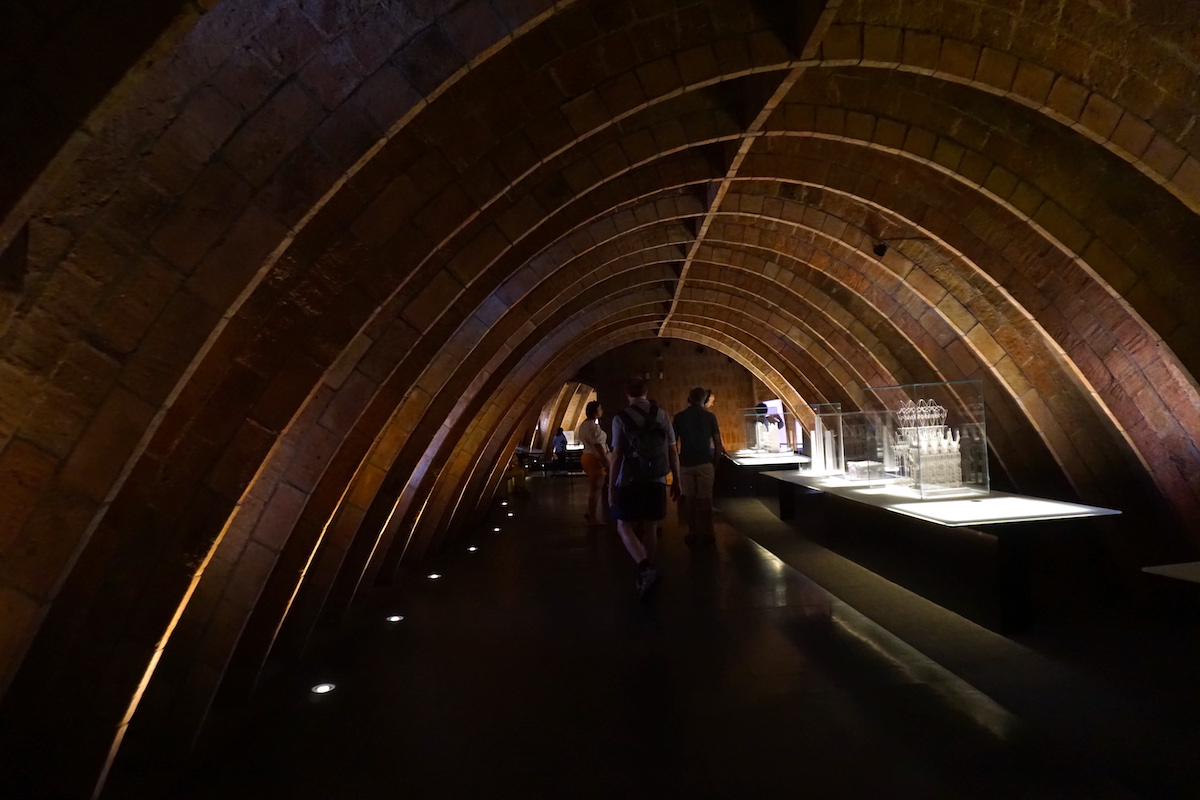
In addition to these functions for domestic use and as a “lift house,” the attic also served as the building’s insulation chamber. It was one of our favorite rooms during the tour, as its structure features 273 brick catenary arches, resembling the ribcage of a giant whale, once again evoking the natural world.

At the Gaudí exhibition located in the attic hallway, we learned more about the famous catenary arch, a fundamental structure and one of the most notable architectural innovations in Antoni Gaudí’s work, which we’ll describe in more detail below.

For Gaudí, buildings should have a double roof, just as the prominent figures of the early 20th century wore hats and carried umbrellas; in this case, the attic corridor served as a sort of hat for the building, and the rooftop as an umbrella.


At the same Gaudí exhibition, we can see several models. The Model of the Basement and the Arches shows us that Gaudí, inspired by the idea of a whale’s belly, commissioned the construction of 273 catenary arches made of mixed brick, all of different heights, which are connected by a rib at the top, creating a large skeletal framework.
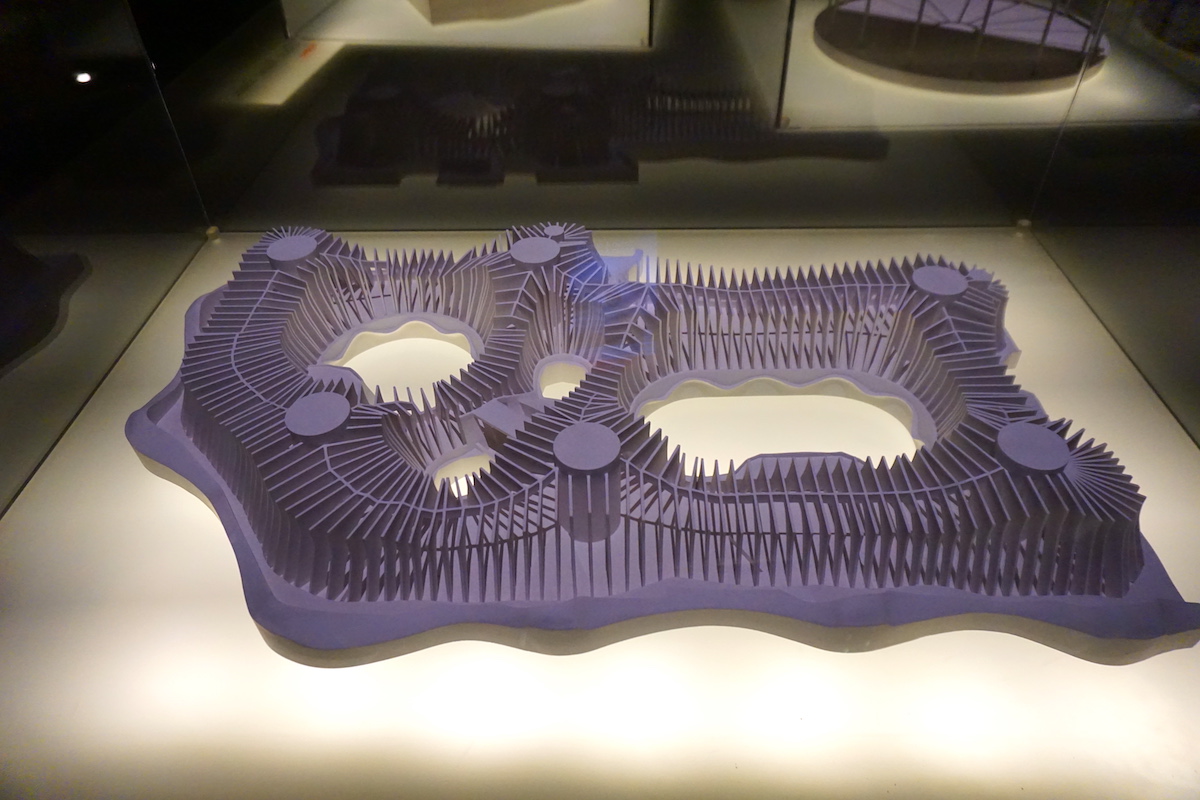
We can also see the model he used for the first garage for carriages and automobiles in a residential building, in which he essentially employed a metal structure resembling a bicycle wheel, supported by iron columns that bear the weight of the wrought-iron railing on the upper terrace.

And the model we found most interesting and essential for understanding how Gaudí’s innovation of the catenary arch came about: the stereo-funicular model. This model helped us understand the architect’s working method when designing the structure and form of a building. The name “stereo-funicular” model comes from funis (Latin for “rope”), and Gaudí’s method involved drawing the building’s floor plan on a board, then nailing the board to the ceiling and hanging chains or strings of varying lengths to form arches, thereby creating the catenary arch. In this way, Gaudí knew what shape each arch should have because he used the curve formed by a chain suspended between two points, and from that chain he hung several small bags of sand that acted as a load (equivalent to the weight the arch would have to bear once built). Finally, he inverted the perspective of the board using a mirror placed beneath the board with the arches of strings or chains. Brilliant, isn’t it? Well, although his methods were controversial and challenged by some in his time, as we read in the exhibition, all modern studies have proven Gaudí right, since although the technique might seem artisanal, the formulas corresponded to exact mathematical formulas and calculations, as perfect as a work of nature—his greatest inspiration.

Gaudí’s architectural philosophy did not consist of copying and depicting animals and plants exactly as they exist in nature, but rather, as we heard during the tour, “to delve into the soul of the world and of things. In his creations, he replicated natural forms because he found in them a great geometric harmony—yes—but always incorporating the most perfect technical and mechanical solutions as well.”
All in all, we found the tour of the attic at Casa Milá to be extremely interesting, and it’s definitely worth taking the time to listen carefully to all the information provided by the audio guide.
Book and buy your official ticket to La Pedrera (Casa Milà) here and learn about Gaudí’s world.
The Warriors’ Rooftop
The rooftop is probably the most recognizable feature of La Pedrera and, as we were told during the tour, also one of the most special places in Casa Milà for Gaudí. In addition to the breathtaking 360-degree views of the city of Barcelona and, most notably, of the Sagrada Familia (a project to which Gaudí would devote himself body and soul until his death), it is a place of great architectural significance.

As we were told during the guided tour, Gaudí envisioned this part of the building—that is, the rooftop—as the top of a “great rock shaped by telluric forces: air, fire, earth, and water.”

The most striking feature is the chimneys—or rather, the warriors—that give the rooftop its name and serve as guardians of the building. If you’re a fan of the Star Wars saga, you’ve surely noticed the similarities between these warriors and the helmets of the stormtroopers. Well, it turns out that any such similarity isn’t pure coincidence and that, apparently, George Lucas drew inspiration from Gaudí’s rooftop when creating his fictional universe—more specifically, when creating these characters so central to the plot.


On the left, a photo by Randomtrip of the “warriors” (chimneys) on the roof of La Pedrera. On the right, a photo from StarWars.com of two Stormtroopers (Imperial soldiers) from the Star Wars saga
Except that in this case, neither the warriors (ventilation ducts) nor the badalots (the six stairwells with crossbeams at the top that contain the steps leading to the attic) are covered by the dark side of the force, but rather by trencadis, Gaudí’s famous decorative technique.
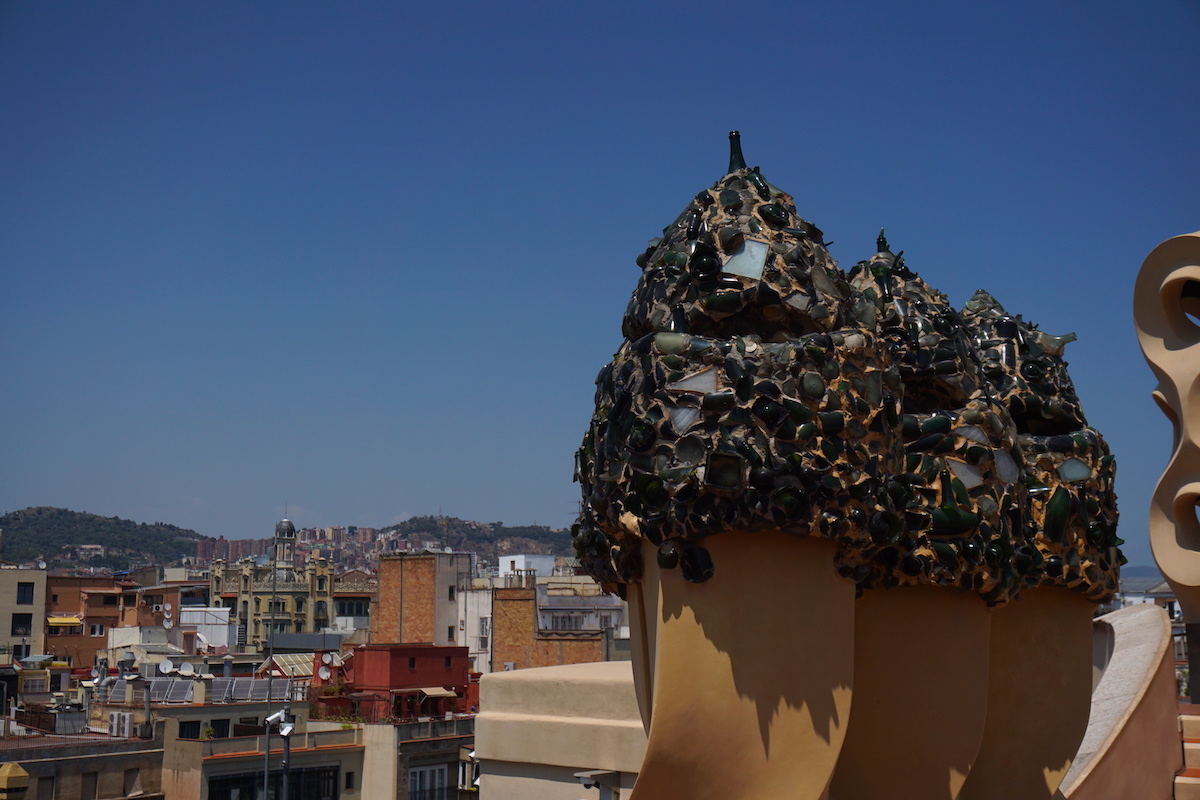

Trencadis is one of Gaudí’s favorite techniques and one of his most characteristic decorative contributions. It involves cladding surfaces with fragments of discarded ceramic and glass (such as broken pieces from demolished buildings), creating colorful patterns and reflecting a commitment to reuse combined with aesthetic value. Beauty always combined with functionality—one of the architect’s guiding principles. Furthermore, trencadis allowed him to adapt the cladding to the sinuous forms of his works quickly and economically.
Also noteworthy on the rooftop are the two arches that frame Barcelona’s two expiatory temples: Tibidabo and the Sagrada Familia. For Gaudí, nature and God, its creator, go hand in hand.


You’ll probably notice the metal grate that protects the entire rooftop from the level of the inner courtyards. By the way, watch out for the uneven surfaces as you walk across the rooftop! At Randomtrip, we took notice of the protective metal grate because, from our architectural layperson’s perspective, it didn’t seem very Gaudí-esque to us. Well, we’ve done some digging, and as a fun fact, we can tell you that this grating was not actually designed by Gaudí.

Remember that Antoni Gaudí always wanted to combine beauty with functionality, and in fact, the protective structure that Gaudí had envisioned (and begun) in 1909 to serve the roof’s intended functions at the time (smoke exhaust from the chimneys and clotheslines) could not be completed due to financial difficulties faced by the Milà-Seguimon couple (who, essentially, after the budget changes, had effectively “cut off the architect’s funding”). Apparently, when the Milà-Seguimon couple installed that metal mesh we see today to prevent falls, Gaudí told them: “Don’t worry about putting up any railings; there aren’t any in the mountains.”


On the left, what Gaudí designed for the Roof of the Warriors but was unable to complete (source: La Pedrera.com). On the right, the metal railing that is currently in place, installed at the request of the Milà-Segimon couple
The tour ends on the rooftop, but if you’re in the mood for a modernist coffee right on Passeig de Gràcia as you leave, you can sit down at the Café de la Pedrera, and, as always in Barcelona, don’t forget to look up and admire its unique ceiling.
Book your tickets for La Pedrera (Casa Milà) on the official website and, if you are a resident of Catalonia, enjoy a 50% discount on admission to La Pedrera Esencial (daytime tour) and a 40% discount on admission to the La Pedrera Night Experience (discounts also apply to children under 13; free admission for children under 7)
Our experience in La Pedrera (Casa Milà) and a difficult question: La Pedrera or Casa Batlló?
If you’re short on time and/or on a tight budget, you probably won’t be able to visit all of Gaudí’s works in Barcelona that you’d like to, so you might be wondering, “Which should I choose: La Pedrera or Casa Batlló?”

Casa Milà/La Pedrera (left) or Casa Batlló (right)?
At Randomtrip, we’re going to take a chance. If we had to choose between visiting La Pedrera (Casa Milà) and Casa Batlló, we’d choose Casa Batlló. While we really enjoyed our visit to La Pedrera and were thrilled to finally set foot on its famous Terrace of the Warriors, we found the tour of Casa Batlló to be much more comprehensive and better organized. It’s true that opting for the Gold ticket at Casa Batlló was a great choice because, in addition to the audio guide, we had an augmented reality tablet that transported us to the life of the Batlló family back then and, at the same time, helped us immerse ourselves in Gaudí’s world. But even with the Blue option—the most basic one, equivalent at La Pedrera to the ticket we purchased (La Pedrera Essential)—the information provided at Casa Batlló is so comprehensive that every visitor leaves this Modernist gem with a much better understanding of Gaudí’s world and all his works, including La Pedrera.

The façade of Casa Batlló (left) and the façade of Casa Milà/La Pedrera (right). If we had to choose, we at Randomtrip have no doubt, but if you can, visit both
In terms of logistics and organization, at Casa Batlló we didn’t feel the crowds in every room and in the hallways that we experienced at La Pedrera. Perhaps we were just lucky—we visited one in the afternoon (Casa Batlló) and the other around lunchtime (La Pedrera) precisely to avoid large crowds—but it was actually at La Pedrera where we encountered the largest number of people.
And on a highly subjective and personal level, architecturally speaking, the Casa Batlló surprised and impressed us even more than La Pedrera, although we admit that the fact that we love the sea may have played a role…
So, in our opinion, if you have to choose, we think the ticket to Casa Batlló offers better value for money. If you don’t have to choose, don’t hesitate—visit both. That’s what we did at Randomtrip, and we have zero regrets.
Check out our complete guide to Casa Batlló:
Book your ticket for Casa Batlló here on the official website and your ticket for Casa Milà/La Pedrera here, also on the official website
By the way, we really wanted to go inside Casa Vicens, Gaudí’s first house in Barcelona. We stopped by while we were walking through the Gràcia neighborhood, and even the façade alone struck us as amazing, so we can’t even imagine how impressive the interior must be. We’ll definitely make it a priority on our next trip to Barcelona.

Where to stay near La Pedrera (Casa Milà) in Barcelona
If you want to stay near La Pedrera, all these options are within walking distance (and there are for all budgets), in Passeig de Gràcia or just a few steps away. In addition, in this neighborhood, Dreta de L’Eixample and the adjoining neighborhood, Gràcia, you will have several other attractions to see, so staying a couple of nights here is not a bad idea:
- The Loft Hostel (from 62€/night): this hostel is one of the cheapest options in the neighborhood considering that it is located 2 minutes walk from La Pedrera. It has shared rooms or triple rooms. The outdoor areas are beautiful, and the hostel has all kinds of services from laundry to lockers.
- The Central House Barcelona Gracia (from €85/night): this hotel occupies a 19th-century building with a nice terrace with plants, sofas and tables, as well as a living area and shared kitchen. It has private and shared rooms, some with private bathrooms and others with shared bathrooms.

- Casa Barcelo Hostel Barcelona (from 85€/night): this hostel offers bunk beds in shared rooms or double rooms with shared bathroom. It also has two shared kitchens, lounge and living area.
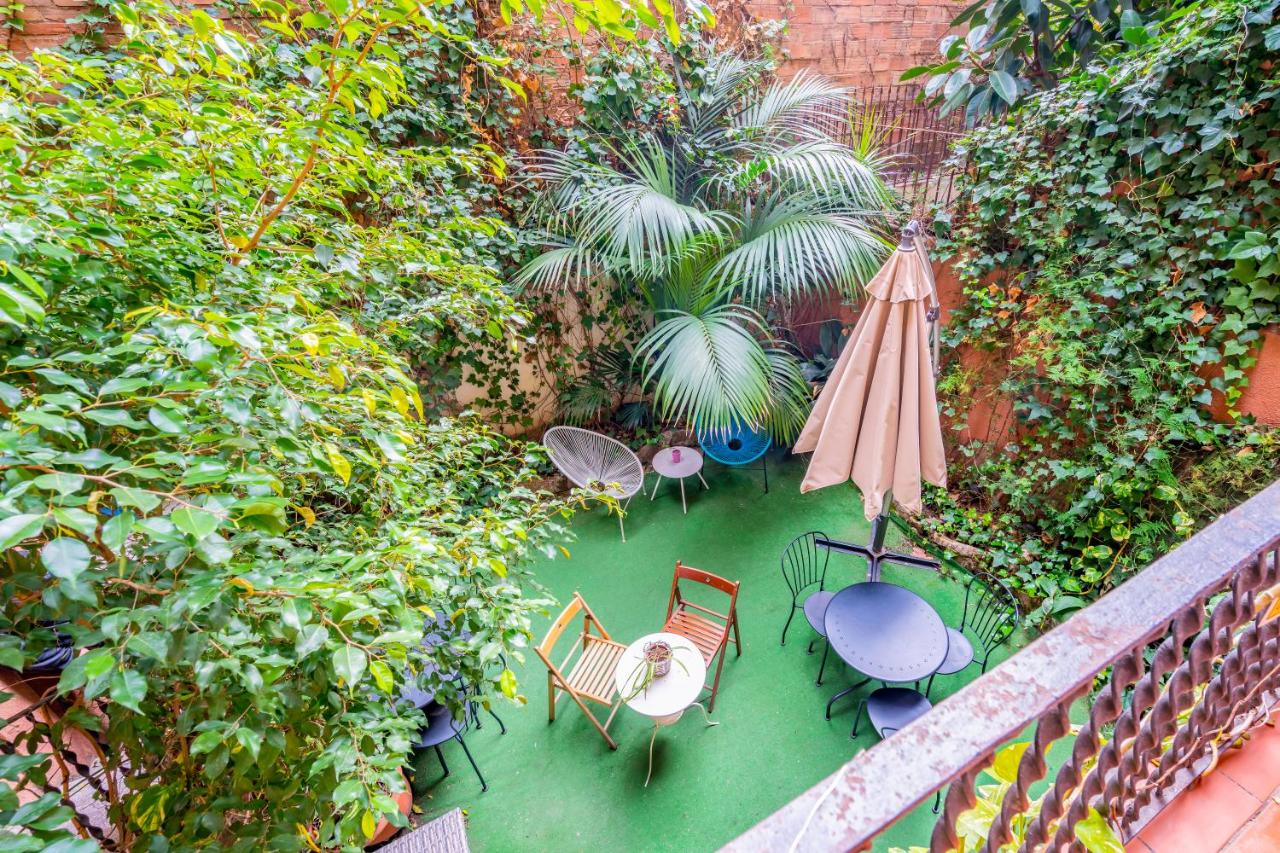
- Generator Barcelona (from 86€/night): double rooms, double Deluxe or beds in shared rooms in a hostel 5 minutes walk from Diagonal and Verdaguer metro stations with an amazing terrace and bar.
- Occidental Diagonal 414 (from 100€/night): rooms in an amazing hotel with good value for money with an incredible terrace and pool. It is not the closest to La Pedrera (500 meters approx) but it is well located to visit several attractions in the area.
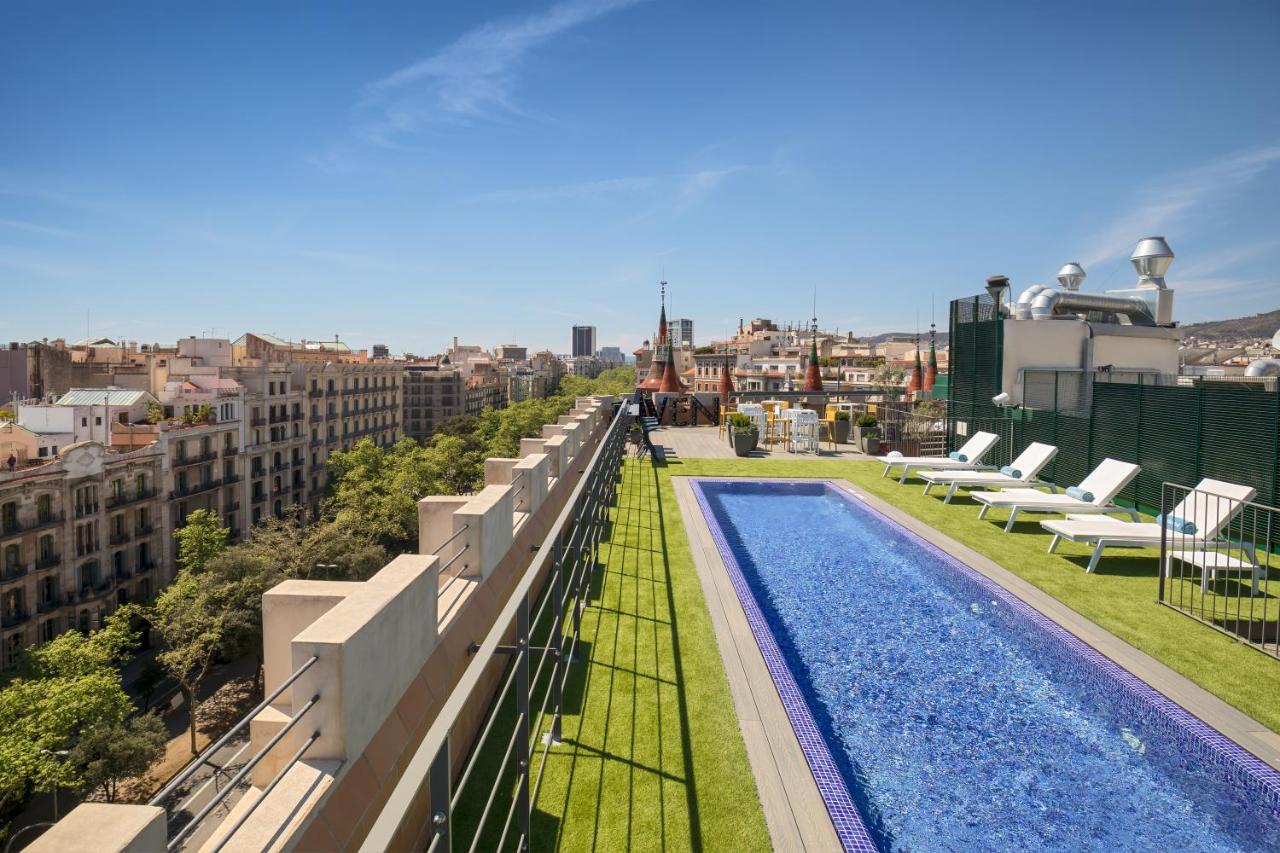
- Yeah Barcelona Hostel (from 102€/night): double rooms, quadruple rooms or beds in shared rooms, ideal if you want to meet people in the city as the common areas are amazing and, in addition, dinners are organized for everyone to get to know each other.
- Praktik Bakery (from 103€/night): No, we were not mistaken. If you like to wake up to the smell of freshly baked bread, don’t hesitate because this hotel houses an amazing bakery (or is it the other way around?). The hotel has double rooms and those who stay here can enjoy breakfast and taste the breads and pastries from the hotel’s traditional bakery.
- Catalonia Diagonal Centro (from 105€/night): double rooms in a hotel with outdoor swimming pool and possibility to bring your pet!
- Room Mate Carla (from 117€/night): great rooms at 5 minutes walking distance from La Pedrera with amazing breakfast included
- Bonavista Apartments – Pedrera (from 202€/night): apartments for 4 or 6 people overlooking La Pedrera. If you come with your family or a group of friends, I think you don’t need to look much more because the price-quality ratio of these apartments is excellent.

- Sir Victor Hotel (from 250€/night): rooms and suites in what will probably be one of the best accommodations. With a stunning rooftop terrace overlooking the city, this hotel is a 5-minute walk from La Pedrera.

If none of these convince you, in this link you will find a list of several accommodations of all types (and all prices) near La Pedrera in Barcelona.
Where to eat near La Pedrera (Casa Milà) in Barcelona
In this case we would recommend you to do what we did: cross La Diagonal de la Dreta de l’Eixample to the Gràcia neighborhood to find more options that fit our budget (and that fled from multinational chains). More specifically in this area we recommend:
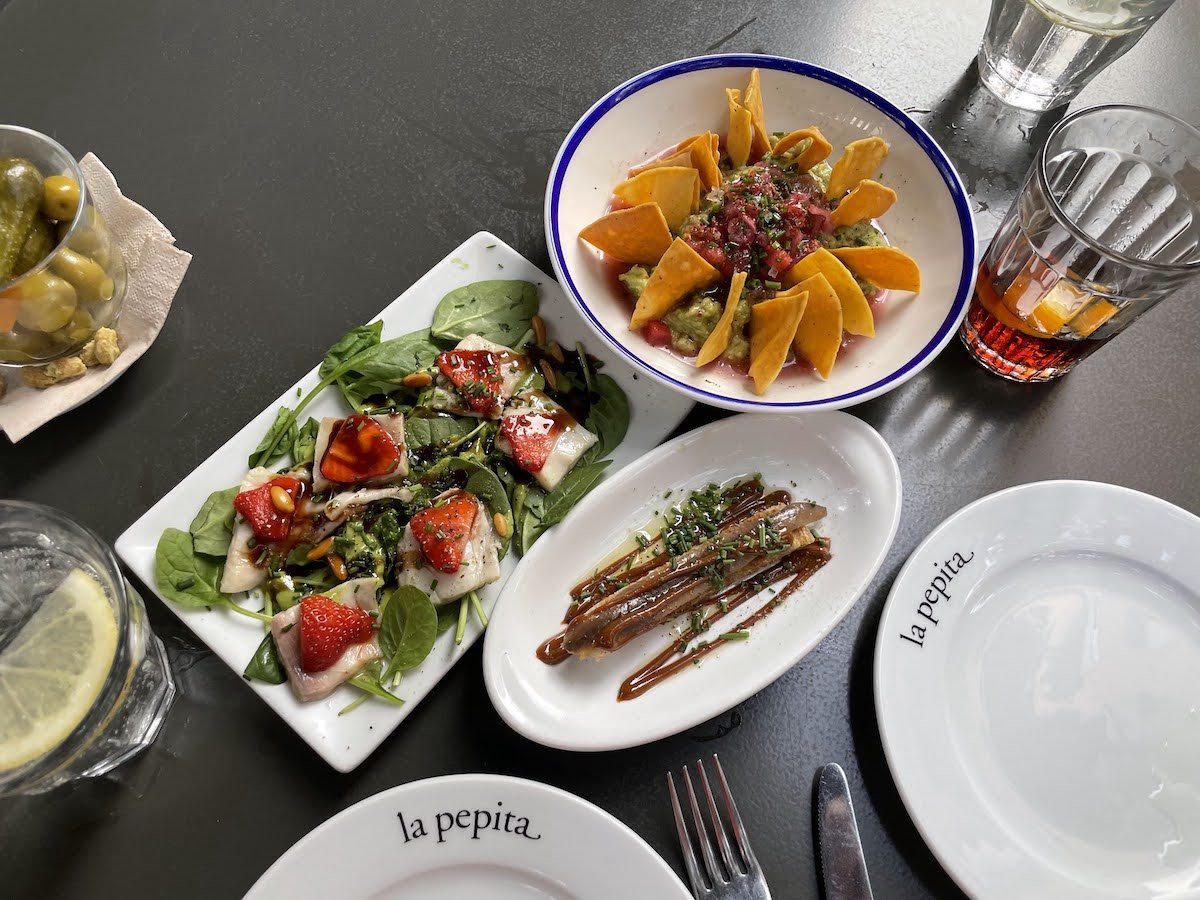
- La Pepita (6 minutes walk from La Pedrera): one of the biggest gastronomic surprises we had on our last trip to Barcelona. It was recommended to us by our friend Marcelo (who should be trusted for gastronomic tips) and, although the anchovy tapa with dulce de leche took the cake for originality, the truth is that it gives us the feeling that anything we had ordered from the menu would have been delicious. Of course, its fame spread quickly and if you don’t book in advance, you will probably have to wait in a long line to try it. Perhaps that is why they have opened next door, a couple of numbers further down the same street, the Mini Pepita, with the same menu but smaller.
- Can Punyetes (7 minutes walk from La Pedrera): It is not a unique place as there are actually three in Barcelona (and two in Madrid) but it is highly recommended. This is located in the neighborhood of Gràcia and is ideal for tasting Catalan cuisine dishes such as the famous calçots (if in season), butifarra and, of course, some good torrades amb tomáquet with different garnishes such as escalivada, trout or longaniza (sausage).
- La Pubilla (13 minutes walk from La Pedrera): Also a Catalan cuisine restaurant, with daily menus if you go at noon and delicious dishes.
Planning a trip to Barcelona? Don’t miss out on one of Gaudí’s most famous architectural masterpieces—book your ticket here on the official website!
