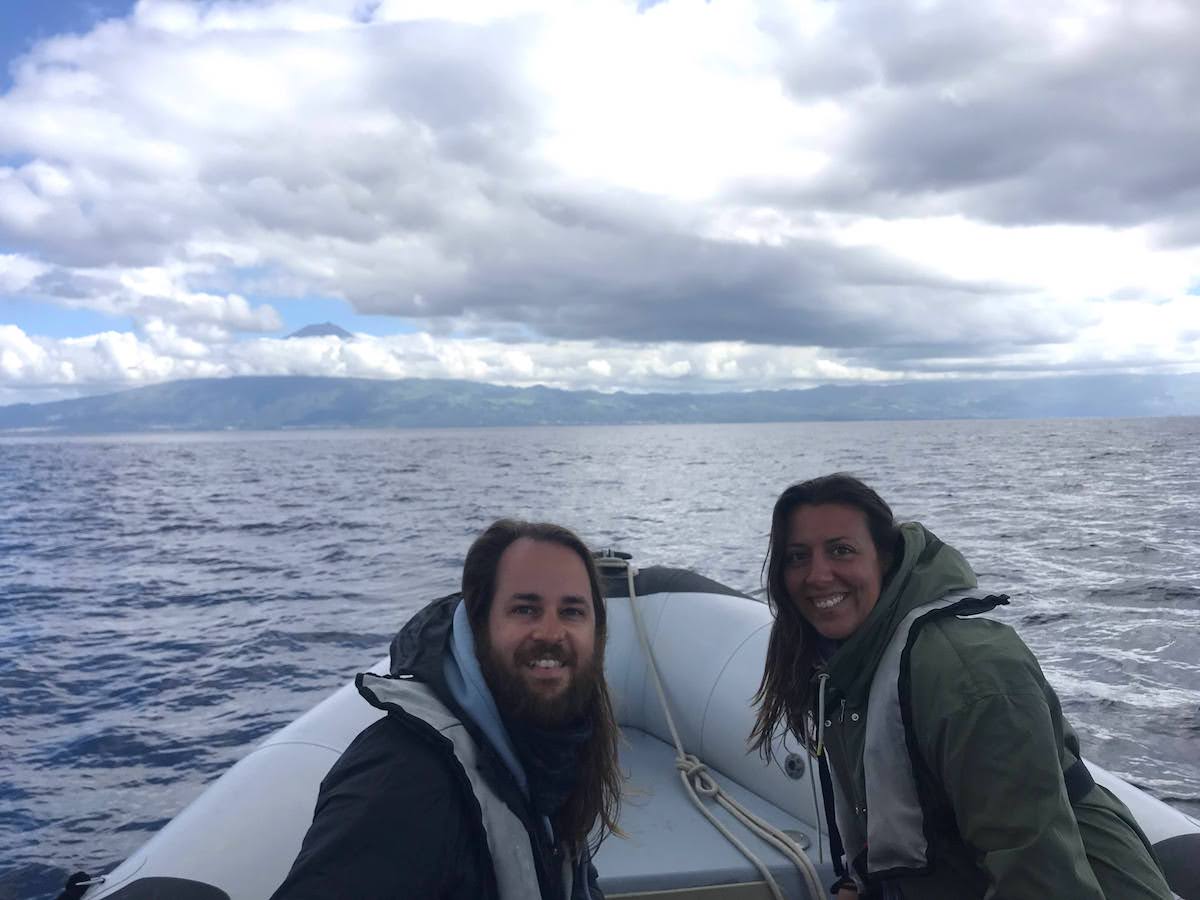
Did you know that different types of cetaceans live in the Azores? Some are residents, others are on their migratory routes (depending on the season), but the point is that observing whales and dolphins in the wild in their natural habitat is one of the top activities in Ponta Delgada, on the largest island of the Azores, São Miguel.
In this guide, we’ll tell you everything you need to know about whale watching—that is, observing cetaceans (whales, dolphins, sperm whales, orcas) in the wild, in the most respectful way possible, from a boat departing from the capital of the largest island in the Azores, Ponta Delgada on São Miguel.
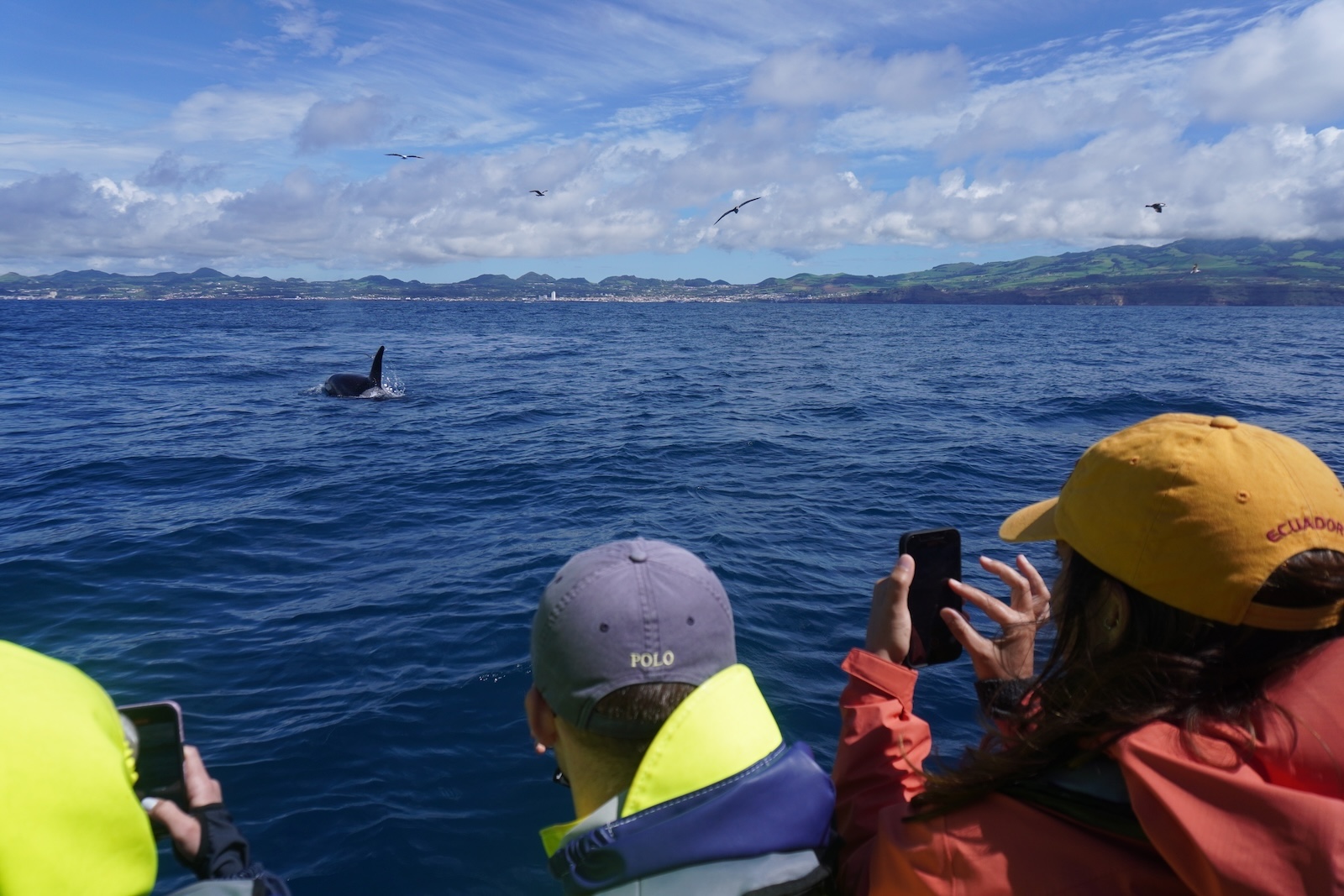
Book your boat tour to see whales, dolphins, and sperm whales in the wild from Ponta Delgada here
For everything else about what to do on the island, we recommend our complete guide to São Miguel.
Basic information for whale and dolphin watching in São Miguel, Azores
How to get there: From Spain, there are direct flights from some cities (such as Madrid, Barcelona, Bilbao, and some Canary Islands) with Sata, Iberia, or Binter, but only during the middle months of the year. The cheapest option is usually to fly from Porto/Lisbon, where there are plenty of flights with TAP or SATA. We recommend using flight comparison sites likeSkyscanner and Kiwiand being flexible with your dates. More info here
When to visit: While it’s possible to spot whales and dolphins year-round, the best months for the variety of species and optimal viewing conditions are usually spring and summer (April through October). More info here
How many days: Whale-watching tours last about 3 hours, but if you want to increase your chances, you can try multiple times.
Regulations: Whale watching is strictly regulated in Portugal, so all companies must comply with the rules. More info here.
How to go whale watching: On a roughly 3-hour boat tour with authorized operators. More info about the tours here.
Who to book the tour with: It’s important to choose a responsible company that doesn’t offer dolphin swimming activities. At Randomtrip, we recommend Futurismo, with whom we’ve taken several sighting tours. More info here.
How much it costs: The tour with Futurismo costs €70 . More info here.
Weather: The weather in the Azores is very changeable (it’s often said that you can experience all four seasons in a single day). With that in mind, it’s usually cooler out at sea, so be sure to bring clothing to protect yourself from the wind, cold, and sun.
What to bring: Sunscreen (lotion, sunglasses, hat/cap…), a waterproof windbreaker for the cold/rain and for fast boat trips, cameras (smartphone, GoPro, professional camera…), water (preferably in a refillable bottle). More info here.
Where to stay: The most common option is to stay in Ponta Delgada or nearby, but you can also stay in other areas and travel to Ponta Delgada on the day of the tour (Ribeira Grande, Furnas, Capelas, Nordeste, Povoação…). More info here.
Internet connection: If you are visiting for a few days, your phone supports eSIM and you don’t want to complicate things, we recommend Holafly eSIM (unlimited data, 5% discount with the code RANDOMTRIP) or Airalo eSIM (limited data, but cheaper, 15% discount with the code RANDOMTRIP15). Otherwise, the cheapest way is to get a local SIM (the main companies are Vodafone, Meo and Nos). More info here
Language: Tours are usually in Portuguese and/or English

In which area of São Miguel do whale and dolphin watching take place?
It’s possible to spot whales and dolphins in many areas of the island of São Miguel, although most tours depart from Ponta Delgada and many of the lookout points (where companies have staff monitoring for signs of cetaceans to direct the boats) are located in the southern part of the island. At Randomtrip we always book the tours from Ponta Delgada with Futurismo and always saw both whales and dolphins.
There is also the option to take a whale-watching tour in the north (from Rabo de Peixe, also with Futurismo), from Vila Franca do Campo (also in the south), and even from Mosteiros in the west of the island.
It’s important to understand that the animals are completely free-roaming, so the boats set out and have to travel to the areas where the spotters can see them from land (sometimes it’s closer to the departure point, other times you have to travel farther).
How to get to São Miguel
From Spain, there are direct flights to Ponta Delgada from Madrid, Barcelona, Bilbao, or some of the Canary Islands, but these are usually only available during spring/summer and only on certain days of the week (with Sata or TAP). The most economical option is usually to fly from Lisbon or Porto with TAP (the Portuguese airline) or SATA (the Azorean airline responsible for all inter-island flights) from Lisbon or Porto. Ideally, you should be flexible with your dates and use price comparison sites like Skyscanner and Kiwi.com.

Best time to visit: when to see whales and dolphins in São Miguel
April through October is usually the best time for whale watching, although in these Atlantic waters there’s a chance to spot cetaceans year-round, so you might get lucky no matter which month you visit the archipelago.
The best months for the highest chance of seeing almost all species are usually April and May.
In fact, if your dream is to see the world’s largest mammal, the impressive blue whale, know that it passes through the Azores between April and May and can reach up to 35 meters in length! Inês saw one with her mother and sister in March on São Miguel, and at Randomtrip we also managed to spot one during our last visit to São Miguel in May (that May tour was incredible—we were incredibly lucky and got to see dolphins, a blue whale, fin whales, sperm whales, and orcas!)

On the other hand, since sightings depend largely on the lookouts on land, sea conditions are a pretty important factor when it comes to getting lucky; on days when the sea is rougher, it’s harder for the lookouts to spot the whales, whereas when the sea is as flat as a pancake, it’s much easier. That’s why, during the winter months, it can be harder to spot them even if they’re there, and depending on sea conditions, trips may even be canceled.


Here is a table showing the different types of cetaceans and the probability of seeing them each month of the year in the Azores, according to this report from the Ocean Azores Foundation:

Best time of day to see whales and dolphins in São Miguel
Based on the data and statistics, there is no best or worst time of day for whale and dolphin watching in São Miguel: it is possible to see them at any time of day.
Whether you can see them, and how close or far away they are, depends on a multitude of factors: the whales themselves, luck, sea conditions, the weather, etc.
If you get seasick on the boat, it’s best to take some medication and try to choose a tour on a day when the sea is calmer (you can check the wave forecast on Windy).
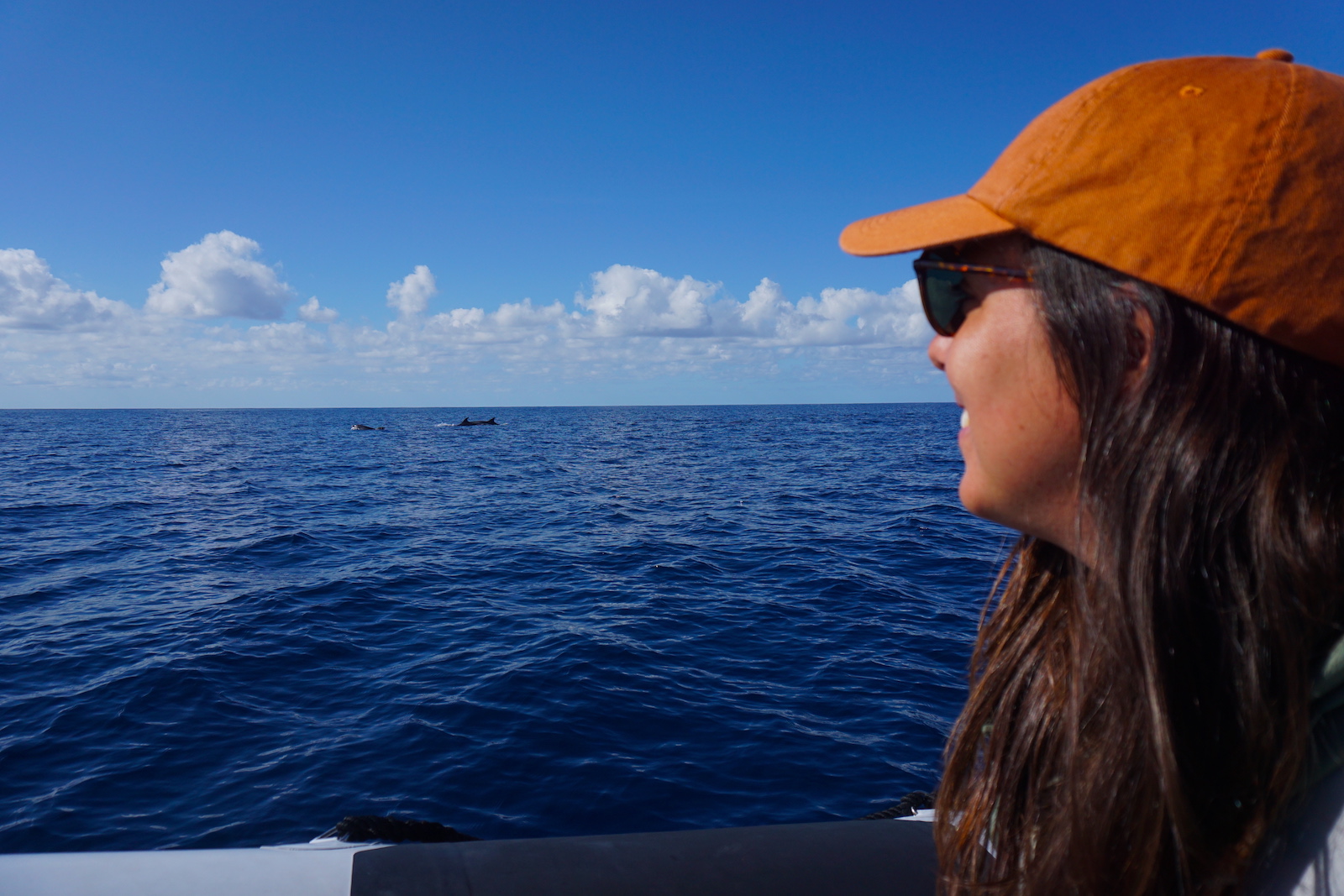
Many companies offer two types of boats: Zodiacs or catamarans. In our opinion, the Zodiac is always much better, as it moves much faster and you’re closer to the water and the “action,” although if you get seasick, it’s a rougher ride (and if you need to use the restroom, it’s not possible). Catamarans, on the other hand, offer a smoother ride, a higher vantage point, and more amenities (you can move around the boat, sit, stand, use the restroom…), but they’re slower.
Keep in mind that whales are spotted when they surface to breathe; often, after surfacing a couple of times to breathe, they dive deep and take a few minutes to resurface, and the location is unpredictable. Therefore, with the zodiac, you’ll reach the sighting location detected by the lookout much faster and have a better chance of seeing them up close.

Ideally, if you want to maximize your chances of seeing them, you should take several tours on different days. At Randomtrip, we took several tours during our various trips to São Miguel, and on all of them we were lucky enough to see at least one species of whales and dolphins, but several people who went on the days before or after us were less fortunate and saw “only” dolphins. Remember that just being able to see them in their natural habitat is a stroke of luck and a privilege. We’re talking about animals in the wild and tours that respect them, so there are no guarantees.
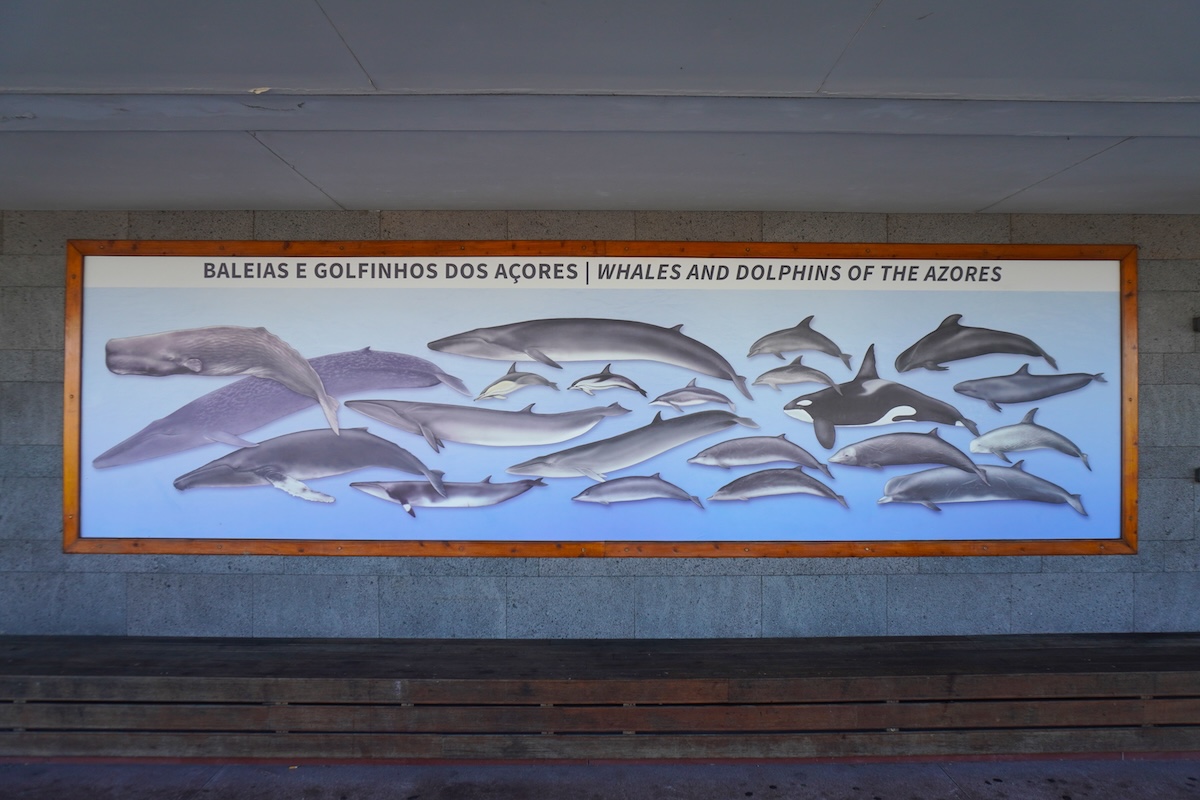
What species of cetaceans (whales, dolphins) can I see in São Miguel?
In the waters surrounding the Azores archipelago, you may spot more than twenty species of cetaceans—both resident and migratory. Among these species, the one you’ll most want to see from the boat is the beautiful sperm whale, a symbol of the Azores, whose photogenic tail breaking the surface is an image we all hope to capture when we set out on a whale-watching adventure.
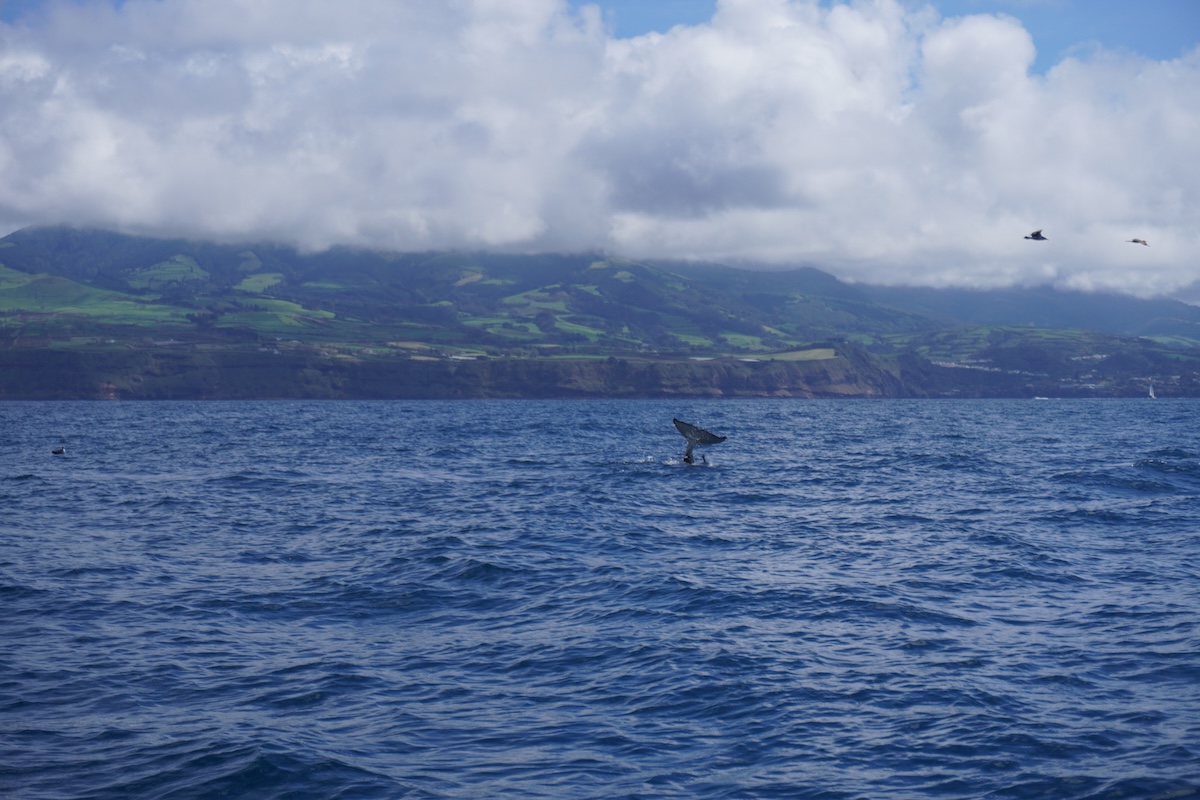
But there are many more! In the Azores, you can see the giant blue whale—the world’s largest mammal—as well as the fin whale (the world’s second-largest), the sei whale (the world’s third-largest), humpback whales, and more. It’s also possible to spot sperm whales, various species of dolphins, and even orcas (!!!), although the latter are very rare.

Rules for whale and dolphin watching in São Miguel
Fortunately, whale and dolphin watching is strictly regulated to protect and conserve these beautiful animals. You should know that the Azores have a history deeply tied to whaling, an activity that was once very important to the local economy. Fortunately, whaling was banned in the late 1980s, and the industry adapted to the sighting of these incredible animals.

You can find the official rules for whale watching here, and below is a summary (if you take the tour with Futurismo, they’ll give you a briefing before boarding the boat where they’ll explain the rules):
- Avoid making noise so as not to disturb the animals
- Maintain a constant speed that is equal to or slower than that of the animal or group of animals
- It is prohibited to approach within 50 meters of the animal or group of animals. If the animal voluntarily approaches the boat to within 50 meters, the engine must be turned off
- Observe the animal or group of animals from behind and at an angle
- The maximum time allowed with the animal or group of animals is 30 minutes
- No more than 3 boats may be within 300 meters of the animal or group of animals (in the case of dolphins) and 500 meters (in the case of whales)
- Swimming with whales is strictly prohibited
- Flying drones is strictly prohibited
- It is not permitted to cause the group of animals to separate, especially if there are calves
- If the animal exhibits evasive movements, boats must move away immediately

We recommend checking out this guide by the Ocean Azores Foundation on how to whale-watch sustainably and responsibly in the Azores.
Can you swim with whales and dolphins?
Swimming with whales is strictly prohibited in the Azores unless you have a special permit (for research and similar purposes). You can read the legal text here.
Swimming with dolphins is permitted under a set of rules, although unfortunately, these rules do not guarantee the animals’ well-being, and we hope this will also be banned in the future. At Randomtrip, we strongly urge you not to participate in dolphin swimming tours. If you want to understand the reasons, we recommend reading this open letter from the operator with whom we went whale watching on the island of Pico.
Are the rules for whale and dolphin watching in São Miguel being followed?
Based on our experience, for the most part they are followed, although not all boats comply (it depends heavily on the company), and much more oversight is needed to ensure compliance. Especially when there are few sightings and many boats, we sometimes observed that the limit on the number of boats around the whales is not respected.
That’s why it’s very important to book tours with authorized operators who have a good reputation and whom you can verify are following the rules— don’t just focus on the price. It’s also very important thatyou read the rules, ask the company questions, and call attention to and/or report any violations to the authorities, and even share them with others on the same boat who may not know what those rules are.
On tours with Futurismo, the company we’ve chosen for whale watching, you’ll always have a guide on board (with a background in marine biology) who will give you a briefing before departure, explain the rules both before and during the tour, and keep you informed of what’s happening (how to spot the whales, what kinds of behaviors they exhibit, what species you’re seeing, etc.) so that all you have to do is enjoy this special experience.

Is whale sighting guaranteed on the boat tour?
Everyone hopes to see a sperm whale or some other whale during the whale-watching tour. It’s important to manage your expectations when taking this tour, as you’re engaging in a beautiful and responsible activity—trying to observe an animal in its natural habitat—but, for that very reason, it’s a gamble whether that animal will come close enough to greet you or not.
Almost all operators advertise that they’ll let you take the tour again for free if no cetaceans are sighted, but it’s practically impossible not to see dolphins, so in practice that clause is more of a marketing ploy than anything else. In the event that the company has that clause and you see neither whales nor dolphins, they will indeed give you the chance to take the tour again for free, so it’s advisable to try to take the tour at the beginning of your trip to have a few days’ buffer in case you need to repeat it (whether because you didn’t see anything or because it’s canceled due to the weather).
What the whale and dolphin watching tour in São Miguel is like
Since these are wild animals in the wild, there’s no way to know for sure whether you’ll see whales or not, where they’ll be, or anything like that, so it’s important to adjust your expectations.
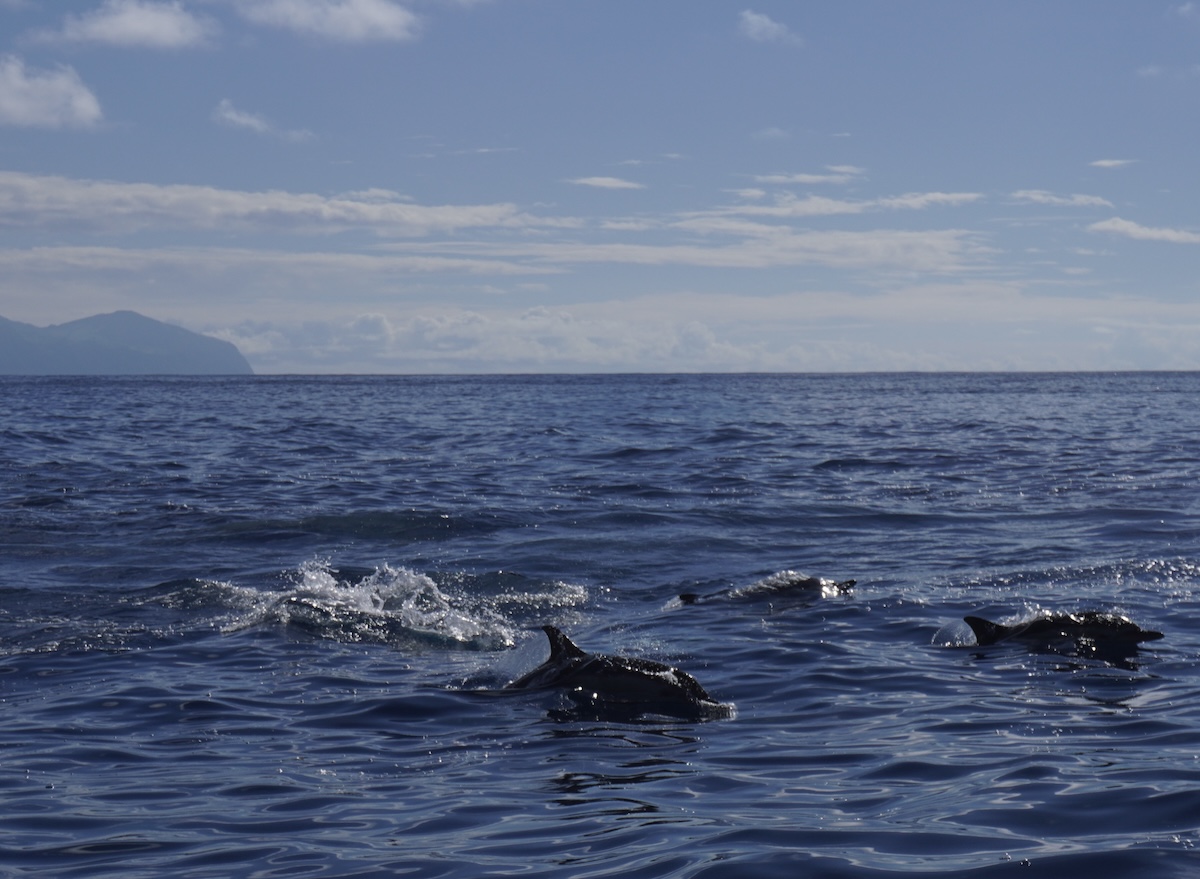
In our case, we were lucky, and on the various tours we took, we always saw at least dolphins and some kind of whale. But other people we know who went a few days before or after our date weren’t as lucky and saw “only” dolphins (it’s almost guaranteed that you’ll always see a pod of dolphins, which is incredible).
In the case of the Futurismo tour—a responsible company we recommend—the tour begins at their offices with a short briefing, where they explain what the tour entails, the rules for whale watching, as well as some fun facts about whales and dolphins.
After the briefing, they’ll direct you to your boat, give you life jackets (depending on the weather, they’ll also offer you waterproof suits to wear over your clothes if you’d like), and take you to the boat.

Once at sea, the boat will set sail, in constant communication with the spotters on land, toward areas where a cetacean has been sighted. This process may take more or less time, and if you’re lucky, it will happen several times so you can observe different species.
Once the tour is over, the boat will head back to the port, where you’ll return the life jacket (and the waterproof suit if you used it) at the office. At Futurismo, they’ll tell you which species you saw if you were lucky and offer you a warm cup of São Miguel tea.

Zodiac or Catamaran?
When booking the tour, most whale-watching companies offer at least two boat options: zodiac (rigid-hulled inflatable) and catamaran.
Each boat has its pros and cons. Here are some details to help you choose the option that best suits your needs.

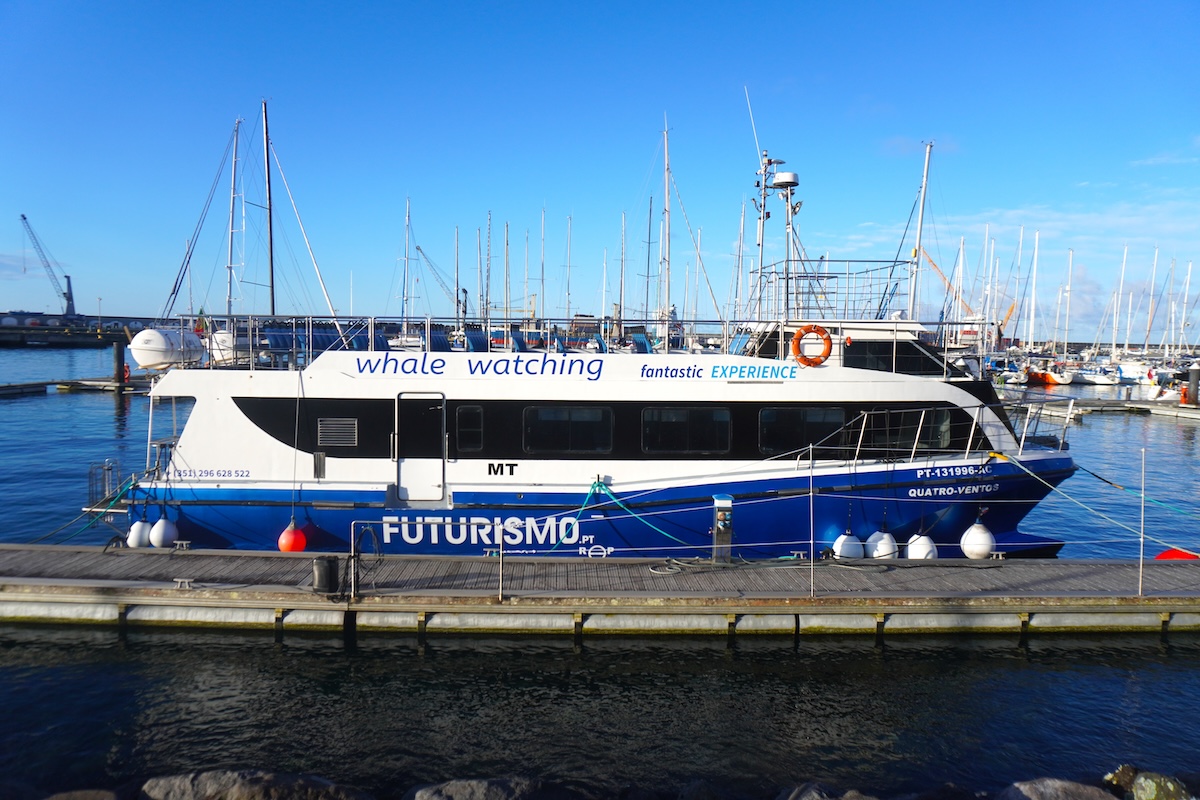
- Zodiacs are faster, so when a sighting is reported, you’ll reach the spot quicker and have a better chance of seeing the whales or dolphins
- In the Zodiacs, you’ll be closer to the water and the action, and in our opinion, you’ll get a better view of the animals
- On the catamaran, you’ll have more comfort and space (you can sit down, walk around the catamaran, etc.)
- The tour lasts about 3 hours; on the catamaran, you’ll have access to a restroom if you need it, whereas on the zodiacs, you won’t.
- The ride will be bumpier in the Zodiacs, so if you have back problems, are afraid of the sea, or get seasick easily, the catamaran is your best option. Inside the Zodiac, the further back you sit, the less you’ll feel the “bounces.”
- The large zodiacs have some rows with 3 seats; if you end up in the middle seat, you’ll have poorer visibility depending on who’s sitting next to you.
- In summary:
- Zodiac: the best option if you enjoy or don’t mind the extra adrenaline rush and your priority is to maximize your chances of seeing whales and dolphins as close as possible
- Catamaran: the best option if you’re looking for comfort (whether you prefer it or because it’s a necessity due to back problems, seasickness, etc.)

RandomTIP: This was the tour we took with Futurismo, which you can book. In our case, we chose to go on the Zodiac (not the Catamaran) for the 8:00 a.m. tour, but it always depends on the day, the season, sea conditions, and, of course, luck.
How long does the whale-watching tour last?
The whale-watching tour lasts about 3 hours, during which the boat you’re on stays in constant communication with various lookout points on land that report sightings of “large” whales to ensure you have the best possible experience and can spot as many species as possible.

How many people are on the boat?
It depends on the tour, the company, the type of boat, and the price: there will always be a captain, at least one guide (trained in marine biology), and the corresponding number of tourists up to the boat’s maximum capacity.
Catamarans can carry between 60 and 80 people, depending on the model:

Zodiacs can carry between 10 and 30 people:

How much does the whale and dolphin watching tour cost?
The price depends on the company you choose, the duration, the type of boat used, the number of people…In the case of Futurismo, tours cost €70 per person, whether on a zodiac or a catamaran.
Since this is an activity involving wild animals in the wild, where the main priority is to respect them and ensure compliance with current regulations,we recommend that you don’t just look for the cheapest operator, but do some research on who you’re going with and their stance on the welfare of these animals.
Recommended company for whale and dolphin watching in São Miguel
Based on what we’ve mentioned, fortunately the activity is regulated and there are clear rules that all companies must follow. Since even so there are boats that don’t comply with the regulations,the most important thing is to choose carefully who you’ll take the tour with, and to make your intentions clear at the start of the tour to engage in responsible sighting and follow the rules.
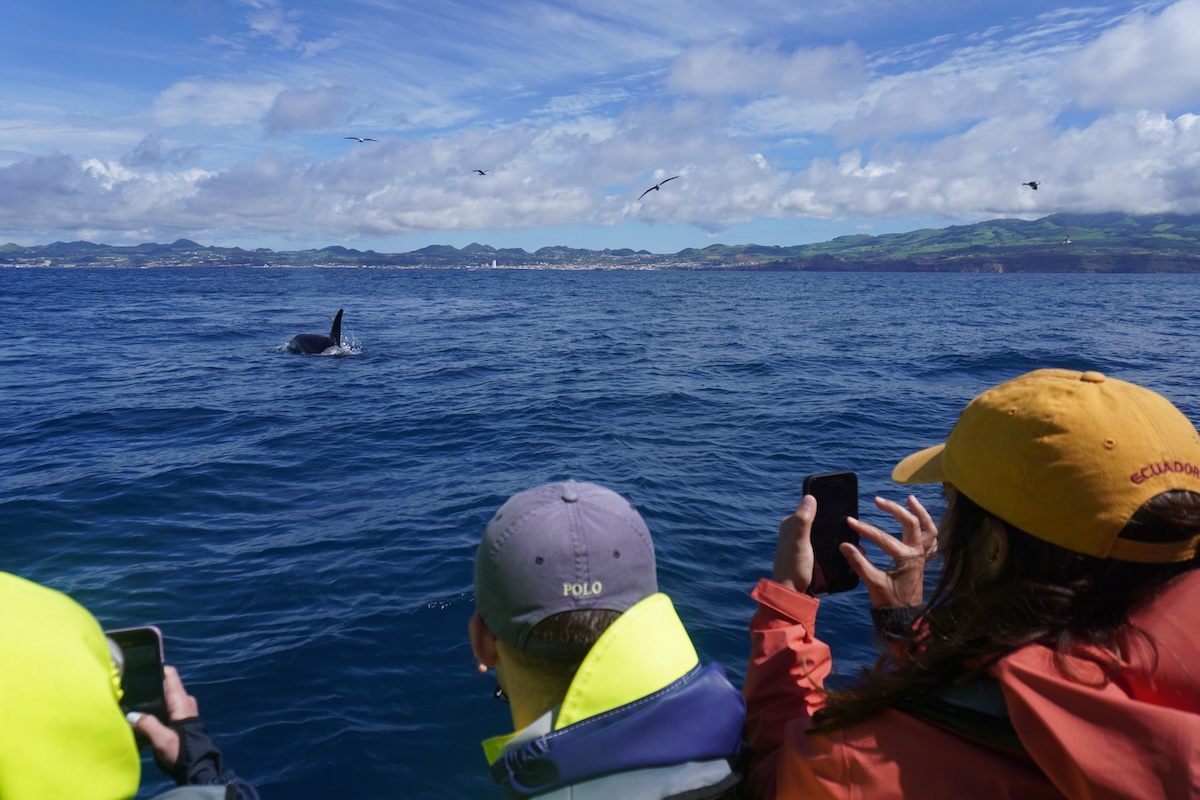
RandomTIP: This was the tour we took with Futurismo, which you can book. In our case, we chose to go on the Zodiac (not the catamaran) for the 8:00 a.m. departure, but it always depends on the day, the season, sea conditions, and, of course, luck.
Our experience whale watching in São Miguel
At Randomtrip, we never miss a chance to say hello to these gentle giants whenever we can, and as soon as we found out that the Azores was one of the best places to do so, we didn’t hesitate. We’ve already done this activity three times on the island of São Miguel (and once on the island of Pico), and it never ceases to amaze us.
I get goosebumps every time I remember seeing that gentle giant, a blue whale over 20 meters long, swimming peacefully right next to our boat (in that case, a catamaran), the first time I visited the island in 2013.
On one of our recent trips, we went on another tour (with Futurismo), and honestly, we were incredibly lucky! We managed to see dolphins, a blue whale, a fin whale, a sperm whale, and orcas.
Since we were going to be in São Miguel for quite a few days, we checked the weather and sea conditions forecast on Windy and chose a day when the sea was going to be calm and rain-free, for the first tour (zodiac at 8 a.m.), since the forecast was for the sea to get rougher in the afternoon.
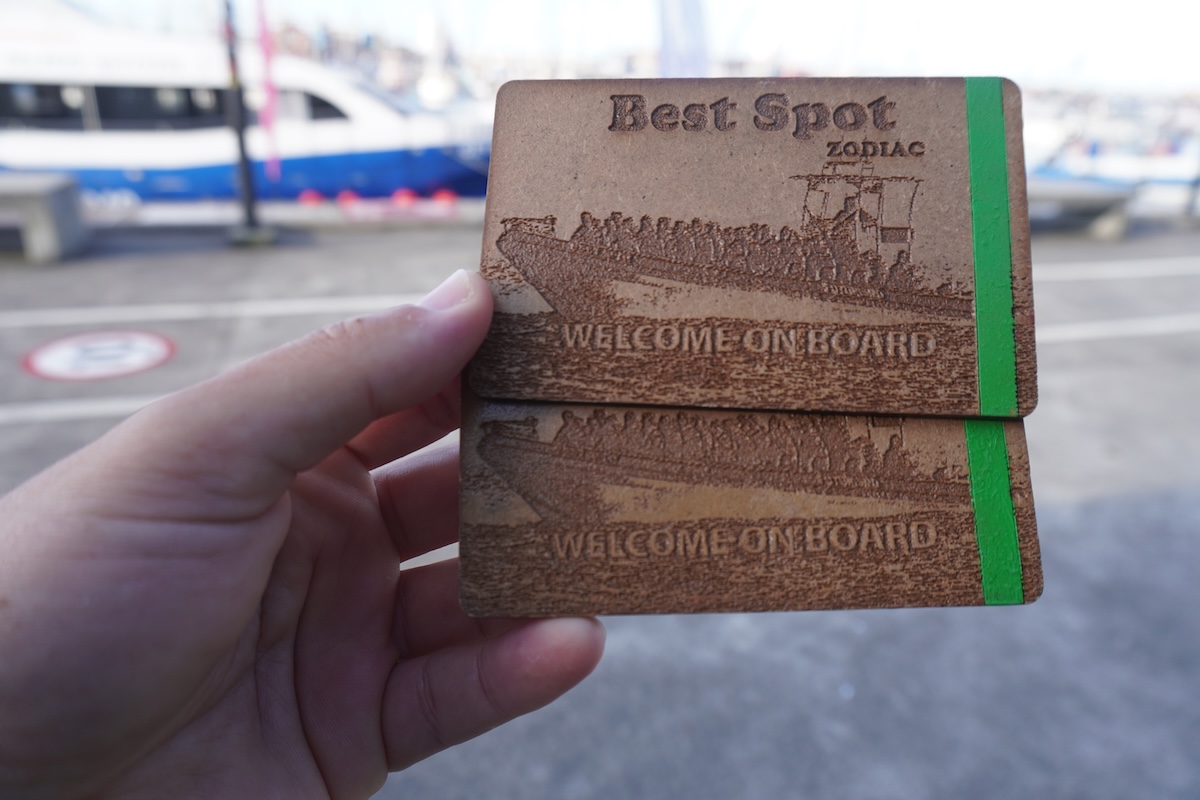
We arrived at the Futurismo office a little before 8 a.m. as requested, where they welcomed us, confirmed our reservation (we booked through GetYourGuide), and gave us small wooden cards with a color (green) and the name of our boat (the Best Spot zodiac).
Next, they took us to a room where we waited for the rest of the group and received a briefing explaining the safety rules on board, the regional regulations governing the activity, and its guidelines. They confirmed that we were in the best season for seeing whales and dolphins (May) and showed us the species we might see (it’s normal to see 2 species or at most 3 on each tour). They also asked everyone to be respectful and civilized—something that, unfortunately, is rare—and in our case, there was even some pushing and shoving to get on the Zodiac and grab the front seats (for the best view).
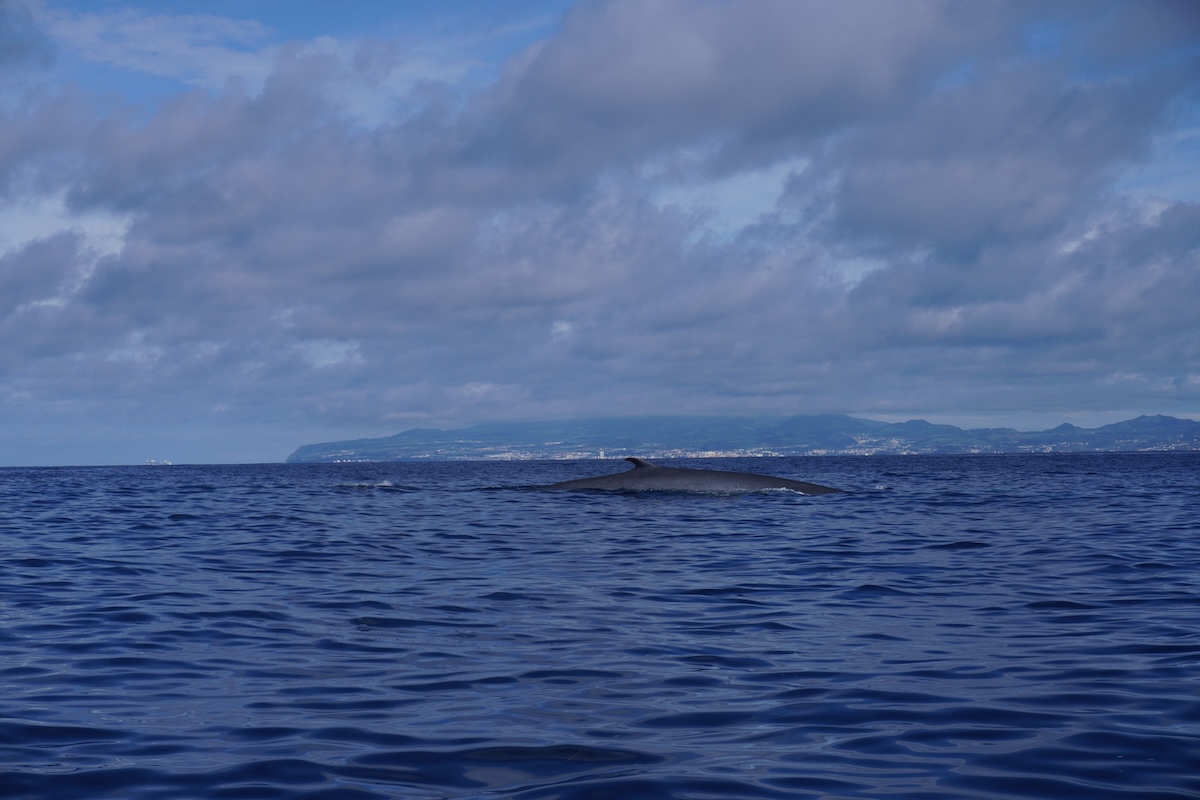
Once aboard our zodiac, the “Best Spot,” we headed out to sea. Both our guide Lucas and our skipper were marine biologists, and Lucas kept us updated on what was happening at every moment. For the first half-hour, we simply enjoyed the views, the sunny day, and being out at sea—which is always a pleasure—even though there was no sign of whales or dolphins. But a few minutes later, after a report from one of the lookouts on the coast, they took us very quickly to an area where we first spotted afin whale ( the second-largest whale in the world), which surfaced a few times to breathe.

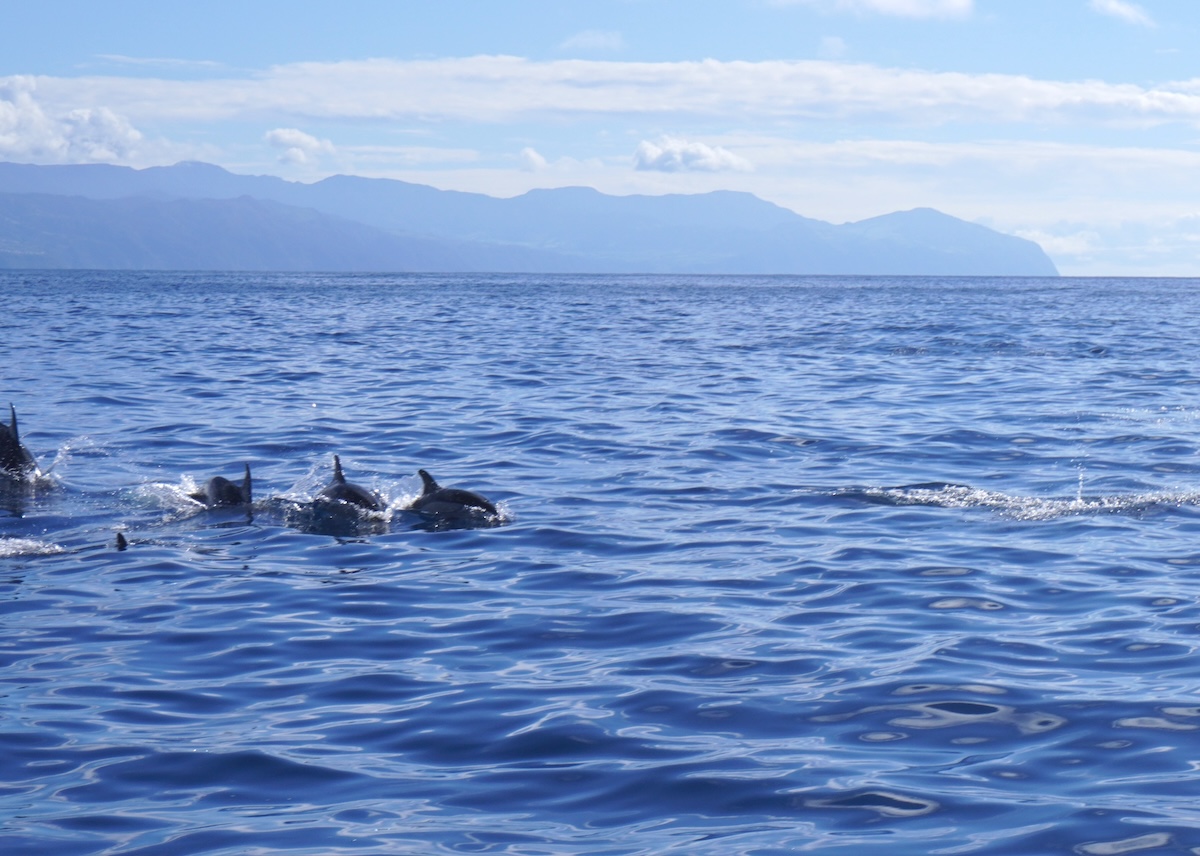
Shortly after leaving this giant behind, we were treated to the presence of a group of dolphins, which swam alongside our zodiac.
After that, we spent another half hour cruising and enjoying the views. It’s important to be patient and keep your expectations in check on whale and dolphin watching tours, since most of the time is spent doing just that—waiting!
We heard our guide Lucas speaking on the radio, and suddenly the skipper sped up the zodiac again—a sign that they’d spotted something! Shortly after, we stopped, and they told us to keep an eye on our right side. Suddenly, a giant whale appears, and they confirm it’s a blue whale! The blue whale is the largest whale (and mammal) in the world. What a privilege to see them—this alone has made the tour worth it.

At this point, having seen three species of cetaceans and after about an hour of sailing, we were expecting at most to see more dolphins and start heading back to port. But a few minutes later, we speed up again and immediately see something surfacing to breathe with a smaller, faster blow: it’s a sperm whale! After several surface visits, it heads back into the depths, so we can just barely see its tail fin dipping into the water. What a marvel and what luck!

Everyone on the zodiac is thrilled, and although we were now more than ever expecting the tour to end, suddenly our guide Lucas tells us there’s a final surprise—and he says it with quite a bit of confidence. In our minds, we imagine it will be a pod of dolphins, so we bundle up and get our cameras ready as the zodiac speeds up.
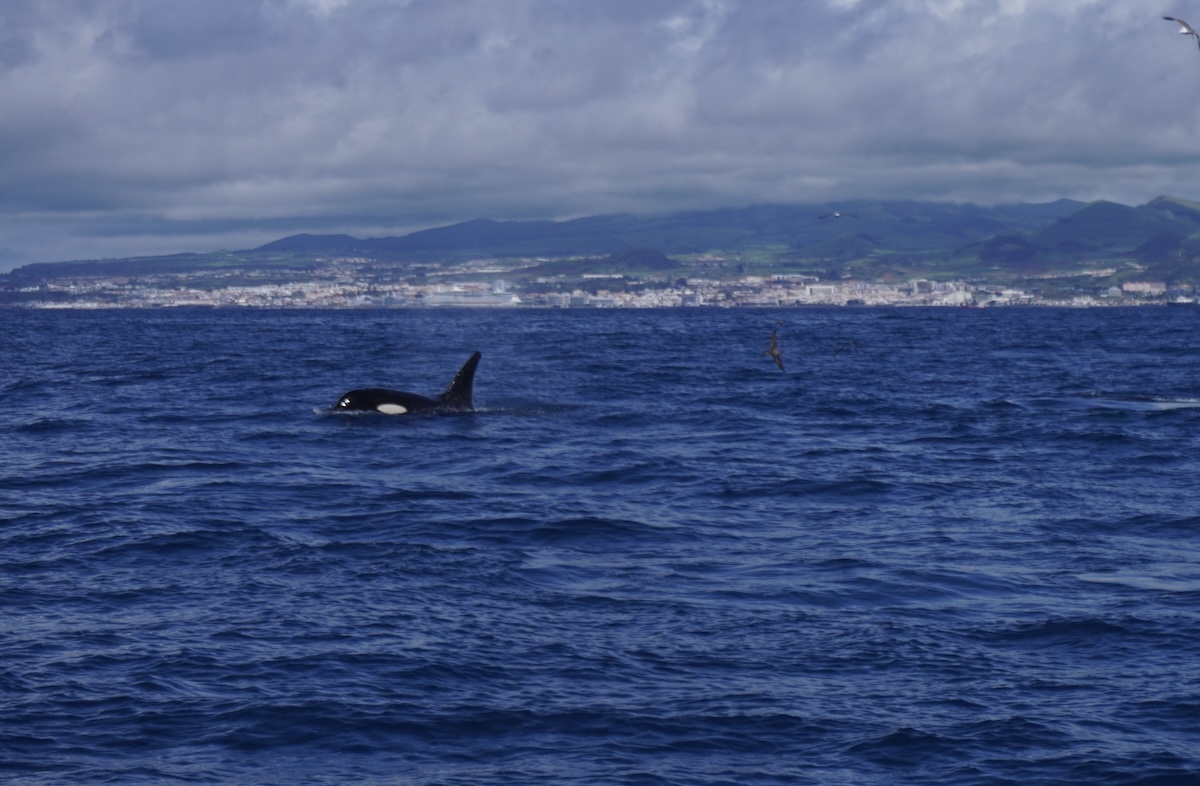
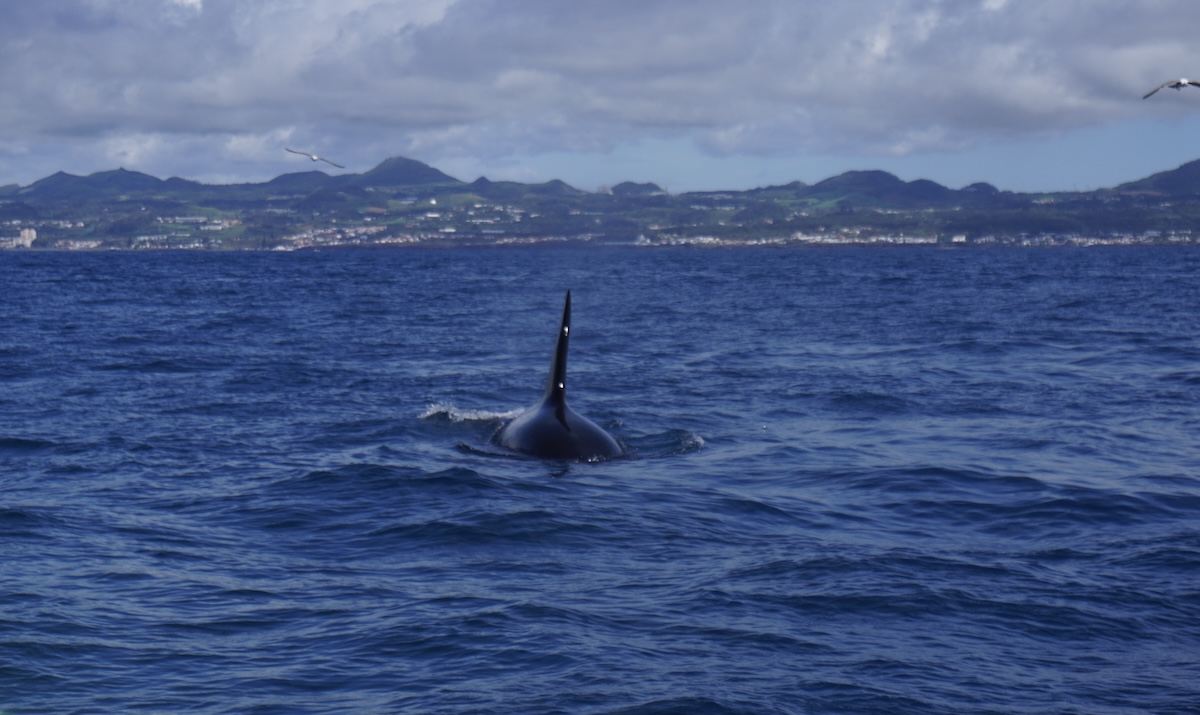
We cruise for about 15–20 minutes, and when the zodiac stops, the anticipation is at its peak. Lucas tells us to keep an eye on the left side, and as soon as we hear a sound, everyone turns their heads to look… several orcas! We can’t believe it, since they aren’t that common or easy to spot, and to see them on a tour where we’d already seen four species is incredibly lucky. We spend a while watching them, and our luck gets even better when one of them heads toward our zodiac and passes right underneath us, letting us get a close-up view .
Our guide Lucas tells us that our time is up, and after saying goodbye to the orcas, we sail for about 15–20 minutes back to the port to end our tour.
Before leaving, we hand in our life jackets. Lucas points out the species of dolphins and whales we’ve seen on a giant panel on the wall, they offer us some warm Azores tea, and he also shows us a small jar of krill, the whales’ food.
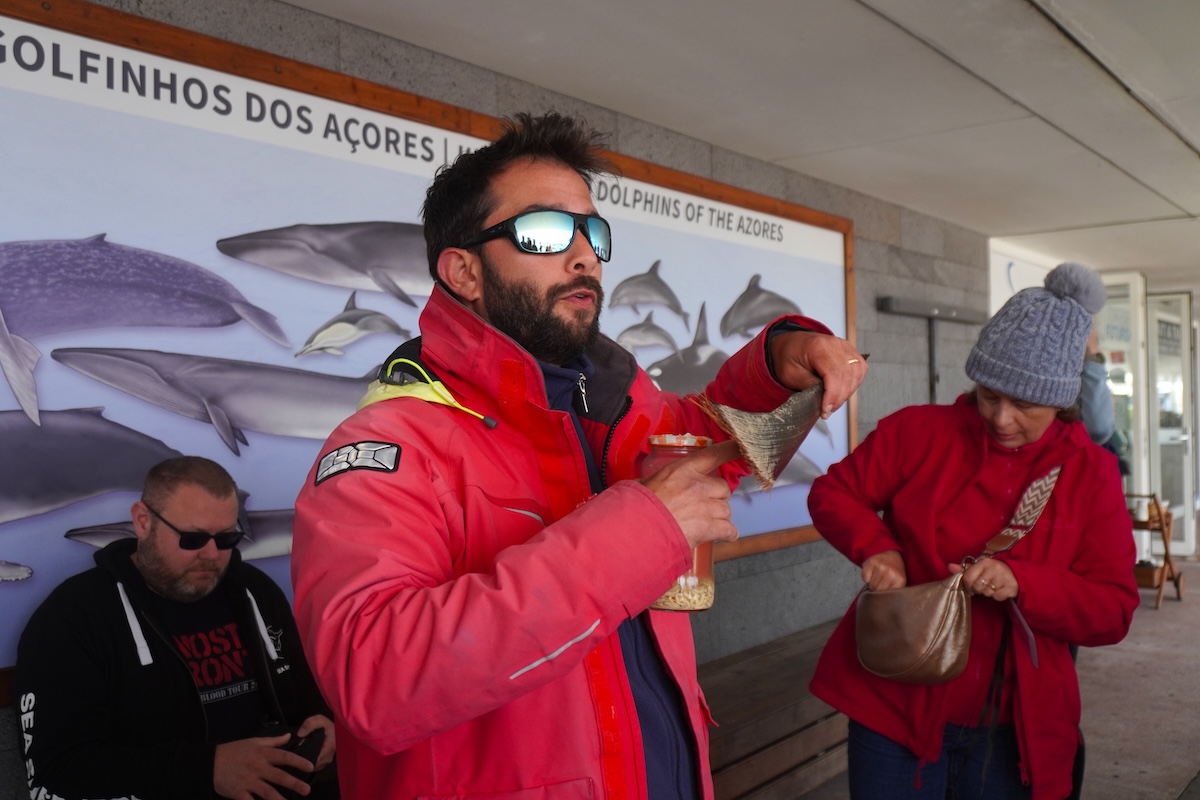
This was the tour we took with Futurismo, which you can book. In our case, we chose to go on the Zodiac (not the catamaran) for the 8:00 a.m. departure, but it always depends on the day, the season, sea conditions, and, of course, luck.
Book your whale watching tour with Futurismo in São Miguel here
A Brief History of Whale Watching in the Azores
Although whale watching today is about admiring their beauty in their natural habitat, highlighting their importance in the ecosystem, and promoting ocean conservation, this hasn’t always been the case. In the past, whale watching was about… hunting them.
Whaling —the“baleação”—was a major economic activity in the Azores (especially on the island of Pico) for about 50 years, and the numbers are staggering: between 1896 and 1949, around 12,000 whales were hunted. The activity was thankfully banned when Portugal joined the then European Economic Community (EEC) in 1986, but it wasn’t until 1987 that the last sperm whale was hunted on the island of Pico.

On several of the Azores islands, you’ll find a Museu Baleeiro (whaling museum), spaces that aim to portray the harsh life of the whalers (mostly men), explaining the hunt itself in the small, fragile vessels known as baleeiro boats.

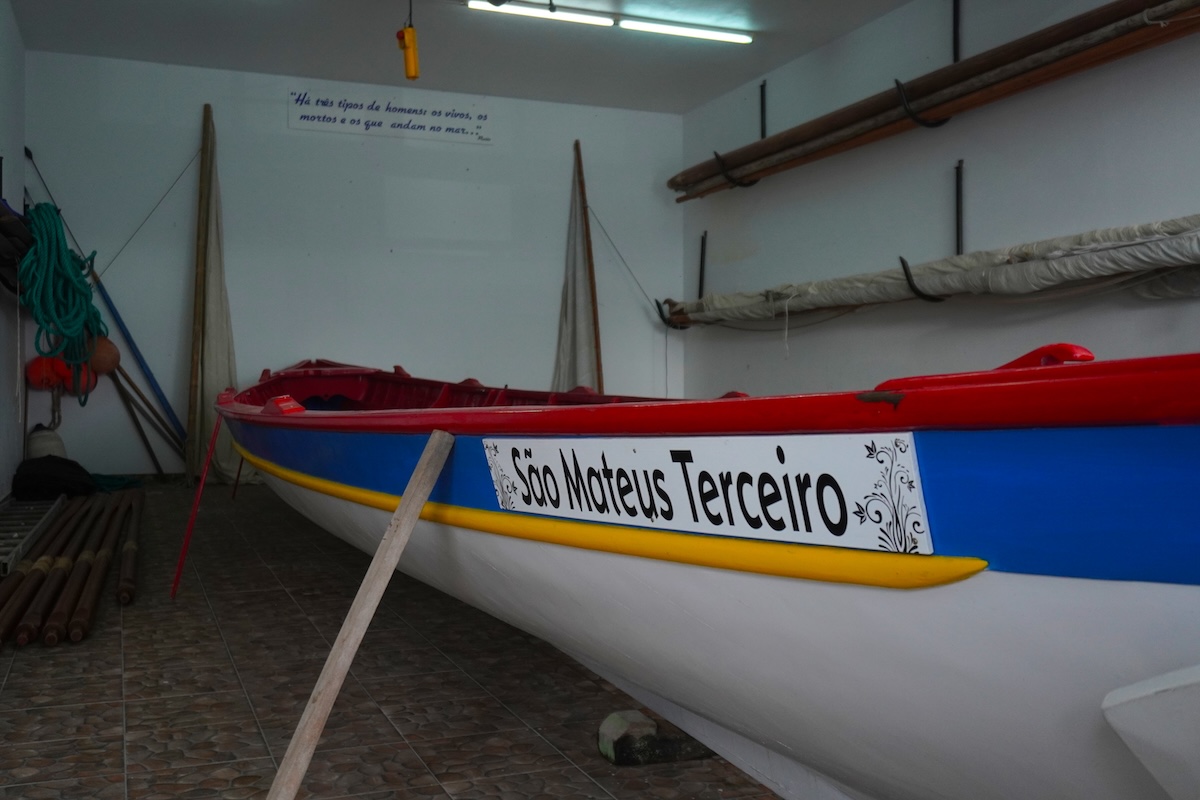
An extremely grueling activity in which both the animals and some of the humans who engaged in it lost their lives. The goal: products derived from sperm whales and other whales—oils for lighting and lubricants (mainly for export) and various types of meal (made from the bones).

It’s often a difficult visit, where you’ll find yourself swallowing hard many times, especially after having greeted the beautiful and majestic cetaceans in their Atlantic home.

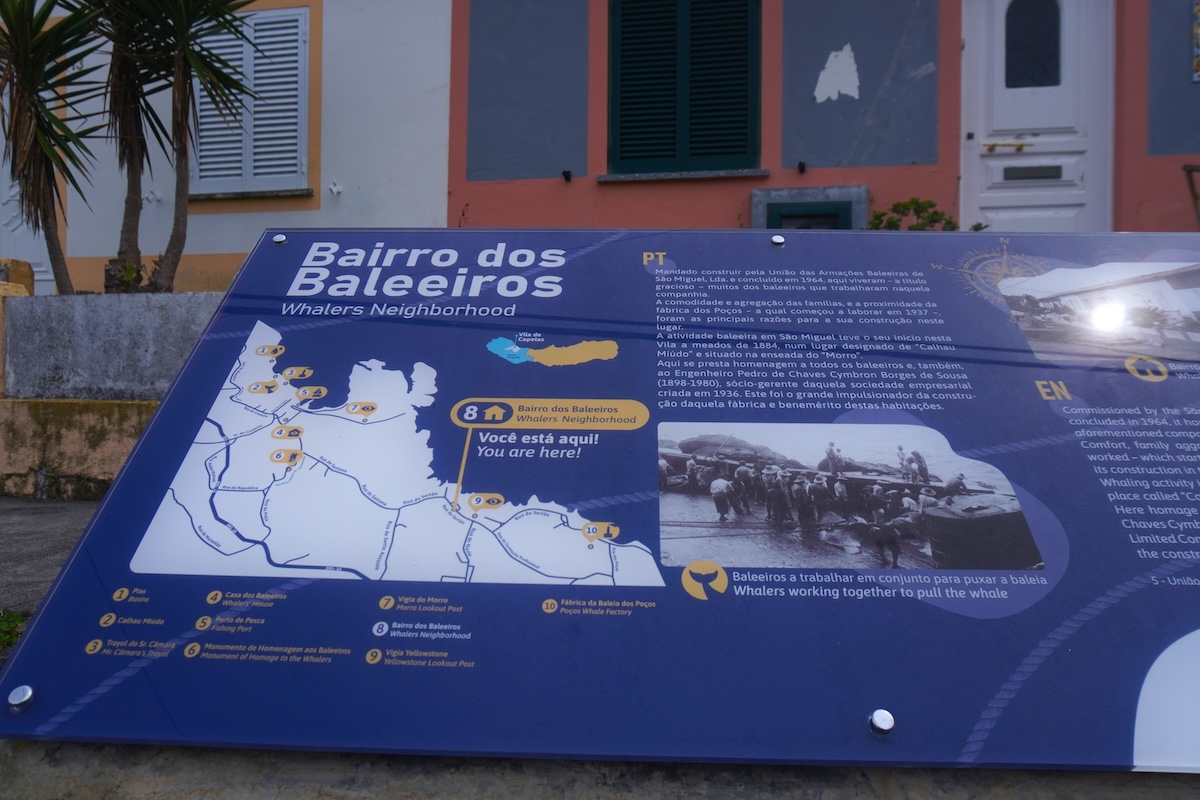
In São Miguel, you can visit the old “Fábrica da Baleia” in Capelas and the surrounding area, which, although it should be a museum, is somewhat neglected, and you’ll simply find a few signs explaining the history.


The most comprehensive museum on the subject is the Museu dos Baleeiros in Lajes do Pico, on the island of Pico, where whaling was most prominent, and the Fábrica da Baleia do Boqueirão on the island of Flores is also very interesting.

It is precisely in the town of Calheta de Nesquim (on the island of Pico) where it is said that whaling began, and the old photographs at the Casa dos Botes (the house where the boats, the whaling boats) bear witness to those years. Today (and fortunately), the boats are used for regattas, and it is very likely that, when visiting Calheta de Nesquim, you will see young people training in the late afternoon. The islands of Pico and Faial usually dominate the regional regatta championships.

Hiking: The Whaling Trail in São Miguel
If you enjoy hiking, you can learn about this history on foot. In São Miguel, the Whaling Trail awaits you—a 3.3-km trail in Capelas, where the whaling industry was most prominent on the island, passing by several must-see sites. You can find all the information about the trail, including its stops and a map, at this link.


Things to See and Do in São Miguel
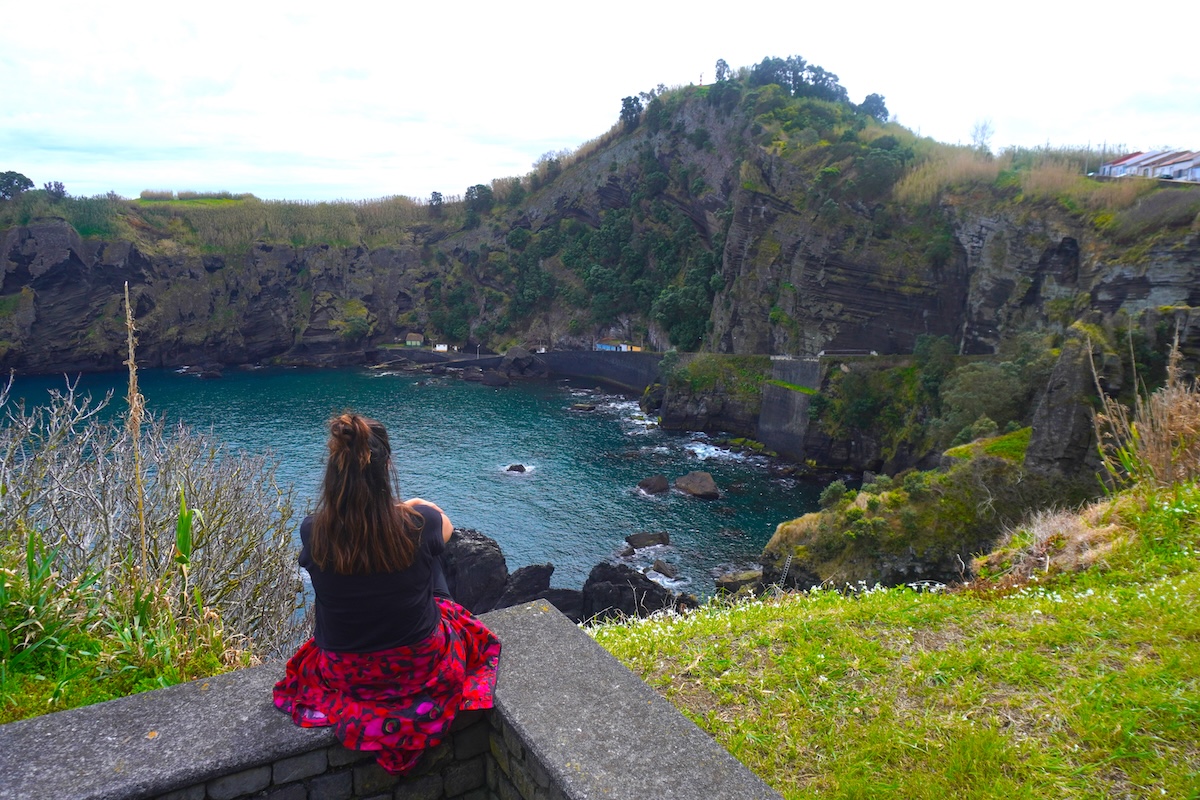
São Miguel is the largest island in the Azores and has so much to offer besides whale and dolphin watching (in fact, we recommend spending at least 7 days there).
Here are some of its top spots and activities, but you can find more in our complete guide to São Miguel:
- Visit some of the archipelago’s most beautiful lagoons, such as Lagoa do Fogo, Lagoa das Sete Cidades, or Lagoa das Furnas
- Visit the village of Furnas, located atop an active volcano and featuring a wide variety of hot springs, drinkable water, fumaroles, and geothermal cooking
- Viewpoints with breathtaking views every few steps
- Incredible trails to explore spots you can’t reach by car
- Winding, green, and (in summer) flower-lined roads
Where to stay in São Miguel
The most common place to stay in São Miguel is usually Ponta Delgada, due to its central location and wide range of accommodations and restaurants. At Randomtrip, we’ve stayed there several times: at Ladeira Loft (a very spacious one-bedroom apartment right in the heart of Ponta Delgada (very close to the Graça Market) with a kitchen and views of the Atlantic); at Hotel do Colegio (a lovely hotel in a 19th-century building with a pool, right in the heart of Ponta Delgada; this was the hotel where Inês stayed with her mother and sister the first time they visited the island, and they loved it); Azores Inn (on our last visit to São Miguel in 2025, we stayed here for three nights. Small, very new, and comfortable rooms, right in the heart of the city (you can walk to every part of the historic center), with a huge shared kitchen (featuring several separate stoves and refrigerators) and a small terrace on the ground floor. It also offers dormitory-style rooms if you’re looking for a more budget-friendly option); or at Hotel Gaivota (we stayed here on our first trip to São Miguel; they have rooms and apartments, some with ocean views, right on Ponta Delgada’s waterfront promenade)
However, the rise in tourism on the island, the difficulty in finding parking, and rising prices are starting to make Ponta Delgada less appealing, and it might be worth considering staying in other areas such as Ribeira Grande, Furnas, Capelas, Nordeste, Povoação…
You can find more information about each area, their pros and cons, the accommodations we’ve stayed at on Randomtrip, and others we’ve noted for future trips in our São Miguel accommodation guide:
Where to Eat in São Miguel
Cuisine is one of the Azores’ strong points, and in São Miguel you’ll find options for every taste. While Ponta Delgada has plenty to offer, prices have been rising and quality/quantity has been declining, so we encourage you to explore the island and try restaurants in other areas. You can see our restaurant recommendations in our complete guide to São Miguel
Recommendations for visiting São Miguel and whale and dolphin watching as a responsible tourist
The Azores are one of the best places in the world for this activity during the April/May season due to the diversity of marine life. The wonder of seeing animals in the wild and in their natural habitat in a respectful and responsible way means you never know what you’ll encounter.
At Randomtrip, we’ve been very lucky at times but not so much on other occasions, so we believe it’s essential to always prioritize animal welfare over human entertainment. Here are our recommendations for this activity, based on our experience:
- Adjust your expectations: while it’s possible to see whales and dolphins year-round and spot many different species, there are no guarantees of sightings at any time of year.
- Be patient:On our tours in São Miguel, we saw several species of whales and dolphins, but 90% of the time we saw nothing, so most of the time is spent observing and waiting. You never know what nature will offer you that day, but remember that just being there is a privilege.
- Never ask the crew to get closer. The captains know the rules by heart, know the boat and the area like the back of their hand, understand the tides and wind, and have spent years observing whale behavior, so listen to them and don’t “insist.” Unfortunately, even though there are regulations to follow, sometimes companies, in an effort to please customers, give in to pressure and bend the rules. Don’t do this, andalways remember to put the animal’s well-being before your own entertainment.
- Be responsible with waste and resource management: Remember the unique and special environment you’re in—don’t throw anything into the sea, and bring a reusable water bottle to avoid buying single-use plastic bottles.
- If you get seasick, we recommend taking a Biodramina tablet 30 minutes before the trip to prevent seasickness and fully enjoy the experience.
- Always follow the whale-watching rules: do not make noise, do not stand up on the boat, and be wary if the tour does not include measures of respect and sustainability (e.g., reduced and constant boat speed and a minimum distance of 50 meters from the animal; avoid having multiple boats within a 300-meter radius of the cetacean group and do not stay with the same animal for more than 30 minutes)
- Do not buy handicrafts made from marine animals or materials extracted from the sea (e.g., dolphin teeth, turtle shells, shark jaws, sperm whale ivory, etc.). The ivory trade, currently the only valuable product from the sperm whale, remains a justification for hunters. Buy local handicrafts made from alternative materials such as wood, stone, or vegetable ivory.
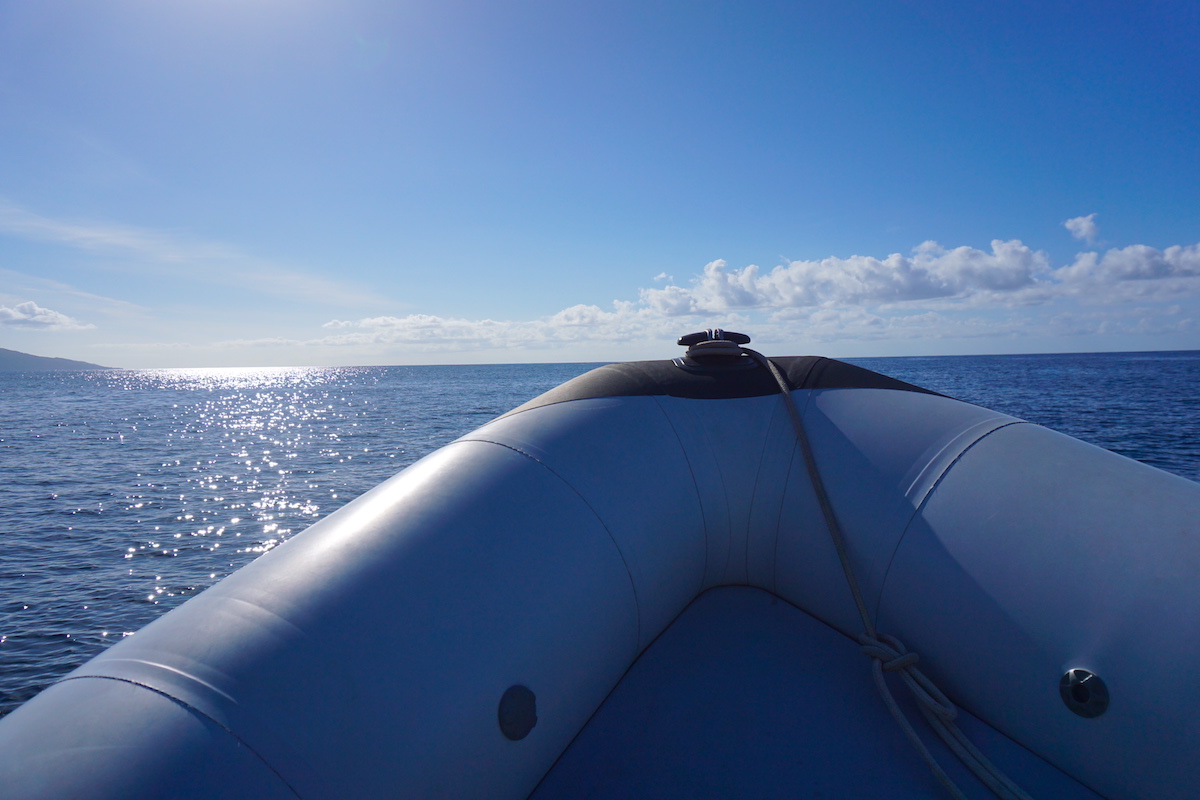
RandomTIP: This was the tour we took with Futurismo, which you can book. In our case, we chose to go on the Zodiac (not the catamaran) for the 8:00 a.m. departure, but it always depends on the day, the season, sea conditions, and, of course, luck.
Checklist for the whale-watching boat tour in São Miguel
Here’s a list of essentials you can’t forget to bring on this whale-watching adventure in São Miguel:
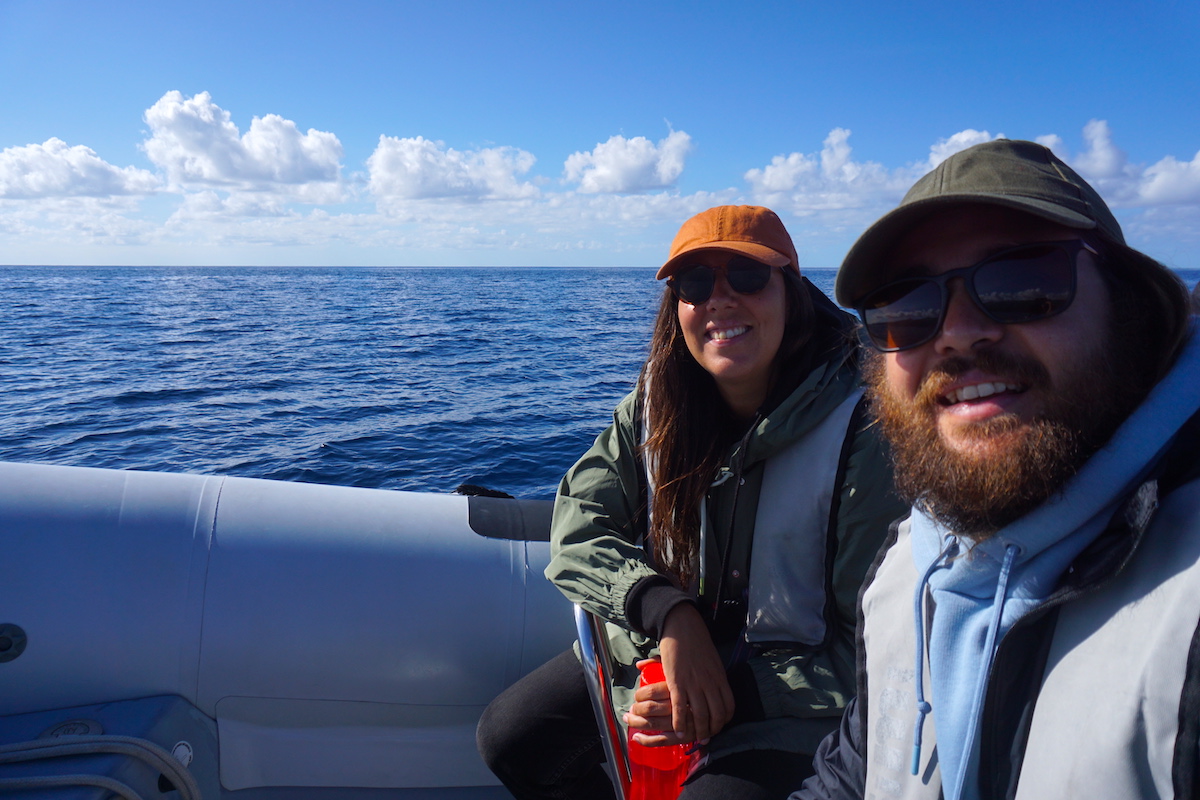
- A reusable water bottle like one of these to carry water with you all the time and void single-use plastic.
- A good camera to register your adventures. At Randomtrip we carry a Sony ZV-E10 and a Gopro Hero12 Black (for underwater pictures)
- A Power bank: taking so many pictures will drain your batteries, so it’s always a good idea to carry a good powerbank. At Randomtrip we travel with these 2 (Anker 20000 mAh and Anker 10000 mAh), which allow us to charge both our phones and our cameras.
- Water Shoes like these ones, ideal for not hurting your feet when entering the water or not touching the ground. Keep in mind that in the Azores you will find lots of volcanic rock pools or pebble beaches so you will want to carry your water shoes at all times to make it easier to enter the water.
- Hiking shoes because the best way to get to know the Azores is by hiking the trails. At Randomtrip we use these Columbia ones.
- Snorkel kit (mask and tube) like this one, a must to take on this trip to contemplate the seabed.
- Water proof dry bag like this one, very useful for keeping your camera equipment, cell phone and wallet safe from getting wet on any boat trip (or even if the tide comes in on the beach).
- Sun screen: always look for a Coral Friendly Sunscreen, i.e. one that protects your skin without harming marine ecosystems by avoiding ingredients such as oxybenzone and octinoxate, which are harmful to corals. Nor that it has been tested on animals.
- Mosquito repellent: like this one, it should have at least 15% deet
- Fast drying towel like this one which doesn’t take a lot of space in your luggage
- A hat or a cap (like this one) and sunglasses to protect yourself from the sun
- Windbreaker waterproof jacket: like this one, to protect yourself from the sudden weather changes in Azores
- First aid kit: In our first-aid kit there is always a medicine against seasickness (such as biodramine for seasickness on boats), antibiotics, anti-diarrhea medication (and a probiotic to recover more quickly), antihistamines, painkillers and antipyretics
- Travel insurance: always travel with travel insurance. We collaborate with different travel insurance companies so that you can get a discount with some of them:
If you want more information for your trip to the Azores, don’t miss our free Randomtrip guide on Things to see and do on the 9 Islands of the Azores:
What are you waiting for to say hello to these beauties in their natural habitat? Book your half-day whale-watching boat tour now for your trip to São Miguel, Azores.