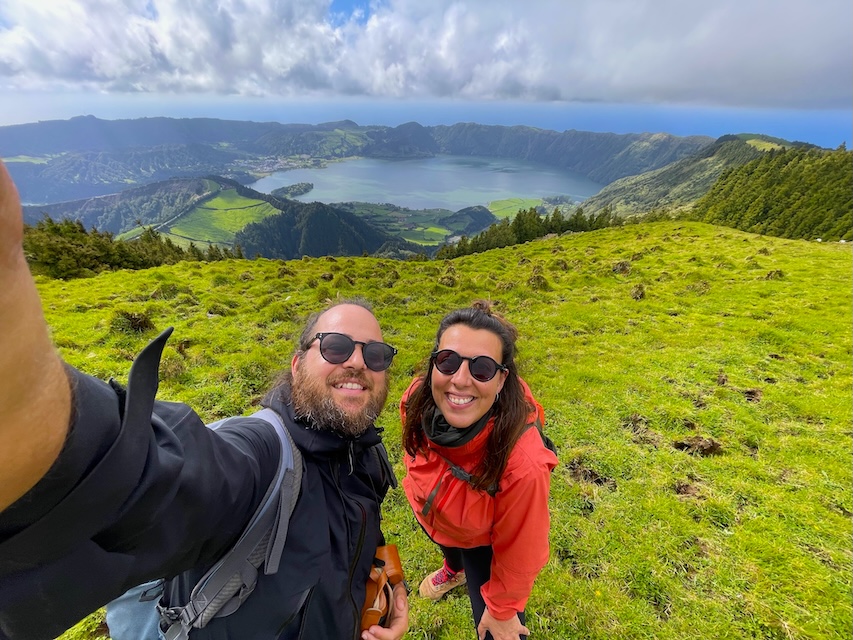
Ponta Delgada, the capital of São Miguel Island—the largest island in the Azores—is an excellent base to stay in due to its strategic location, as it allows you to travel to any part of the island (complete guide to São Miguel here) with relative ease. It’s worth spending not just your stay here, but also a day or two exploring its buildings, squares, and markets—and, above all, getting to know its charming people. Plus, it’s precisely in Ponta Delgada where much of the island’s culinary scene is concentrated, so there are plenty of options for a delicious dinner just steps from your accommodation, before you head to bed after a full day.
Here in the capital, you can also enjoy one of the most popular activities in the Azores: whale-watching where, with any luck, you’ll spot dolphins, whales, and sperm whales in their natural habitat. In this guide, we’ll tell you everything you can (and should) do in Ponta Delgada, where to stay, and, of course, the restaurants we liked best so your trip will be just as incredible as ours was.

Basic Travel Information for Ponta Delgada
Language: Portuguese
Currency: Euro
Population: 67,000 (in 2021)
When to go: Without a doubt, the best time to visit Ponta Delgada (and São Miguel in general) is in the summer due to better air and water temperatures and a lower chance of rain, although winter isn’t very cold (but it tends to rain more). We’ll tell you more (with a table showing climate and rainy days per month) here.
How many days: At least 1 day to explore the capital; 2 days are recommended if you spend a full morning on a whale-watching tour.
How to get there: From Spain, there are direct flights from some cities (such as Madrid, Barcelona, Bilbao, and some Canary Islands) with Sata, Iberia, or Binter, but only during the middle months of the year. However, the most economical option is usually to fly from Lisbon/Porto (with Tap or Sata). Ideally, you should be flexible with your dates and use price comparison sites like Skyscanner and Kiwi.com.
Where to stay: At Randomtrip, we stayed at the Ladeira Loft apartment (right in the center with ocean views), but there are plenty of options for all tastes and budgets in Ponta Delgada. There are more budget-friendly options like the Nook Hostel or the Holy Cow; the legendary Hotel do Colegio on one of the capital’s main streets; the Casa da Graça and the Armazéns Cogumbreiro; or something more upscale like the Azor Hotel with incredible rooms overlooking the Atlantic. More accommodations in Ponta Delgada here
What tours to book: Since São Miguel is one of the best places in Europe for whale watching, in Ponta Delgada we recommend booking a tour with Futurismo, where we’ll get to see (from a distance and in a respectful manner) dolphins, whales (the two largest in the world), and even orcas!
How to get around: In Ponta Delgada, you can reach most places on foot, though to explore the rest of the island, the best option is to rent a car. At Randomtrip, we did it with Autatlantis and loved it: new cars and the best deductible policy. Find your rental car at the best price on this DiscoverCars comparison site. More info on how to get around here
Cost: Starting at €70/day per person (approx.) for flights, car rental, private accommodation for two people (budget options), and meals.
Internet connection: If you are visiting for a few days, your phone supports eSIM and you don’t want to complicate things, we recommend Holafly eSIM (unlimited data, 5% discount with the code RANDOMTRIP) or Airalo eSIM (limited data, but cheaper, 15% discount with the code RANDOMTRIP15). Otherwise, the cheapest way is to get a local SIM (the main companies are Vodafone, Meo and Nos). More info here
Time zone: UTC +0. The time in the Azores archipelago (Portugal) is one hour behind mainland Portugal and the Canary Islands, and two hours behind mainland Spain.
Azores travel insurance
Do you know what cannot be missing in your luggage? A good travel insurance! We are affiliates of several specialized travel insurance companies and you can get a discount in some of them if you book with us:
Appart from the medical assistance in case something happens when you visit Portugal, the insurance can also cover anything that happen while you get into adventures like hiking, kayaking, snorkeling and diving. Also, if something happens to your luggage (damage, theft, delays, losing it) or if your flight is cancelled or delayed (or, if because a delay you lose another connecting flight), a travel insurance can also help
Carefully read the terms and conditions of each policy and hire the insurance that best suits your needs.
Things to see and do in Ponta Delgada
Although it isn’t our favorite Azorean city (Angra do Heroísmo, on Terceira, and Horta, on Faial, have earned their spots as our top picks in the archipelago) because it strikes us as a city poorly designed on a human scale (cars are the undisputed stars of the city, where many sidewalks are too narrow to walk and explore), its beautiful historic center, fantastic restaurants, and views of the Atlantic mean that even after a full day of exploring the island, you’ll still want more.
HEADS UP! Many people confuse Ponta Delgada with São Miguel: São Miguel is the island, and Ponta Delgada is the capital of the island of São Miguel (and also the name of the island’s airport). If you’re looking for information on things to do in São Miguel, check out this link for our complete guide to the island
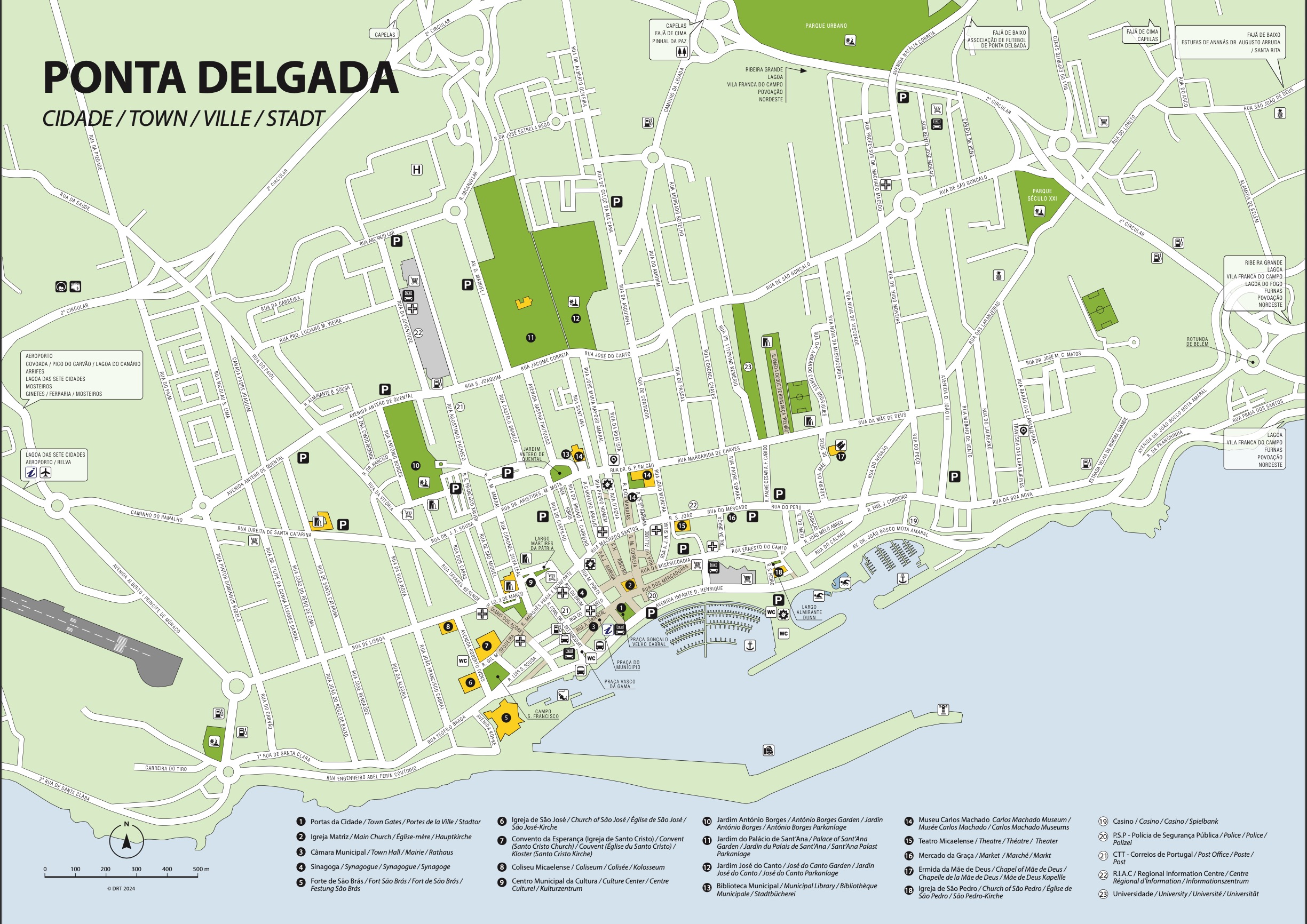
Below is a map and all the points of interest in Ponta Delgada
Map of the city of Ponta Delgada
Here is a Google Maps map with all the points of interest in Ponta Delgada included in this guide, including restaurants. You can save it to your Google Maps app on your phone to consult it during your visit to Ponta Delgada:
Here is also a PDF map of the island that includes a tourist map of Ponta Delgada
Whale Watching
One of the activities you can’t miss in São Miguel is whale watching (dolphins and whales) in their natural habitat, out in the open Atlantic Ocean. In this specific guide, we’ll tell you everything you need to know to do this activity in Ponta Delgada (São Miguel), but the most important thing is to make sure you go with a company that respects sustainability and animal protection rules (maintaining a safe distance between the boat and the cetaceans, etc.). In Ponta Delgada, we recommend booking the tour with Futurismo; the tour departs from their offices here

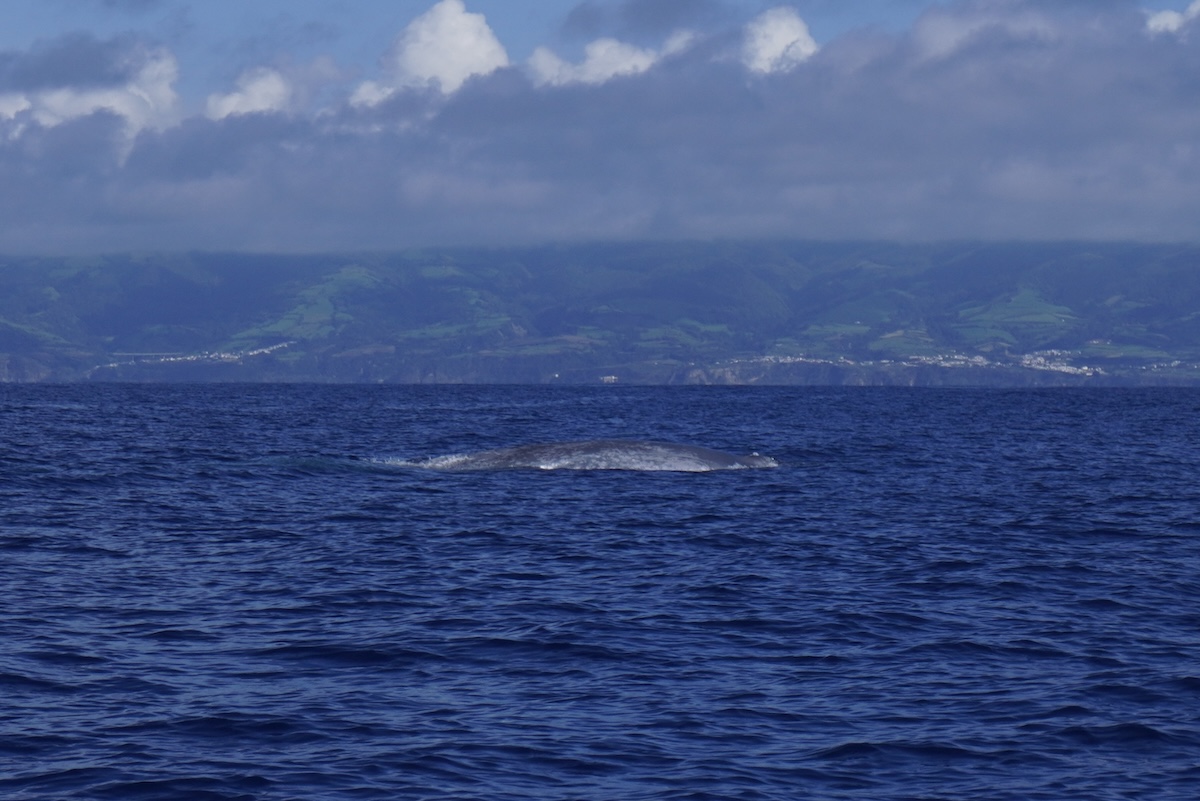
We’ve done this activity three times on the island of São Miguel (and also on the island of Pico), and it never ceases to amaze us. I get goosebumps every time I remember seeing that gentle giant—a blue whale, over 20 meters long—swimming peacefully right beside our boat during my first visit to the island in 2013.
On our latest whale-watching trip in São Miguel with Futurismo, we were lucky enough to see the two largest animals in the world: the blue whale and the fin whale. We were also greeted by curious and playful dolphins, a resident sperm whale, and, as a final surprise,orcas!


On the island of Pico, we were lucky enough to spot three “sardinheiras” (northern right whales), none other than the third-largest whale in the world, and several dolphins (we’ll tell you more about it in the Pico guide). The Azores are a paradise for whale watching, so you know what to do— set aside a morning on your trip for this activity.
RandomTIP: The wonderful thing about observing animals in the wild and in their natural habitat in a respectful and responsible way is that you never know what you’re going to encounter. The Azores are one of the best places in the world to do this activity during this season (March/April) due to the diversity of marine life. At Randomtrip, we were very lucky at times but not so much on other occasions, so we recommend: adjusting your expectations (if you go this season, you’ll likely see cetaceans, but there’s no guarantee you’ll see them or at what distance) and increasing your patience because you never know what nature will offer you that day—but remember that just being there is a privilege. This was the tour we took with Futurismo, which you can book. In our case, we chose to go on the Zodiac (not the catamaran) for the 8:00 a.m. departure, but it always depends on the day, the season, sea conditions, and, of course, luck.
Book your responsible whale-watching tour with Futurismo in Ponta Delgada here
Portas da Cidade
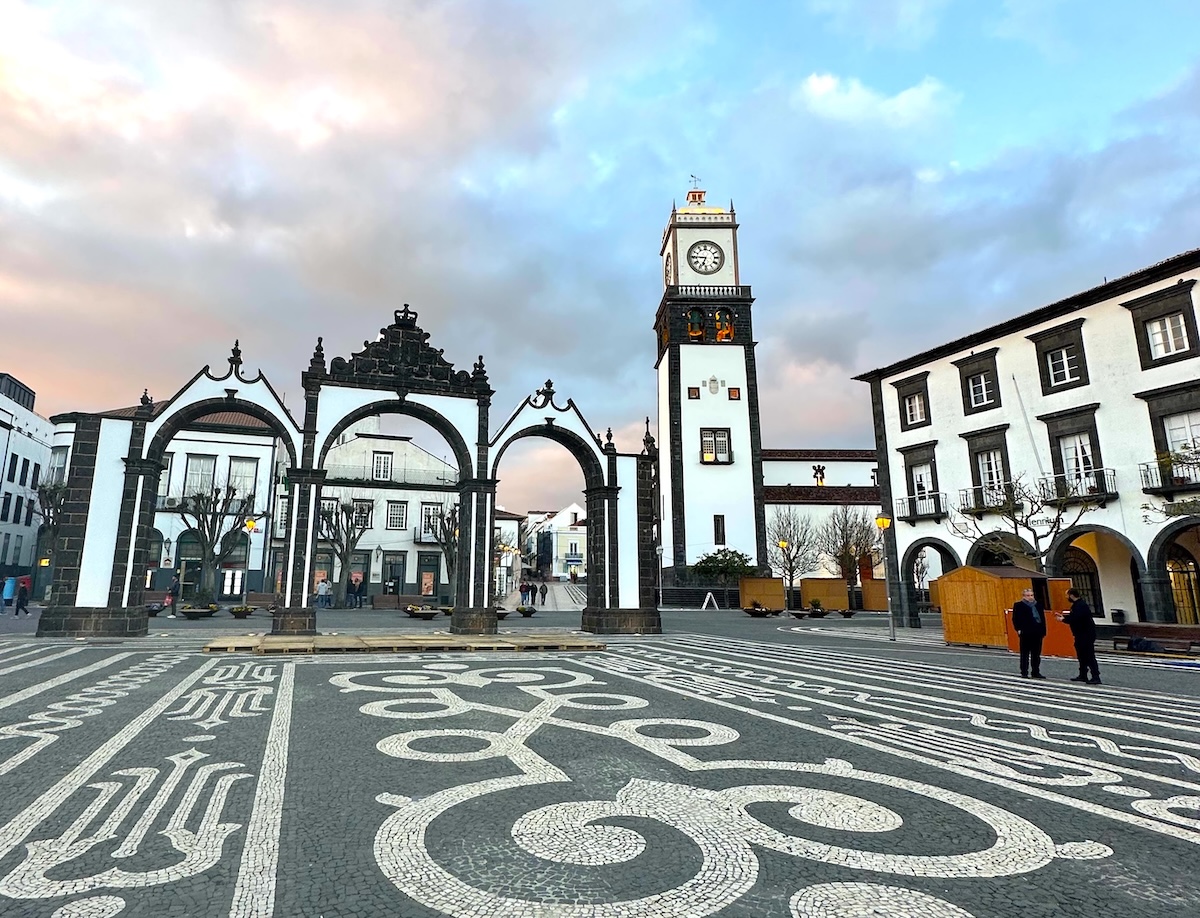
The Portas da Cidade (City Gates) are one of the most important landmarks in Ponta Delgada. This set of three arches was built in the 18th century and is one of the city’s main attractions. The square where they are located hosts various events, such as the Espírito Santo festivities or Christmas decorations.

Torre Sineira and City Hall
The Torre Sineira, also built in the 18th century (more specifically in 1724), is part of the Ponta Delgada City Hall building (or, as it is called in Portuguese: Câmara Municipal). It stands over 30 meters tall and has 106 steps you can climb to enjoy a panoramic view of the city—completely free of charge. Below, enjoy the square in front (Praça do Município), which is quite photogenic.

Largo da Matriz and Igreja Matriz
Behind the Portas da Cidade lie the imposing Igreja Matriz and the square where it stands, Largo da Matriz, which features several terraces and restaurants. This square is the heart of the city, always bustling with tourists and locals looking for a spot on one of its terraces or heading to one of the many restaurants in the surrounding streets.

The Matriz Church of São Sebastião, built in the 18th century, has been remodeled several times since then. Its Manueline and Baroque porticos stand out, as does the gilded wood carving that adorns its naves, chapels, and altars. Inside, it also houses sacred art pieces, statues, gold, and vestments of great value.
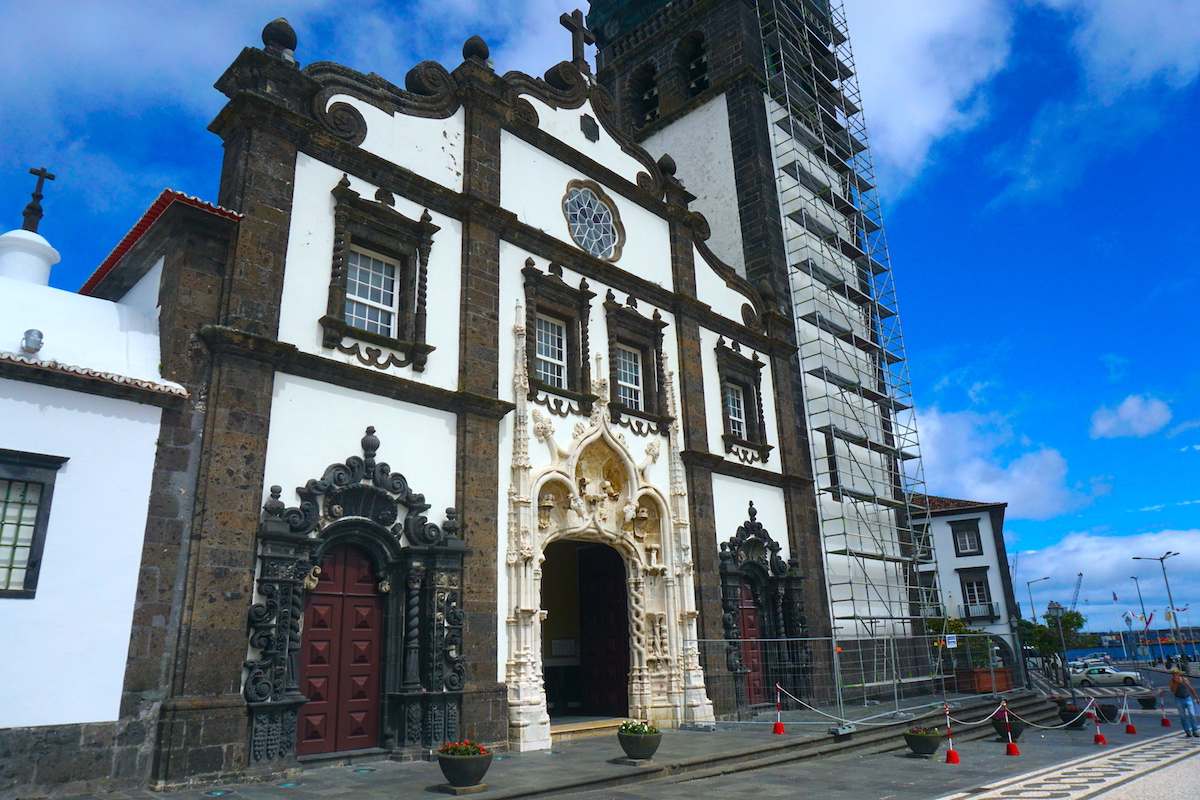
As a fun fact, the clock at the top of the church tower was a gift from a wealthy merchant from Ponta Delgada, who donated it to the city in the 19th century.
Church of São José
The Church of São José, located in Campo de São Francisco Square, was built in the 16th century as part of an old Franciscan convent. After several renovations and alterations, the church we see today was constructed in 1709, with the first Mass celebrated in 1714.
If you’d like to see the interior, it’s best to visit (respectfully) before or after Mass to appreciate its gilded altarpieces and tile panels.
Forte de São Bras
Forte de São Bras is the island’s most important defensive structure and also houses the Azores Military Museum. It was built in the 16th century and has witnessed numerous tales of pirates and privateers.
If you’d like to visit the museum, it’s open daily from 10 a.m. to 6 p.m., and admission is €3.
Coliseu Micaelense
The Coliseu Micaelense was the cultural epicenter of the island: built in 1917, it went through several phases, beginning its decline in the 1980s (when it was used almost exclusively for the traditional Carnival Dances, eventually closing down). The city council purchased it in 2002, and after restoration work, it reopened to the public in 2005, reviving the Carnival Dances and offering a schedule of performances.
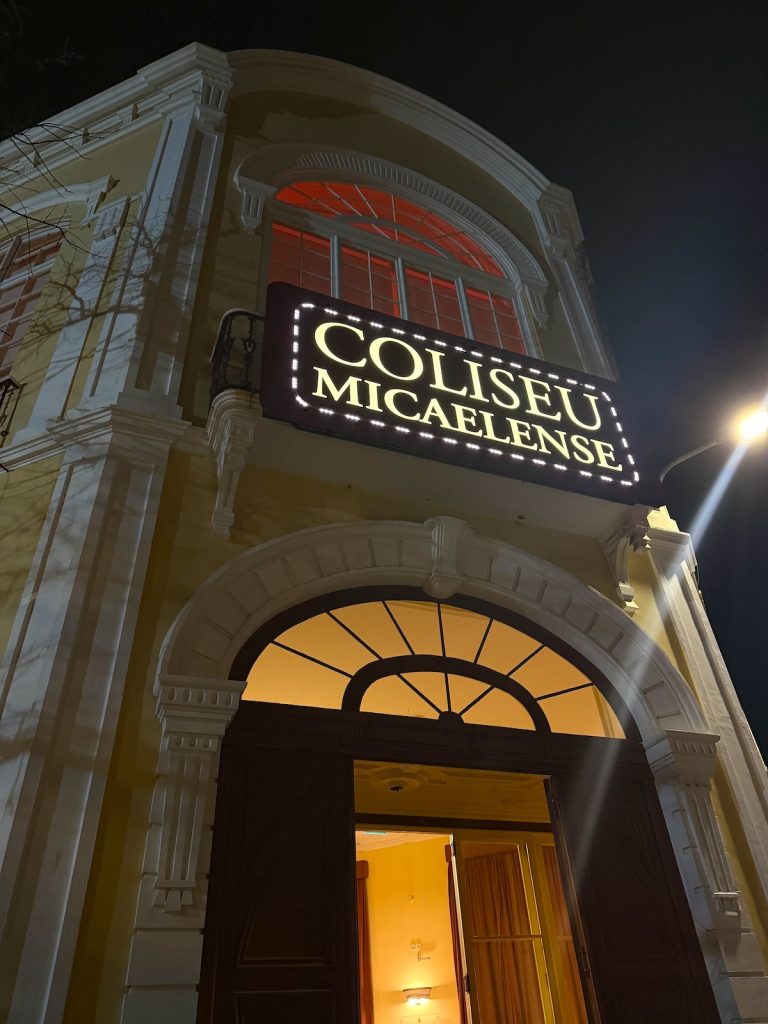
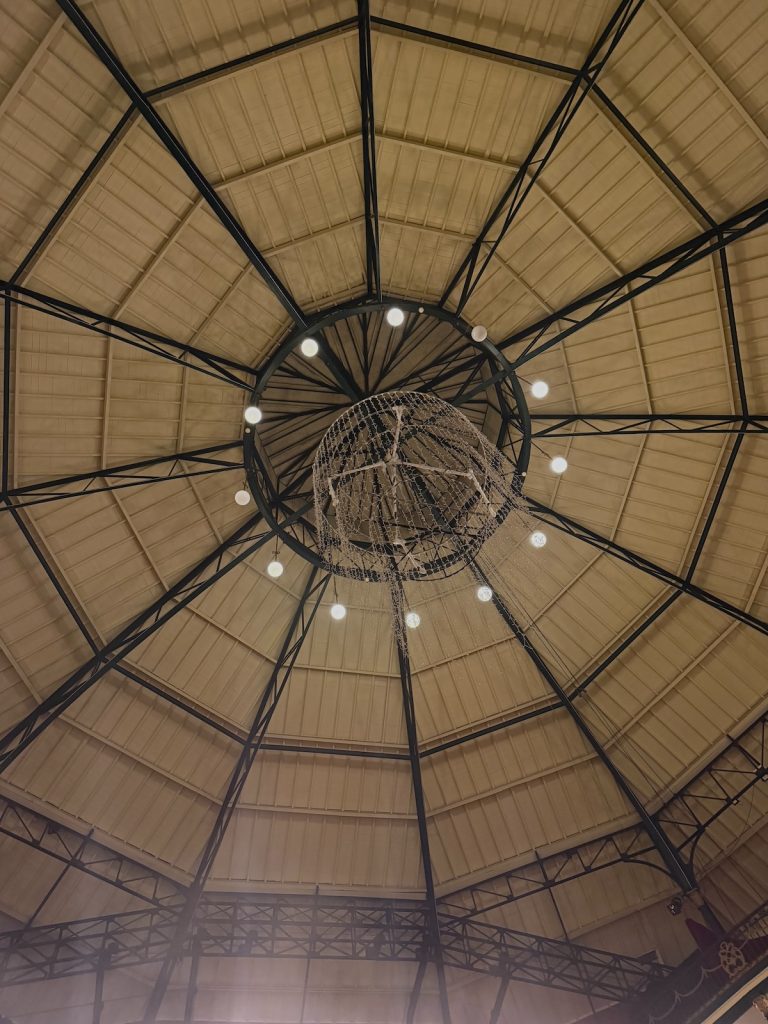
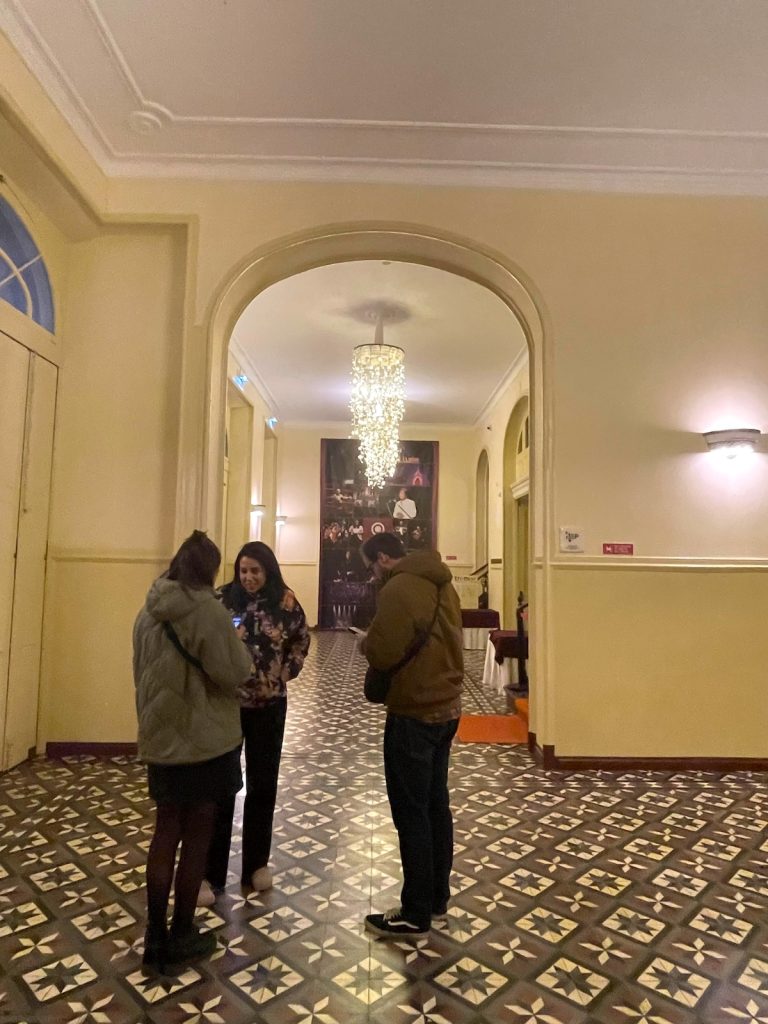
It has a seating capacity of about 1,300 people, and in addition to the main hall, it also features other spaces such as the entrance hall and the upstairs lounge. If you want to go inside, you’ll need to buy tickets for one of the shows (you can check the schedule here)
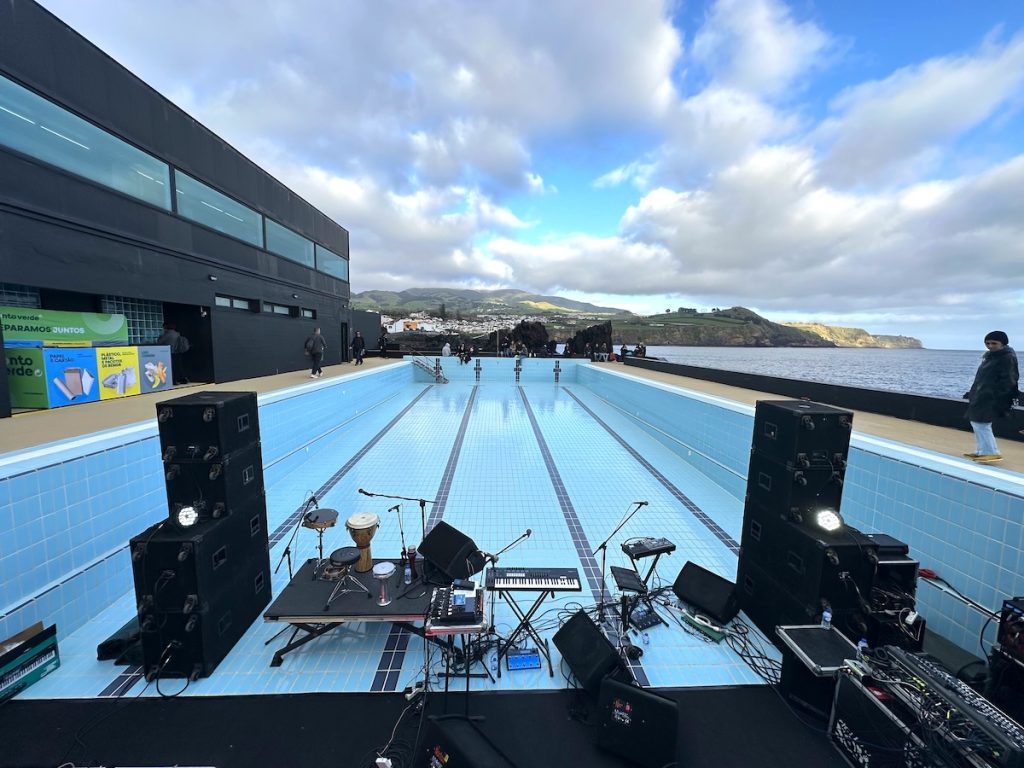
While at Randomtrip, we had the chance to attend several concerts and DJ sets during our time at the Tremor Festival; you can read more about it here and in our complete guide to São Miguel
Padre Sena Freitas Garden
During your stroll through Ponta Delgada, you can take a break at the small Jardim Padre Sena Freitas, built as a tribute to an important priest from the island.
For a longer break, we recommend the city’s other gardens, which we discuss below.
António Borges Botanical Garden
The Jardim Botânico António Borges is a public garden with a café/restaurant inside (serving healthy, delicious food and non-alcoholic cocktails), a very pleasant spot to take a stroll or have a drink.
Admission is free, and hours vary by season (9 a.m. to 6 p.m. in winter, 9 a.m. to 9 p.m. in summer).
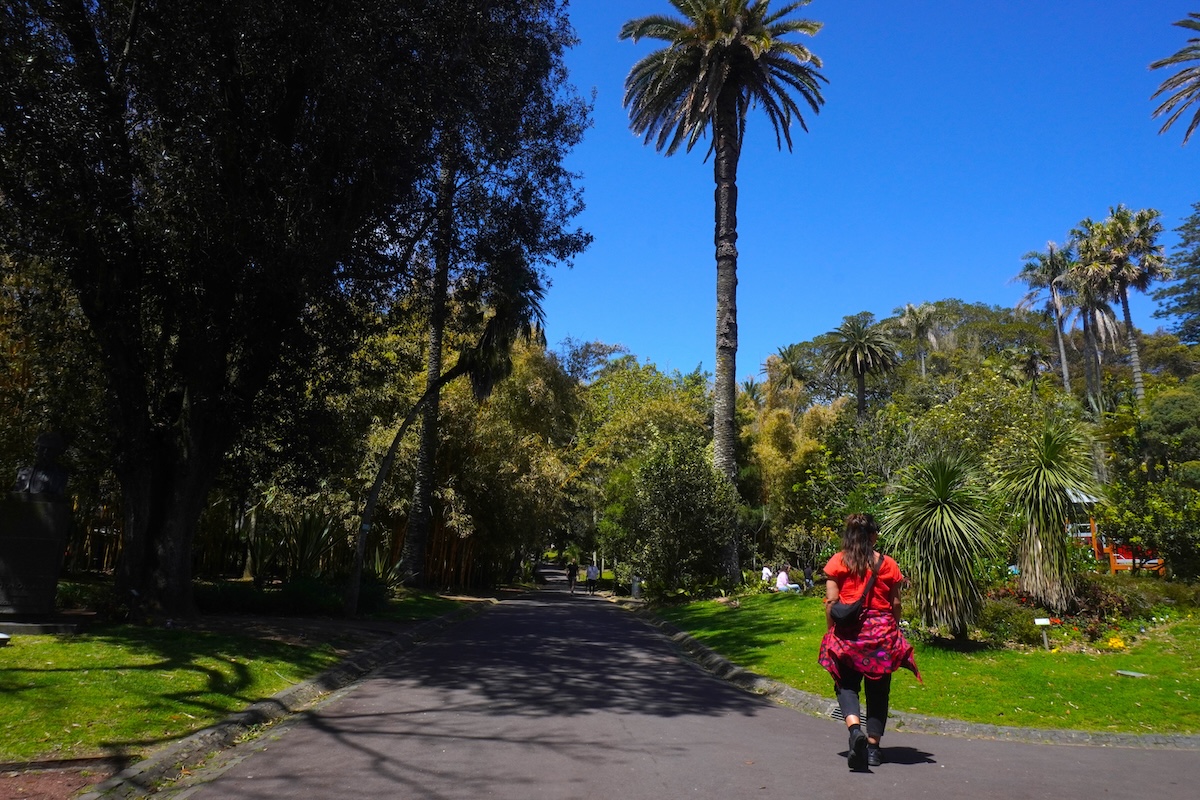
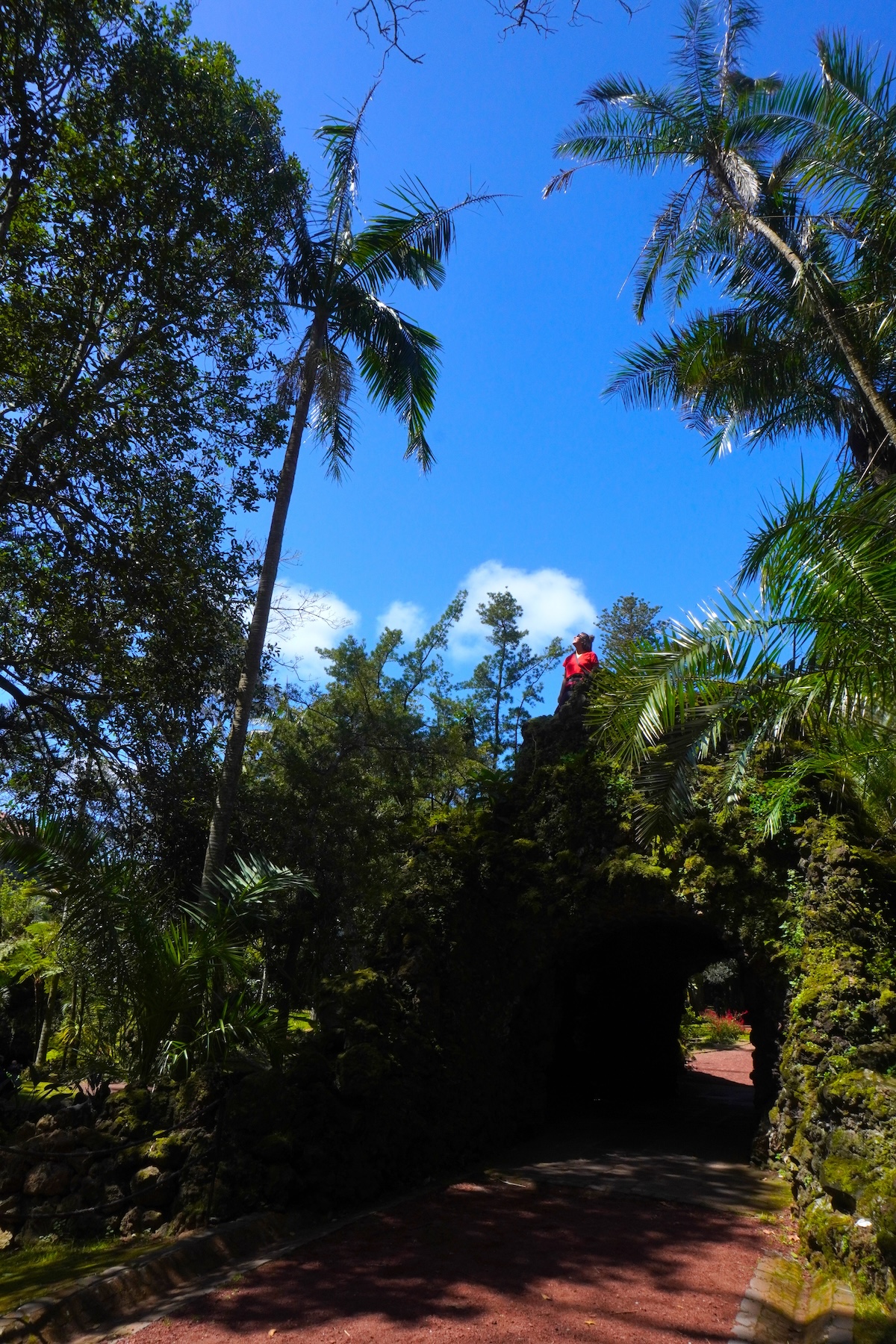


It’s a peaceful oasis in the center of Ponta Delgada. It features tunnels and man-made bridges, built with red lava stone, which offer the chance to take some beautiful photos, and there are some free-roaming animals (ducks, roosters, etc.).
Jardim Antero de Quental and Largo do Colégio
Another garden where you can stop to rest in the center of Ponta Delgada is the Jardim Antero de Quental, a tribute to the São Miguel poet Antero de Quental, one of the leading figures of 19th-century Portuguese literature. You can take the opportunity to have a drink (such as one of the cocktails they make with pineapple) at the red kiosk:


Next to the garden is Largo do Colégio, where you can admire the Igreja do Colégio and its imposing Baroque-style façade carved from dark volcanic stone, which contrasts with the white paint. Inside, the main altarpiece (an incredible gilded Baroque carving) and the tile panels stand out. Additionally, since 2006, it has been part of the Sacred Art collection at the Carlos Machado Museum. You can check the hours and prices on the museum’s official website.
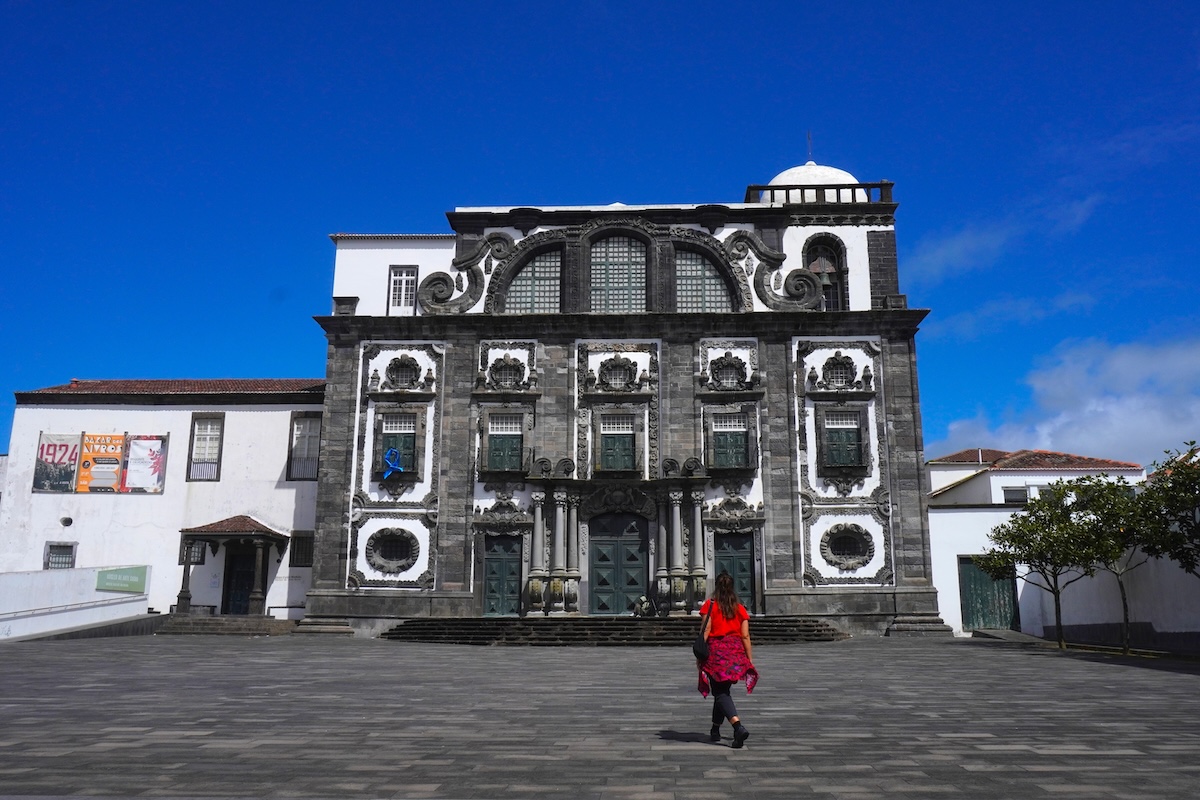
At Randomtrip, we had the privilege of attending a viola da terra concert inside the church—an incredible experience—as part of the Tremor festival program.
O Quarteirão – Art District
O Quarteirão – Art District is an area of Ponta Delgada with restaurants, clothing and artisanal shops, art galleries, and more—the perfect place to spend a few hours exploring. You can view the complete list of businesses on this map


Jardim de Sant’Ana and Palácio de Sant’Ana
The Jardim de Sant’Ana, located next to the Jardim Botânico José do Canto (which we’ll discuss below), is a slightly more “exclusive” garden, as it forms part of the Palácio de Sant’Ana and serves as the seat of the Regional Government Presidency as well as one of the official residences of the Regional Government President.
The Palace and Garden were built by José Jácome Correia, a landowner and member of an aristocratic family from São Miguel, in the 19th century, during the boom in orange cultivation and export on the island. The building was purchased by the regional government in 1978 and designated as the official seat of the regional presidency in 1980
The garden is open to visitors Tuesday through Sunday, from 10 a.m. to 4 p.m., and admission is €2
José do Canto Botanical Garden
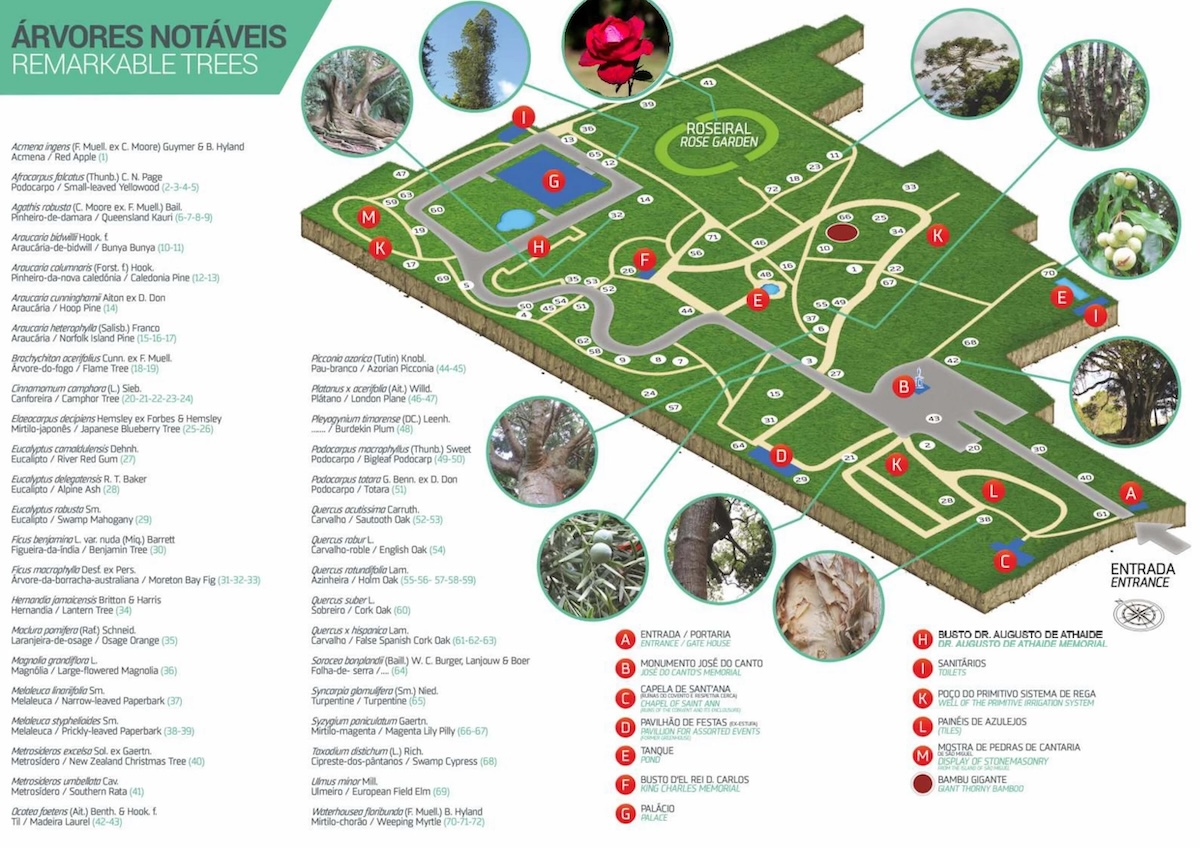
The José do Canto Botanical Garden is a botanical garden featuring various species from all over the world as well as endemic plants, a church, and a waterfall. The garden was started by its owner, José do Canto, in the 19th century and has been open to the public since 2014.


Opening hours are from 9 a.m. to 7 p.m. in summer (April to September) and from 9 a.m. to 5 p.m. in winter (October to March), and admission is €5 per person. The grounds are large, so if you’re interested in paying the admission fee and visiting, plan to spend at least an hour exploring it.
Here you can view the official brochure with a map of the garden and some of the most notable trees:
Carlos Machado Museum
The Carlos Machado Museum was founded by Dr. Carlos Machado in 1876. Initially, it was a school museum designed to spark curiosity about natural history among children, but over time, it gradually attracted the interest of the scientific community.
It’s important to note that the museum currently has four núcleos or locations:
- Núcleo de Santo André: located in the former Convent of Santo André, where you can learn about the convent’s history and natural history (featuring many real animals preserved through taxidermy)


- Núcleo de Arte Sacra: located in the Colégio Church (which we mentioned earlier in this guide), where you can view paintings and sculptures from the 17th and 18th centuries, including the standout piece “Coroação da Virgem” by Vasco Pereira Lusitano (1535–1609), painted in Seville in 1604, and paintings depicting stages in the life of St. Francis Xavier, attributed to Bento Coelho da Silveira (1620–1708).
- Núcleo de Santa Bárbara: located in a former 17th-century “retreat.” This section is dedicated to culture and remembrance. Unfortunately, when we visited, it was closed for exhibition maintenance.
- Núcleo da Autonomia dos Açores: located in the Palácio da Conceição, this wing focuses on the history of the Azores’ autonomy as a region.
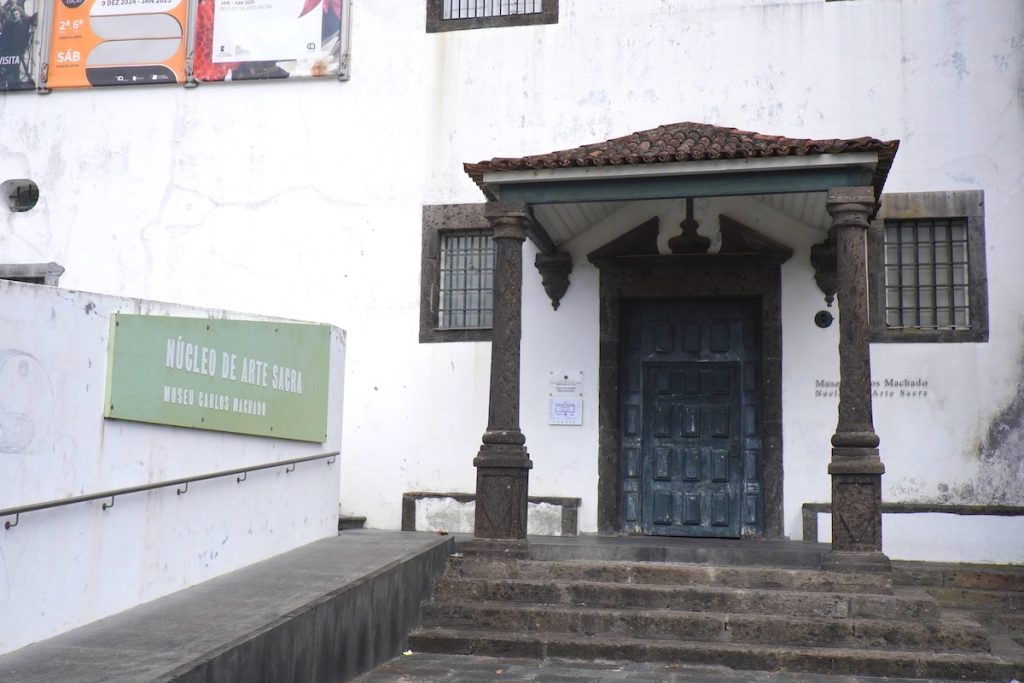
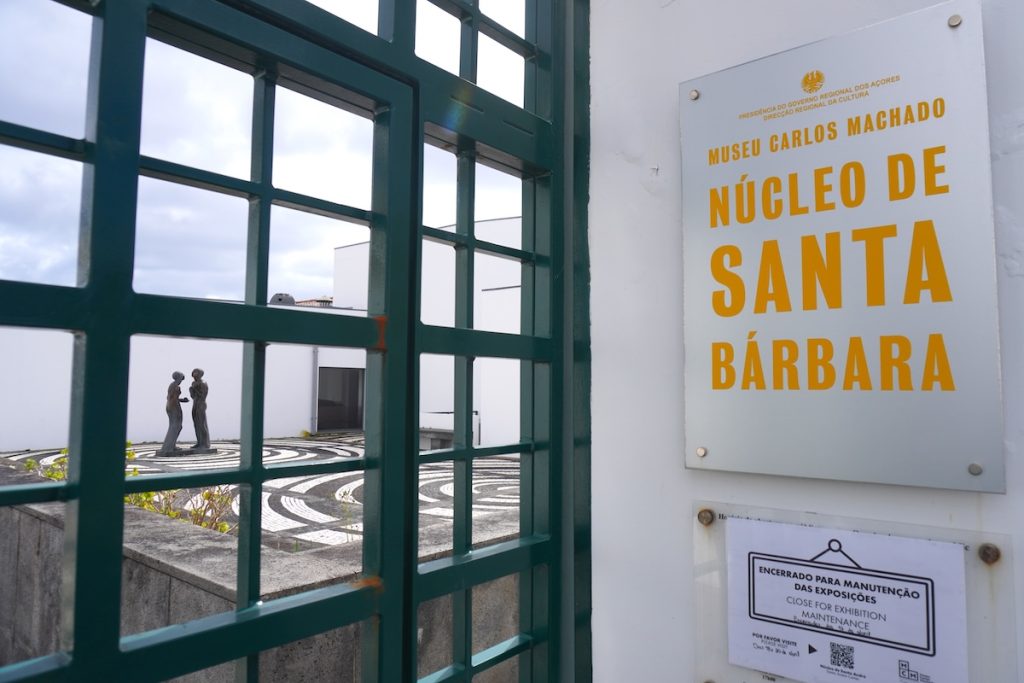
Hours vary by site and by time of year:
- Arte Sacra, Santo André and Santa Bárbara (closed on Mondays):
- Winter (October 1 to March 31): 9:30 AM to 5:30 PM (last admission at 5:00 PM)
- Summer (April 1 to September 30): 10:00 AM to 6:00 PM (last admission at 5:30 PM)
- Autonomia dos Açores:
- Monday through Friday from 10:00 AM to 5:00 PM (last admission at 4:30 PM)
- Last Sunday of every month from 3:00 PM to 6:00 PM
Admission to each site is €2 (except for the Núcleo da Autonomia dos Açores, which is free), and you can purchase a ticket for the other three sites for €5 (valid for one day only, in case you want to visit them all)
Teatro Micaelense
Over 70 years old and inaugurated in 1951, the Micaelense Theater is the city’s leading cultural promoter. Here you’ll find plays, film series, dance performances, poetry readings, and various cultural programs. In fact, it hosts some of the events of the Walk & Talk, one of the best arts festivals in the Azores, which is usually held in July.

Graça Market and Rei dos Quejos
Something we always enjoy doing on our trips is visiting local markets, and when we stay in an apartment, we take the opportunity to buy local fruits and vegetables, so at the Mercado da Graça in Ponta Delgada was no exception. If you visit the island in the summer, you can try buying Meloa (cantaloupe) from the neighboring island of Santa Maria and pineapples grown in greenhouses near Ponta Delgada using a method unique in the world.

In addition, there’s a very special shop at the market: the Rei Dos Queijos, featuring cheeses and butters from all the islands in the archipelago (if you can, try the “Rainha do Pico” butter from the island of Pico, or the one from the island of Flores, though the latter isn’t always available due to its small-batch artisanal production). They also have bread (you can’t leave the Azores without trying Bolo Lêvedo) and other local products. Another similar option for buying cheeses and butters is Principe dos Queijos, right in the center, which we liked even more.

Church of São Pedro
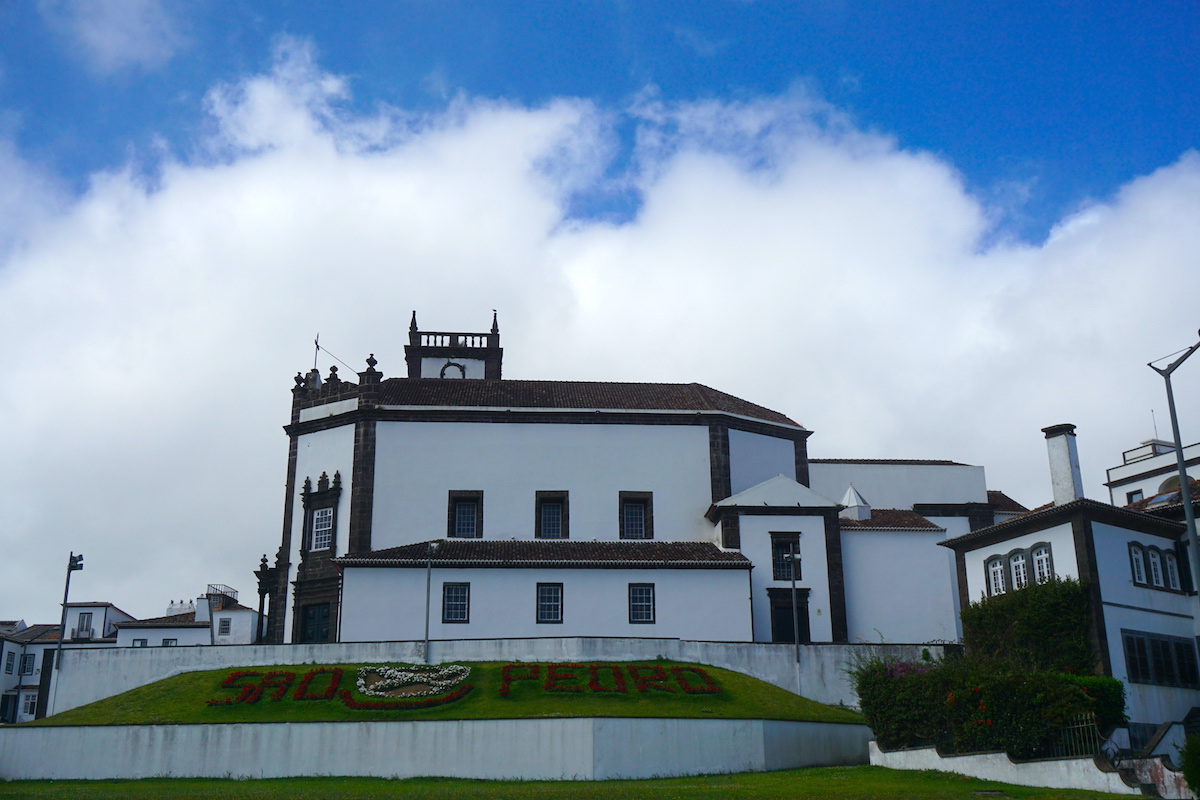
What caught our attention most of all was its location, as the church sits atop a small hill of the same name. The Church of São Pedro dates from the 18th century, during the Portuguese Baroque period, a style evident in the entrance portico, the columns, and the gilded wooden altar. If you’re able to go inside, you’ll find that all the walls of the church are covered with paintings, including the ceiling.
Portas do Mar and Piscinas do Pesqueiro
The Portas do Mar (Gates of the Sea) is a newly developed area with restaurants, parking, shops, etc., designed to serve as a cruise ship stopover. It’s not our favorite area, but if you’re looking for a place with plenty of dining options, where you can stroll along the waterfront or even take a dip in the summer right in the heart of the city at the Piscinas do Pesqueiro, this is the spot for you.

Ermida da Mãe de Deus
The Ermida da Mãe de Deus is located on a hilltop and features a viewpoint, the Miradouro da Ermida da Mãe de Deus, from which you can enjoy views of the city. Climb the stairs, walk through the garden surrounding the chapel, and stop by the information panel to learn about what you’re seeing, including nearby landmarks, as well as the chapel’s geographical and geological details.
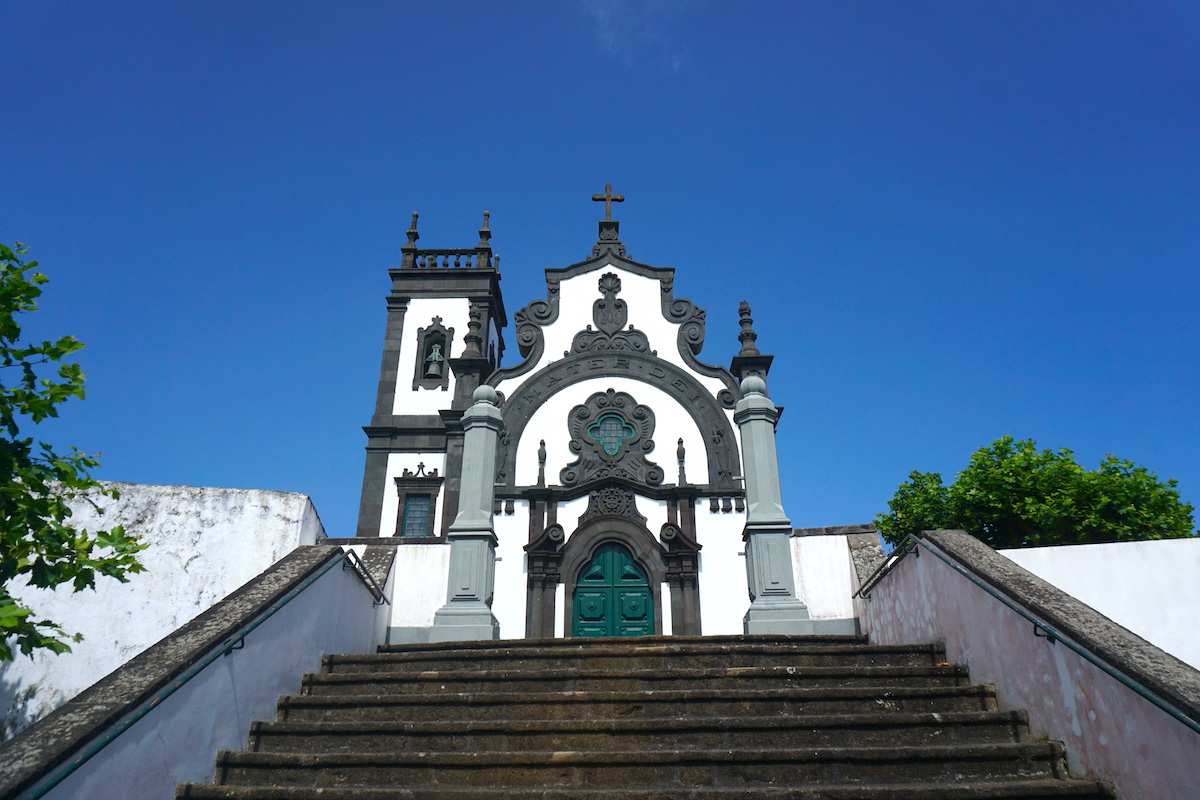
In addition to the views, this chapel has many stories to tell. Although it was originally a 19th-century chapel, during World War I, in 1915, the chapel was demolished so it would not serve as a target for German submarines. Reconstruction began in 1925, and it was still unfinished when, in 1942, during World War II, it was occupied by Portuguese troops to facilitate surveillance of the city’s port. It wasn’t until 1947 that the structure we see today was completed—a 20th-century chapel featuring Neo-Baroque Renaissance religious architecture.
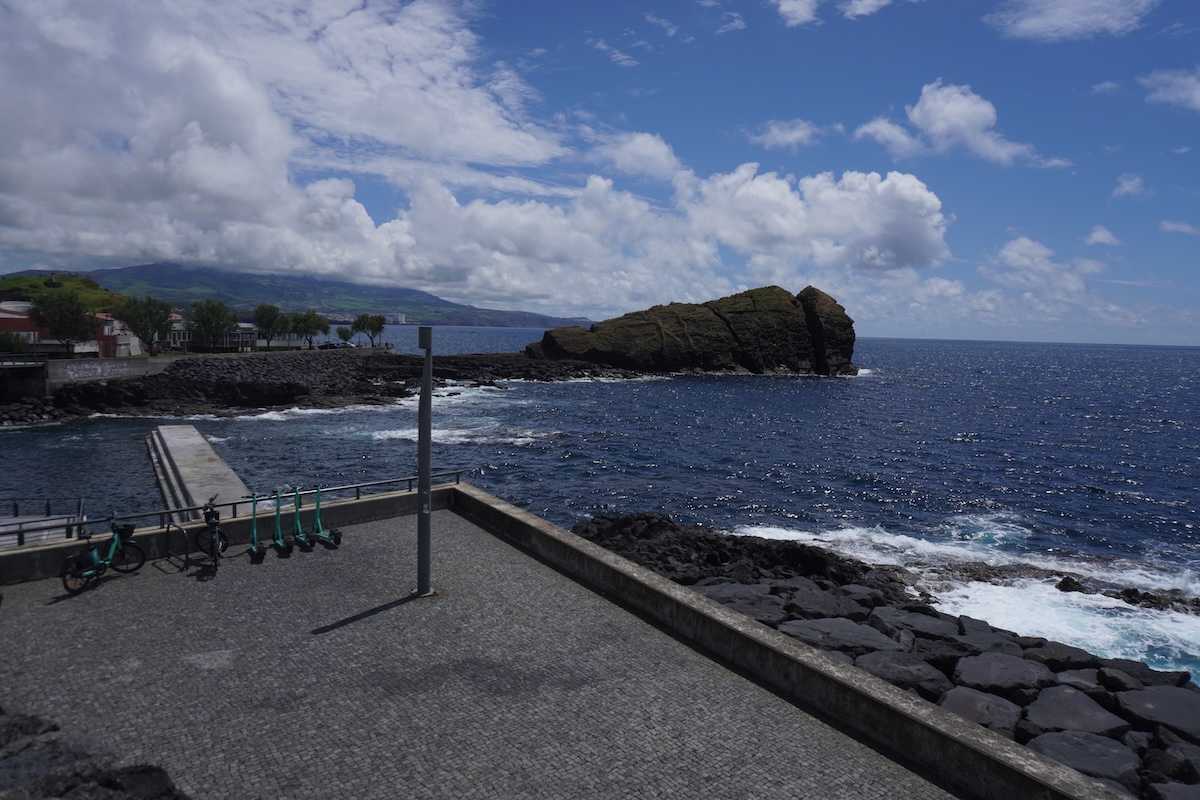
Rosto de Cão
This islet (so named even though it isn’t really one because it’s connected by land and is therefore a peninsula) is called this because they say it resembles a dog (though in our case we see more of a shark’s head). What do you see?
If you pass by Rosto de Cão and you’re hungry, don’t hesitate to grab lunch or dinner at one of its restaurants (O Galego, Cais 20…)
Don’t hesitate to also stop by and see the “Ilhéu do Rosto de Cão” from the viewpoint:

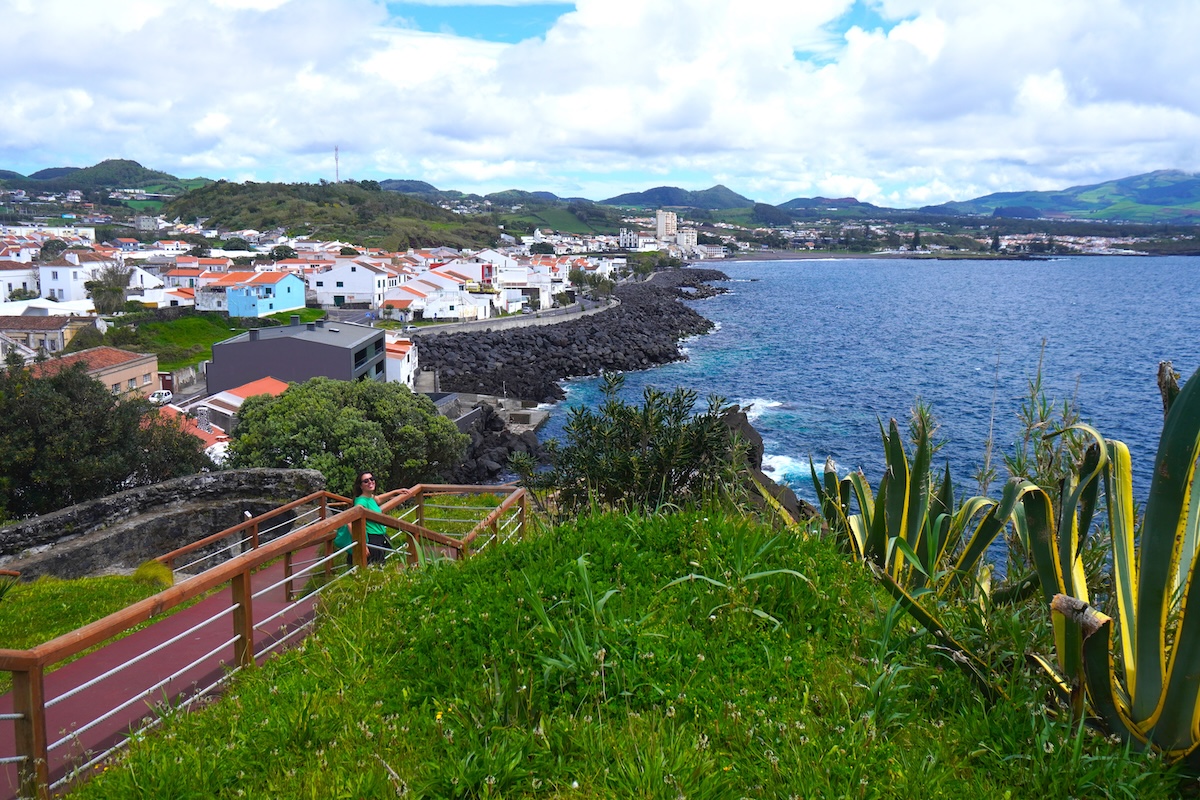

Strolling along the sea (between Forno de Cal and Forte de São Brás)
We think it’s a great idea to take a leisurely walk from the center, between Forno de Cal and Forte de São Brás. If you prefer, you can do it by bike using the Atlantic Bikes app.

Near Forno de Cal is the restaurant where you can sample the best (or perhaps the very best) “bife à regional” on the island, at O Galego. If you can, do as we did on Randomtrip: after visiting “O Galego,” there’s nothing better than a stroll with views of the sea.
Gruta do Carvão (lava tunnel)
Don’t confuse the name with the famous Algar do Carvão, a unique volcano in the world that you can explore from the inside, as that one is located on Terceira Island (and we tell you all about it here). The Gruta do Carvão is located near Ponta Delgada, the capital of São Miguel, and is the largest lava tube on the island, stretching 1,912 meters across three sections, of which only the northern section—Paim—is open to the public.

Geologically, the Gruta do Carvão is part of the Picos Volcanic Complex and is estimated to be between 5,000 and 12,000 years old. Inside, you can observe a wide variety of geological structures, such as lava stalactites and stalagmites and secondary amorphous silica stalactites.
To explore this enormous lava tube from the inside, a guided tour is required, and you must book in advance ( by phone at +351 96 139 70 80 or by email at grutadocarvao@amigosdosacores.pt). The admission price is €10 per person.


In our case, we were in a group of 15 people, and our guide, Rodrigo, was incredible. The cave’s name has nothing to do with coal (which isn’t there) but rather with the color of the rock, which resembles it. It’s a cave very close to the surface, and the tour lasts about 50 minutes (longer tours of 2–3 hours are available; contact them for more information).

Pineapple Plantations and the Pineapple Culture Interpretation Center
The pineapple (ananás, in Portuguese) is one of the island’s symbols (in fact, the greenhouse cultivation method in São Miguel is unique in the world, using glass greenhouses to try to replicate the climatic conditions of the fruit’s place of origin, South America) and is featured in many of the activities you can do on the island.

To learn more about pineapple cultivation on the island, the best place to go is the Pineapple Culture Interpretation Center (free admission, open Monday through Friday from 9:00 AM to 12:30 PM and from 1:30 PM to 5:00 PM)


You can also visit some of the plantations; here are a few options, all free of charge:
- Plantação de Ananás dos Açores: They have several pineapple greenhouses where you can learn about the process using QR codes along the walkway, and where you can also sample some products (for a fee) such as pineapple liqueur, pineapple beer, pineapple cake… At Randomtrip, we tried fresh pineapple and pineapple beer—everything was delicious
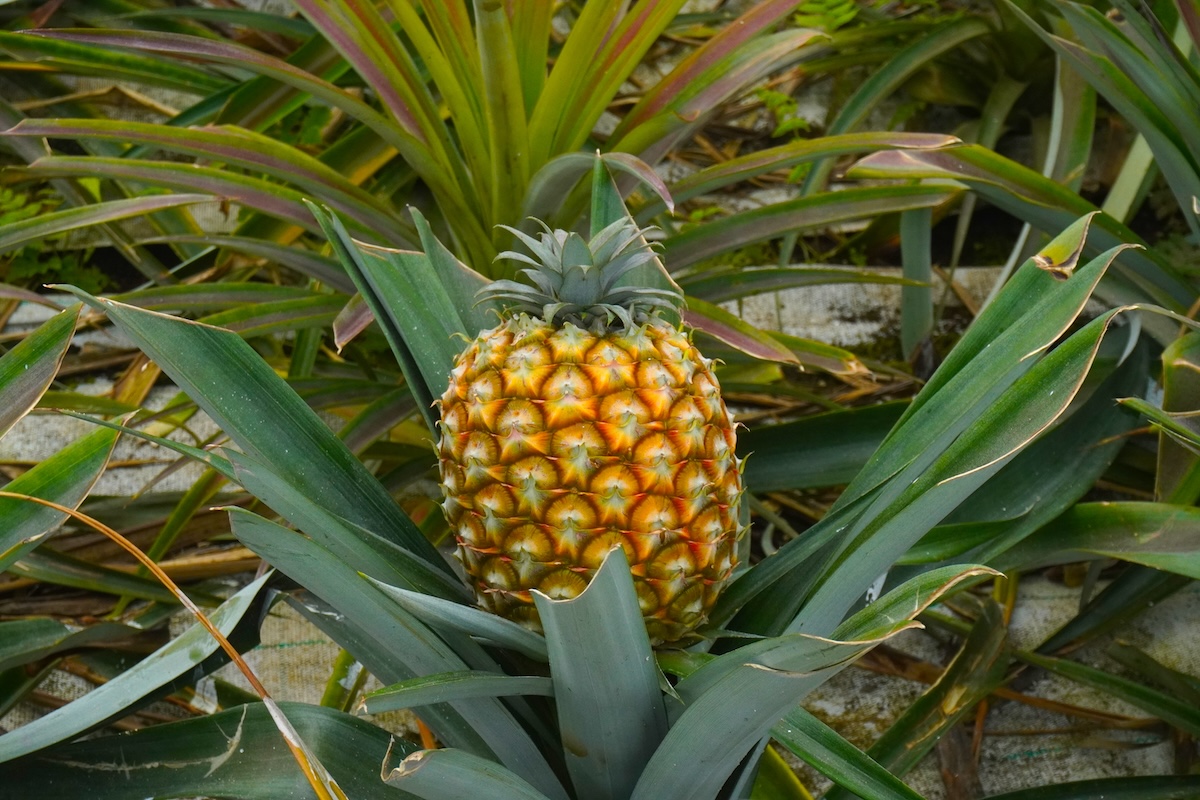


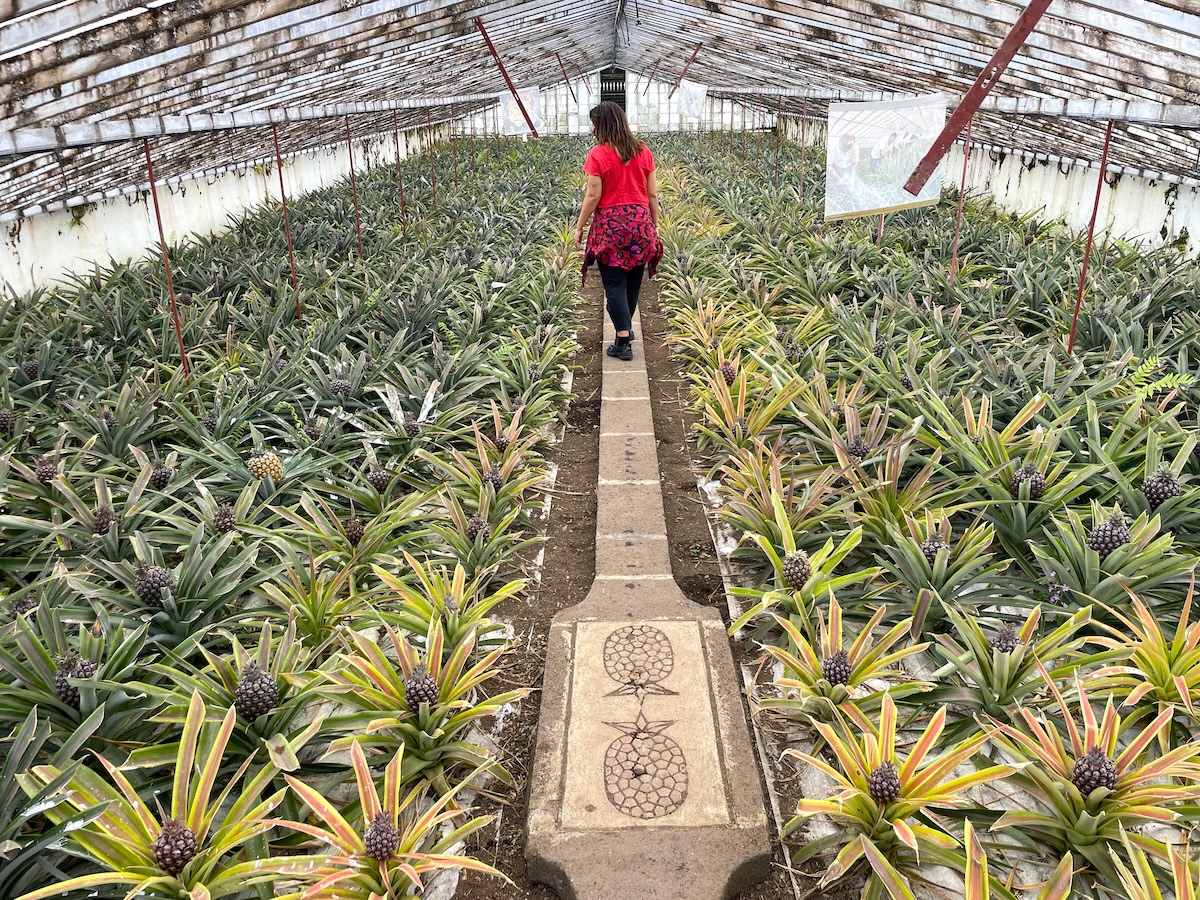
- Ananás Santo António: They offer a short, free guided tour where they’ll explain the history of how pineapples came to São Miguel and the cultivation process (all done by hand and using traditional methods)


- Ananases A Arruda: This is the most well-known and touristy option; they also offer a free tour of the greenhouses and sell a wide variety of pineapple-based products. Since we were trying to avoid the crowds, we decided to visit the first two, and we highly recommend them.
Plus, in São Miguel, even the traditional Three Kings’ Cake is made with pineapple! It’s known as malamanhado and is an adaptation of the typical Christmas cake, filled with pineapple jam and egg custard. You can try to find it at A Colmeia. They also told us about the pineapple flan with cheese, the famous dessert at the restaurant Anfiteatro.
On the other hand, at Herdade do Ananás , the experience is different. Here you can enjoy an Ayurvedic massage among pineapple plantations (with the delicious scent to match, of course). Perfect for a romantic surprise: the massage can be enjoyed as a couple.
At the 18th-century estate of the Senhora da Rosa Tradition & Nature hotel, you can even swim amidst pineapple plantations, as there is a heated indoor pool in one of the greenhouses.
And finally, at Mulher do Capote, in Ribeira Grande, you can sample a pineapple gin. The Goshawk Azores Gin is a gin distilled with pineapple liqueur, and as gin lovers, we were left wanting to try it.

In Ponta Delgada, we recommend the excellent rooms at Hotel do Colegio, the Ladeira Loft apartment, or the charming Armazéns Cogumbreiro, all right in the heart of the city. More accommodations in Ponta Delgada here.
Things to do around Ponta Delgada
Just a short distance from Ponta Delgada, you’ll find beaches, natural pools, coastal trails, and even a unique experience for gin lovers! Here are a few ideas for things to do near the capital (for everything else, check out our complete guide to the island of São Miguel):
- Praia das Milícias and Praia do Pópulo are the two beaches closest to Ponta Delgada and are very popular with locals due to their easy access, water quality, and amenities. At Randomtrip, we visited Milícias in the middle of July and were pleasantly surprised.

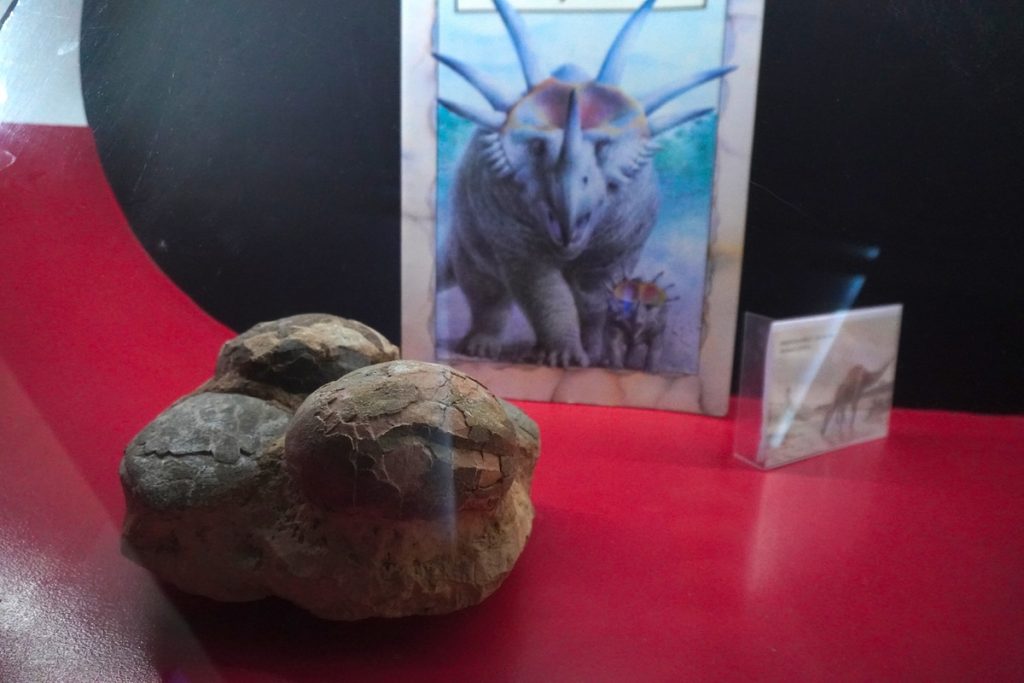
- Lagoa: another option for cooling off in the Atlantic near Ponta Delgada is Lagoa and its natural pools. There are two main areas: the “Complexo Municipal de Piscinas” (which features natural pools, an artificial pool, pools for children, and all kinds of amenities) and the “Zona Balnear do Cruzeiro (Poças de Atalhada)” (more rugged, unsupervised, with natural pools of crystal-clear water). Since you’re in the area, don’t miss the chance to visit the Azores Volcanological and Geothermal Observatory (note: it’s only open in the afternoon from 2:30 PM to 5:30 PM), where you can learn more about seismic and volcanic activity in this part of the Atlantic.
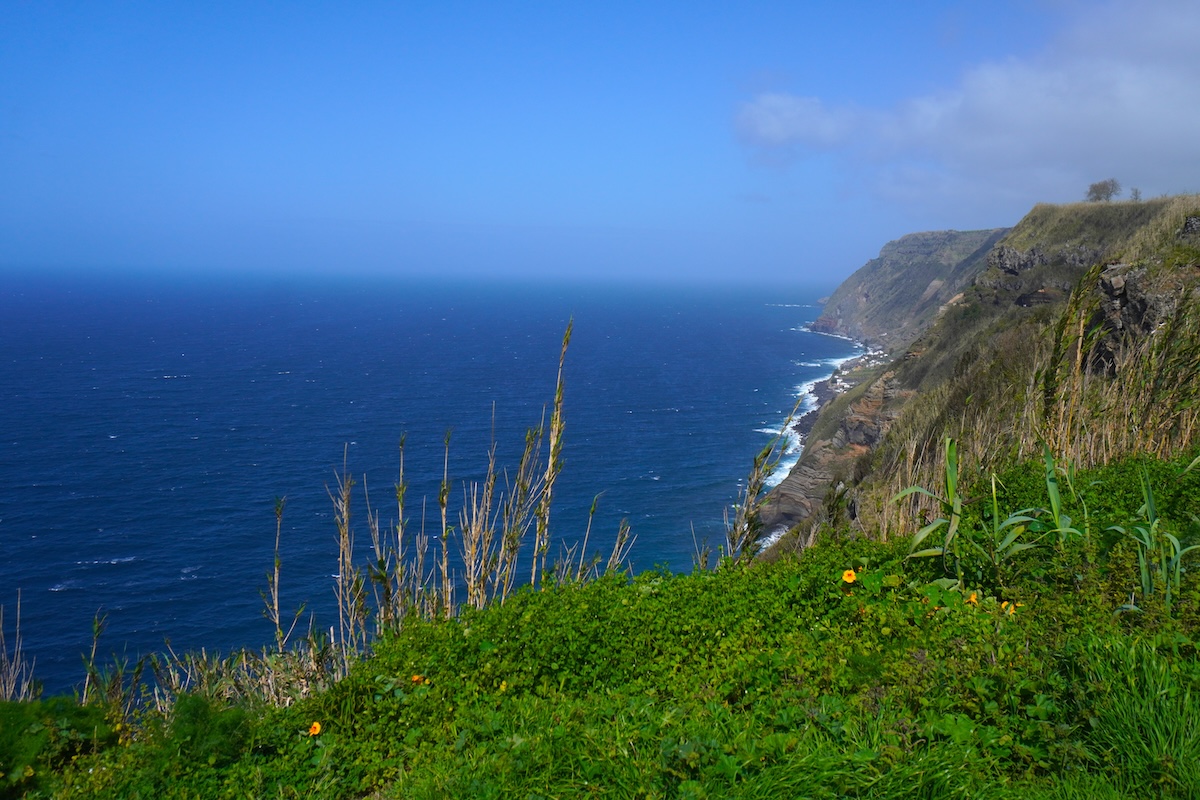
- Relva: if you’d like to go hiking near Ponta Delgada, in Relva you can take a trail that runs parallel to the sea. The trail is the PCR20SMI (official brochure), a 5.5 km (3-hour) linear (round-trip) trail where you’ll visit a “fajã detritica” (so-called “fajãs” formed by the collapse of part of the cliff), descending to sea level with the chance to take a dip if the weather and sea conditions allow. Another interesting feature of this trail is that you can make a reservation for lunch or dinner (reservations are required in advance) at Lapsa Garden, a farmhouse with a beautiful terrace overlooking the sea, where the owners prepare private dinners so you can enjoy, for example, the sunset (more info here)
- If you’re a gin fan, you can’t miss the world’s largest gin library, located very close to Ponta Delgada. No less than 480 bottles of gin. At Solar Branco, the project behind the “Gin Library,” you’ll find a bar where you can learn a lot about gin and enjoy a gin and tonic (you can even try two local gins: Baleia and Rocha Negra), a garden where many of the spices and botanicals used by Ali and Caroline to create the spectacular gin and tonics you’ll enjoy on their terrace are grown, and even local accommodations with six independent units that you can book here.


Beyond Ponta Delgada and its surroundings, the island of São Miguel hides the most beautiful lagoons in the entire Azores archipelago, steaming volcanic caveswhere sulfur-scented stews are cooked, natural hot springs in the heart of nature where you can relax, and breathtaking viewpoints. We’ll tell you everything there is to see on the island with specific itineraries for 3, 5, or 7 days in our complete guide to São Miguel:
Where to Stay in Ponta Delgada
Ponta Delgada is, without a doubt, the preferred choice for most people traveling to São Miguel, thanks to its central location, its vast selection of accommodations and restaurants to suit every taste, and its range of tourist attractions. It’s also the ideal place to stay if you’re not renting a car, since most shared tours depart from there, although in our opinion, the best way to explore the island is to rent a car so you can move around with complete freedom of schedule.
However, it also has several drawbacks: we’ve noticed a significant increase in accommodation prices in recent years; parking can be tricky (if you’re staying in Ponta Delgada, we recommend finding a place that includes parking or is near a free parking area); restaurants get crowded, and you sometimes have to book several days in advance; and restaurant prices have gone up while quality and/or portion sizes have gone down.
At RandomTrip, we’ve stayed in Ponta Delgada several times during our visits to São Miguel. Below are the accommodations we’ve stayed at and recommend:
Ladeira Loft (from €92/night), a very spacious one-bedroom apartment right in the heart of Ponta Delgada (very close to the Graça Market) with a kitchen and views of the Atlantic, where we stayed for several days at RandomTrip.

Hotel do Colegio (from €75/night), a lovely hotel in a 19th-century building with a pool, right in the heart of Ponta Delgada. This was the hotel where Inês stayed with her mother and sister the first time they visited the island, and they loved it.

Azores Inn (from €130/night): On Randomtrip, we split our stay across several locations on the island during one of our visits to São Miguel in 2025 and stayed here for three nights. Small, very new, and comfortable rooms, right in the heart of the city (you can walk to every part of the historic center), with a huge shared kitchen (featuring several separate stoves and refrigerators) and a small terrace on the ground floor. It also offers dorm-style rooms if you’re looking for a more budget-friendly option.
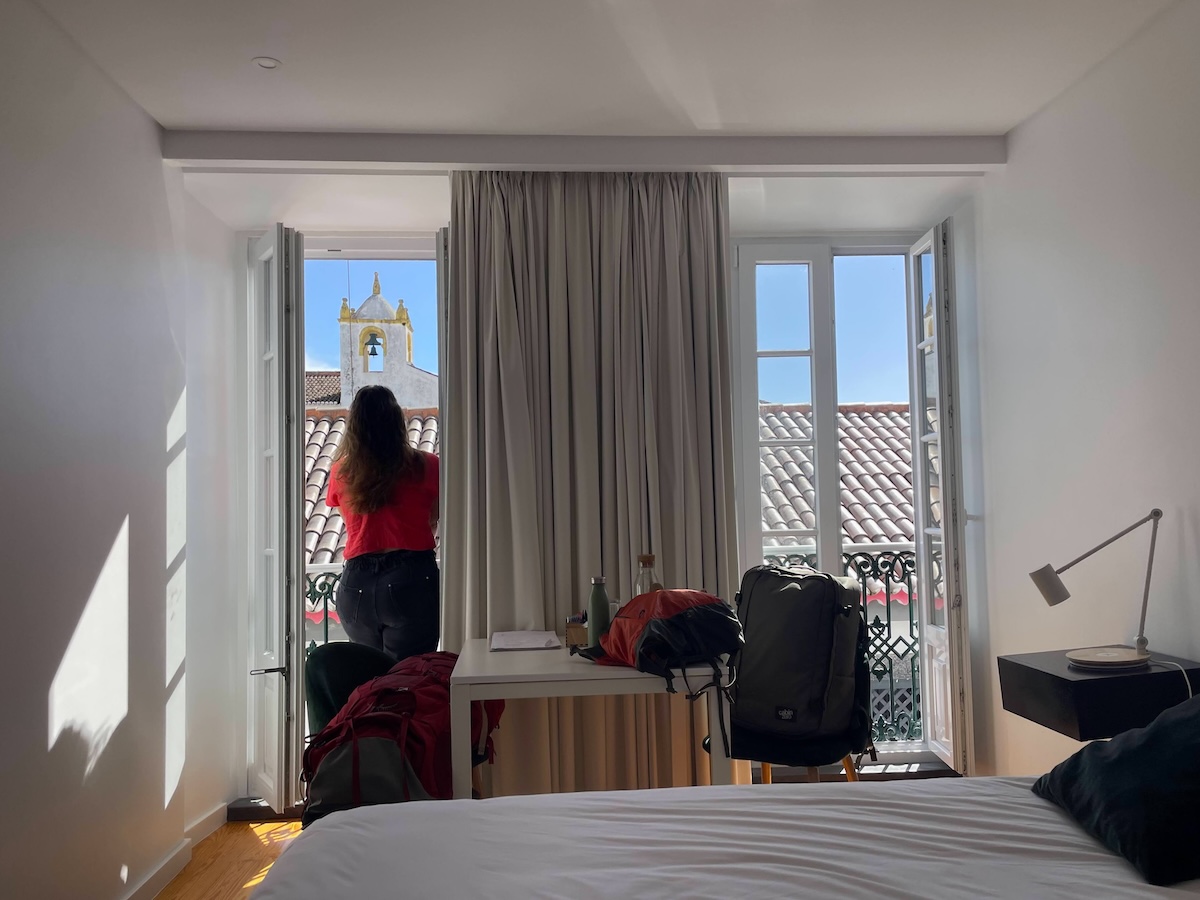
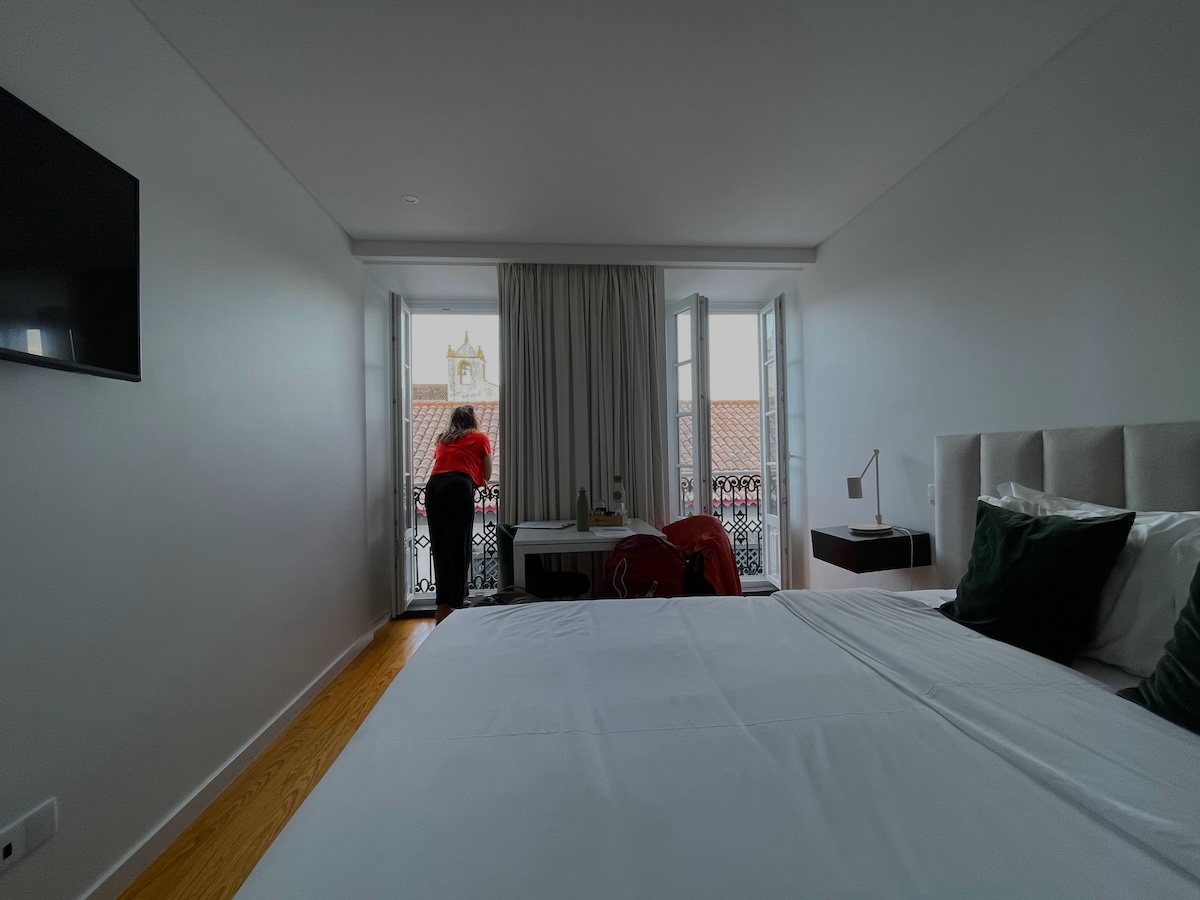
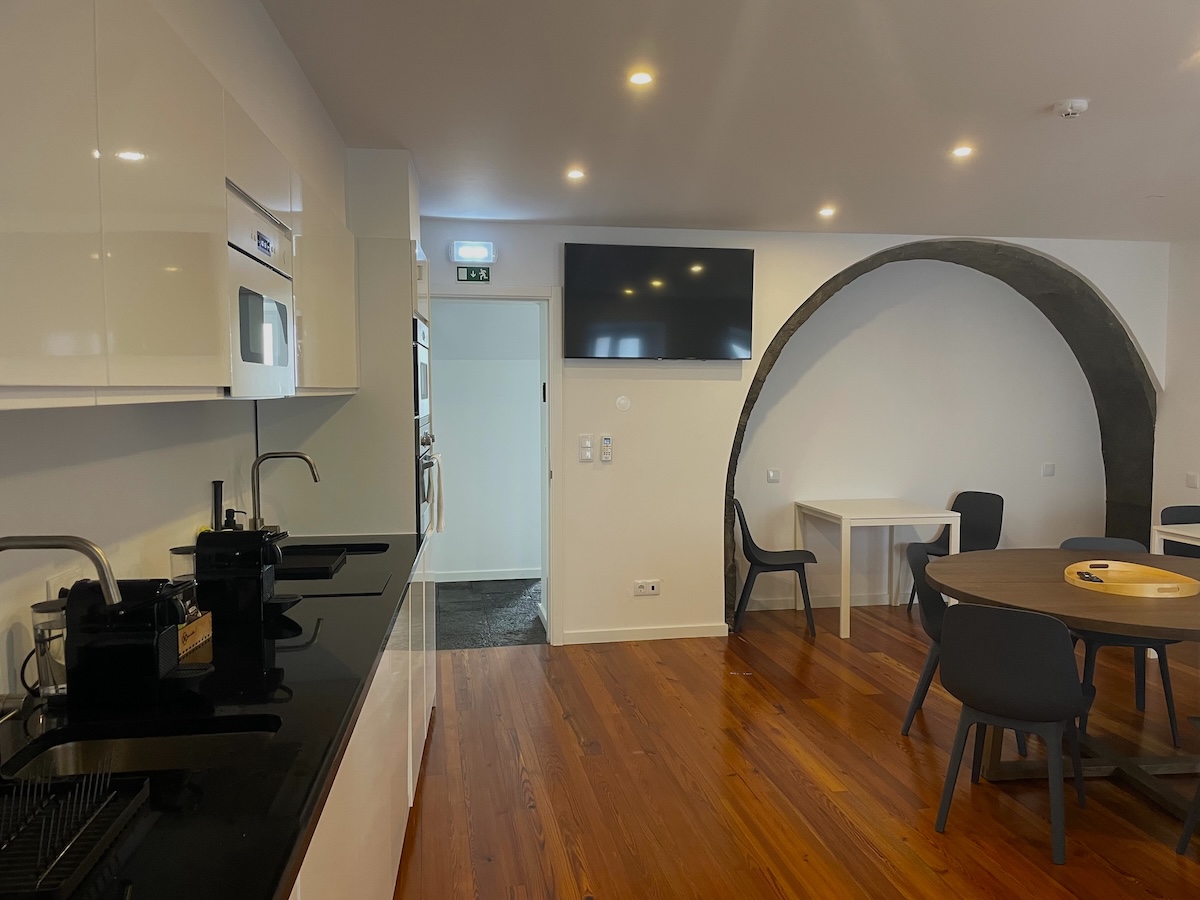
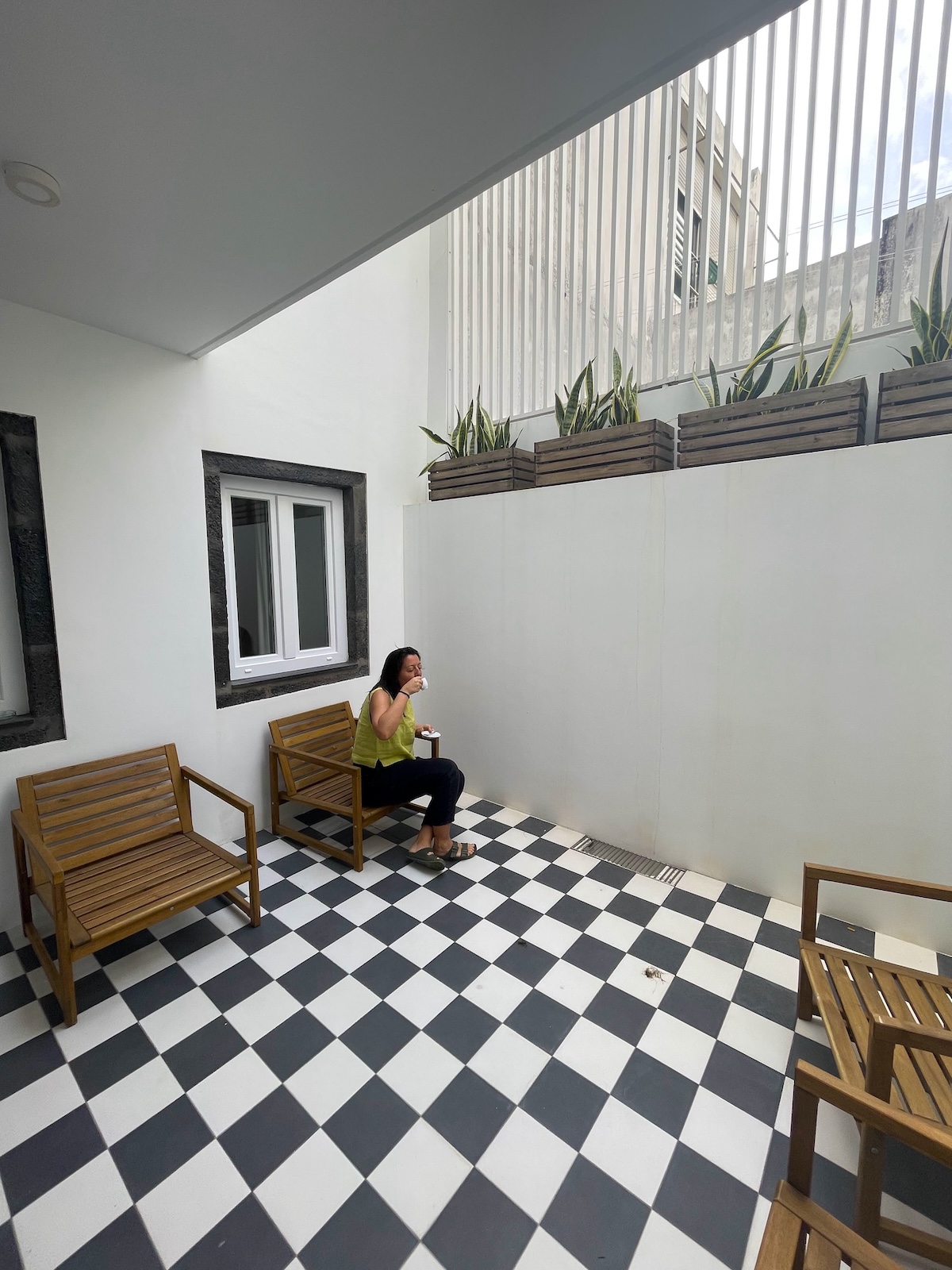
Casa da Graça (from €120/night): Our friends Catarina and Ricardo recently visited São Miguel and loved staying at Casa da Graça, a hotel very well managed by Vânia and Sergio that, aside from the wonderful rooms (and breakfasts), makes you feel right at home in Ponta Delgada:

Hotel Gaivota (from €115): At Randomtrip, we stayed here on our first trip to São Miguel. They offer rooms and apartments, some with ocean views, right on Ponta Delgada’s main boardwalk.

Casas Amarelas ( from €99/night): On our last visit to São Miguel in March 2026 to attend the Tremor festival —which we try to go to every year—we stayed with our friends at one of the Casas Amarelas, an excellent option if you’re visiting the island as a group. They have several types of houses; ours was huge, with 3 double bedrooms (all with private bathrooms), a living room with a double sofa bed, and a table that seated up to 8 people. Here are some photos of the house:


Other accommodations we recommend in Ponta Delgada:
Nook Hostel (from €50/night): right in the historic center, it offers everything from two-bedroom apartments to private rooms and beds in dorms.

Garoupas Inn (from €65/night): It’s not in the center of Ponta Delgada but offers ocean views and a shared hot tub on the terrace.

Holy Cow (from €80/night): a hostel with private-bathroom rooms and dorms less than a 10-minute walk from the historic center.
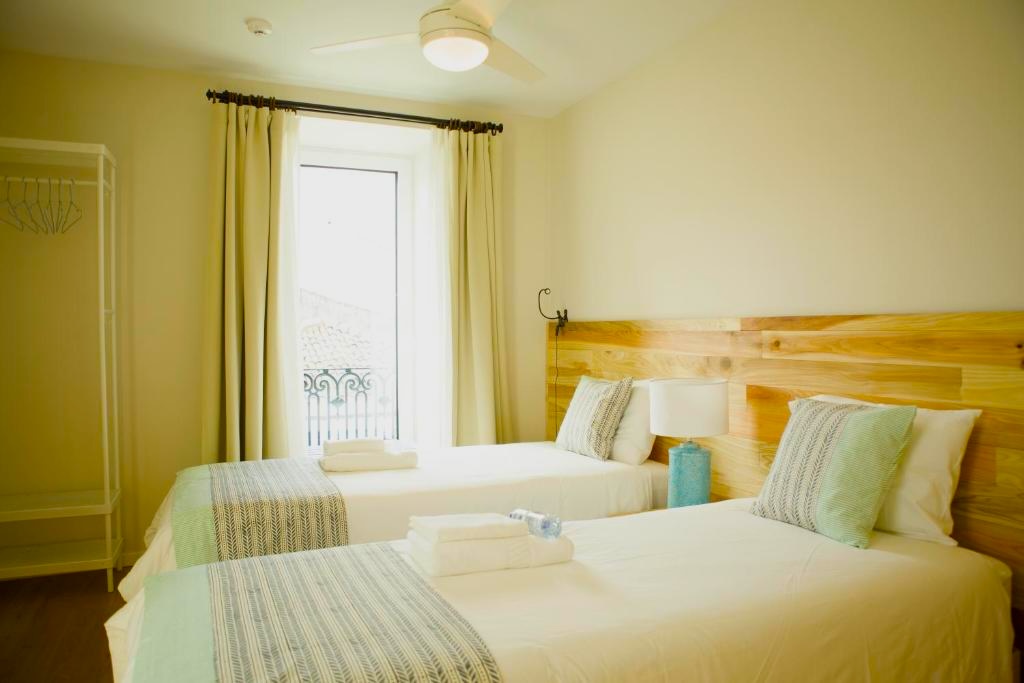
Vip Executive Azores Hotel (from €90/night): a large hotel about a 20-minute walk away, featuring a rooftop restaurant with ocean views and private parking (for a fee)
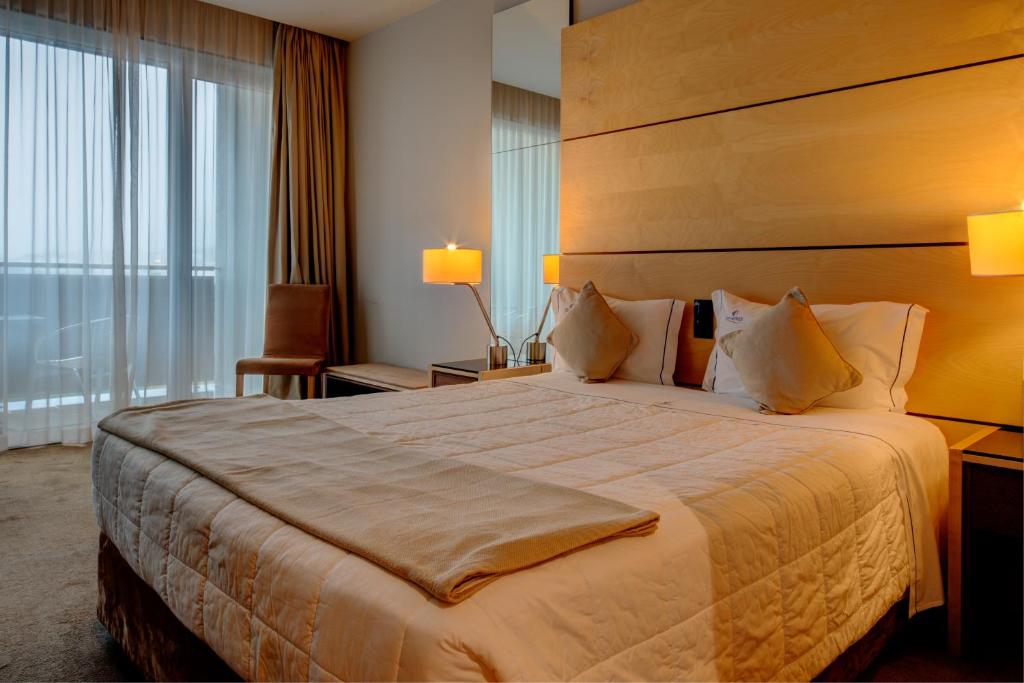
Chez Lúcia (from €100/night): a two-bedroom apartment (sleeps up to 4) with a terrace, right in the heart of Ponta Delgada.
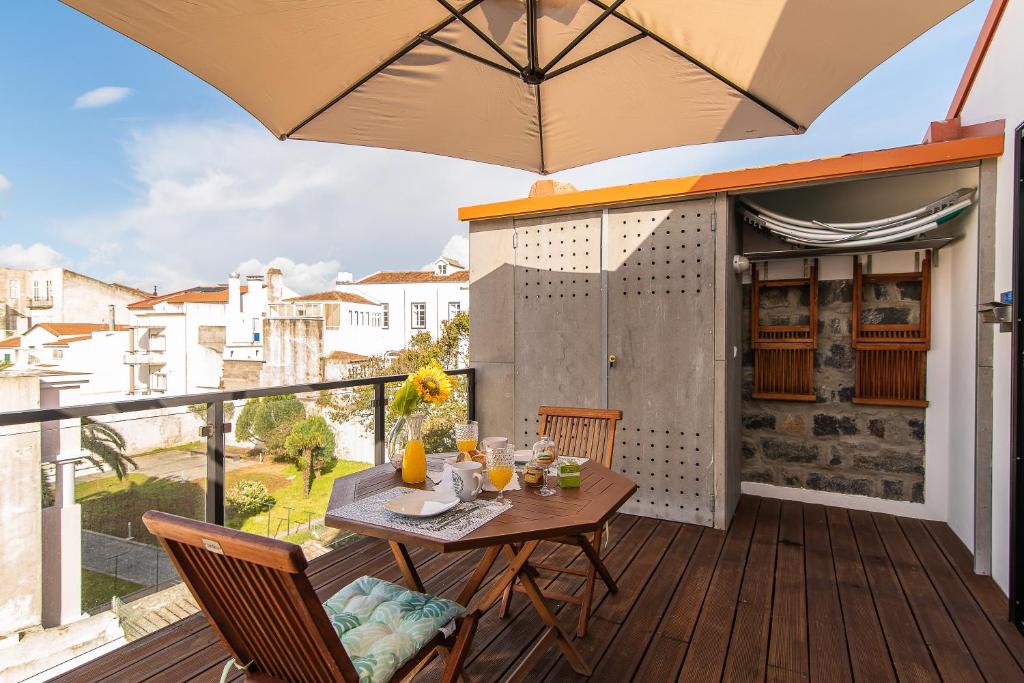
The Lince Azores (from €100/night): a beautiful hotel featuring rooms with views of the city, the sea, and the island’s landscape, a breakfast buffet, and a heated indoor pool with an outdoor section that is covered in winter—ideal if you’re visiting São Miguel in winter.

Octant Ponta Delgada (from €140/night): a 5-star hotel featuring modern, soundproofed rooms with incredible ocean views, a spa, and an outdoor pool. In addition to its central location and elegant design, the Octant Ponta Delgada also offers delicious breakfasts, the À Terra restaurant with innovative dishes, and a bar that’s open in the evenings. One of the best options for staying in Ponta Delgada to surprise someone.

Grand Hotel Azores Atlántico (from €150/night): a 5-star hotel located right in front of the “Portas do Mar.”

Armazéns Cogumbreiro (from €150/night): once the island’s largest commercial establishment, it is housed in a renovated 1913 building in the heart of the city center, featuring spacious and bright rooms.

To see more of our recommended accommodation options in other areas of São Miguel Island, check out our dedicated guide to Where to Stay in São Miguel:
Where to Eat in Ponta Delgada
While Ponta Delgada is where most restaurants are concentrated, we believe they have been getting worse with the rise in tourism (fewer options, higher prices, lower quality…). Even so, there are several recommended options in Ponta Delgada.
- Tasquinha Vieira: pricey but very, very good, fusion cuisine. The rice dish we tried was spectacular. We paid €56 for two dishes, a bottle of wine, and dessert


- A Tasca: a BBB option (good, nice, and cheap), but they don’t take reservations, so you’ll have to wait in line (which is usually long in the summer). In our opinion, it’s fine, but don’t let waiting in line for the restaurant derail your plans for the island—there are other options, and it’s not exactly one-of-a-kind. If you decide to give it a try, you’ll need to leave your name and stay nearby since they call out names as they go…


- Õtaka: a Nikkei fusion restaurant. They offer several tasting menus (starting at €75 per person) or you can order à la carte. It’s a bit pricey, but worth it if you’re looking for something different. They’ve opened another restaurant nearby, Ají, which also looks promising, though we haven’t tried it yet


- Alcides: one of the most legendary traditional restaurants in Ponta Delgada, where you can try the famous “bife à regional.” Reservations are a must. We paid €50 for two back in 2015, which included an appetizer, two main courses, a bottle of wine, dessert, and coffee, but prices have gone up quite a bit since then, and we haven’t returned on our recent trips (we prefer O Galego, which we’ll tell you about below)
- Adega do Mestre André: We went a couple of times; once we tried the abrótea steaks and the other time the beef steaks. It’s a good option in Ponta Delgada at a reasonable price (two steaks, a dessert, and half a liter of wine for €50).

- Cais 20: also legendary in Ponta Delgada because it stays open very late (until 2 a.m.). Recommended for tapas, seafood, and fish. We went with our friend Raquel from São Miguel, and she explained that it’s very typical to order an “absurdo” (a small glass of beer— imperial —with a small plate of boiled shrimp)

- O Galego: It competes with Alcides and Associação Agrícola for the title of best bife à regional in São Miguel, but in our opinion, it’s the best. We paid €42 for an appetizer, two main courses, two beers, and two coffees. The steak is served as a half or a whole cut; in our opinion, the half is more than enough for one person.

- Rotas da Ilha Verde (vegetarian): one of the few vegetarian restaurants on the island, with creative, high-quality dishes; they’ve been open for over 20 years. We tried to go several times but they were either closed or fully booked; hopefully we’ll make it on our next visit. It’s essential to book well in advance.
- Ta Gente: recommended for tapas or cocktails, though the prices are a bit on the high side.
- Nonna’s Teeth: wonderful pizzas with thin Neapolitan crust; they only have about 7 options and change the “Pizza of the Month,” the Nonna. The best we tried on the island (in the archipelago, actually). We ordered a Rockys pizza and a Se Scampi pizza, half a liter of house wine, a sparkling water, and a dessert (cannolo) and paid €49.30. At lunchtime, it’s easier to find a seat if you go early; for dinner, it starts filling up around 7:15 p.m.… We went back several times afterward because they were so good


- Forneria São Dinis: very good wood-fired pizzas. We paid €42 for an appetizer, two pizzas, a bottle of wine, and water.

- Mané Cigano: a well-known local restaurant where you can try traditional Azorean cuisine. The fried mackerel is a standout, and the prices are reasonable. Unfortunately, it’s only open from 12 PM to 3 PM and tends to get crowded.
- Michel Restaurant: highly recommended for local cuisine (limpets, tuna, etc.)
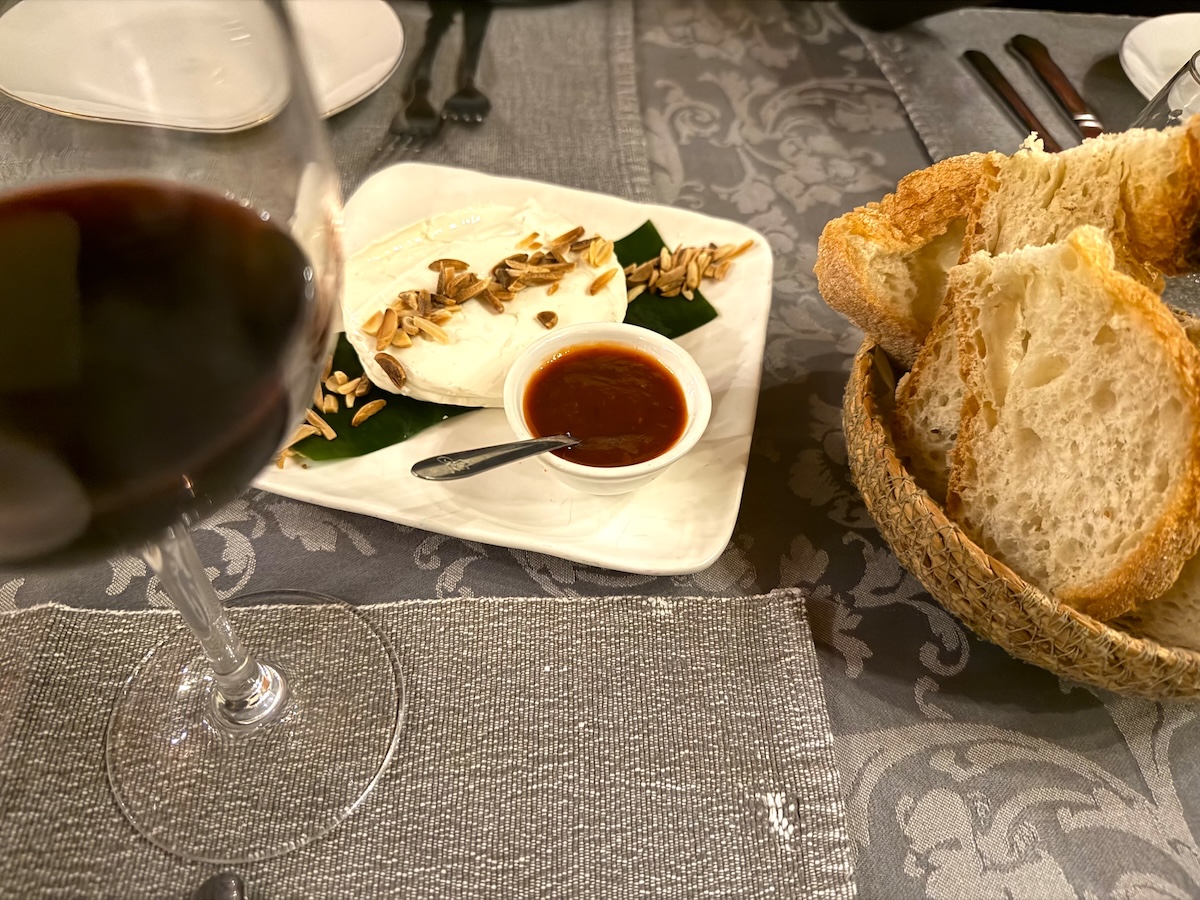

- Jardim Natural Food & Coffee: a small kiosk-restaurant right in the heart of the António Borges Botanical Garden, offering healthy food, good prices, and a beautiful setting.

- Palma Sushi: if you’re craving sushi, we heard great things about this
- Taberna na Boavista: a restaurant serving delicious and original tapas (petiscos), though a bit pricey. We ordered the spicy octopus, patatas bravas, camarão na taberna, and the banh-mi—all delicious. With two glasses of wine and a bottle of water, the total came to €60.


- Clube União Micaelense: a small, super-local bar where you can drink beer at good prices and grab a bite to eat.
- Mascote: another local restaurant offering excellent value for money
- Restaurante Aliança: we didn’t have time to try it, but a local told us that, in his opinion, it serves the best steak on São Miguel, better than O Galego, Alcides, etc.
- Anfiteatro: right in the heart of Portas do Mar in Ponta Delgada, here you can enjoy traditional dishes with contemporary twists prepared by students in training.
- Suplexio: If you’re craving burgers, look no further. Here you’ll find artisanal burgers and, best of all, a bar serving Portuguese craft beer. What more could you want?
- Bolos do Vale: a café where you can try the famous bolos lévedos on the outskirts of Ponta Delgada (we paid €7.50 for two assorted bolos lévedos and two drinks)
- A Colmeia Bakery: a local bakery where, at Christmas, they make the famous Azorean pineapple king cake, the malamanhado
- Gelataria Abracadabra: artisanal ice cream with island flavors (dragon fruit, passion fruit, pineapple…) as well as the classics (chocolate, vanilla). We ordered two small scoops with two flavors each and paid €5.60—they were delicious.

- La Gelateria: another Italian-Azorean ice cream shop that was recommended to us, though we didn’t get a chance to try it
- For buying cheese: Rei dos Queijos or Príncipe dos Queijos. Both also sometimes sell Flores butter (one of the best) and “Rainha do Pico” butter.
- Bars for a drink in Ponta Delgada:
- Cantinho dos Anjos: a legendary bar and meeting spot to have a few beers and soak up the atmosphere.
- Raíz Bar: for drinks with live music. On Fridays and Saturdays, starting at 10 p.m., there are usually concerts featuring blues, jazz, rock, folk, or African sounds.
- Resvés: a cocktail bar that’s always lively with great music
- petrichor.bar: a very interesting cocktail bar; each cocktail tells a story inspired by the Azores.
- Outro Lado: another cocktail bar that was recommended to us at the Tremor festival.
Outside of Ponta Delgada but in the southern part of the island, you also have plenty of options. Here are our recommendations:
- O Rui (Lagoa): a local restaurant that looked promising. We wanted something quick and light, so we ordered a tuna bifana and a beef prego, a beer, and water. We paid €17; everything was delicious. The other dishes looked good too.
- Pizzaria Rosárium (Lagoa): an Italian restaurant recommended to us in Lagoa; we didn’t end up going.
- Borda D’Agua (Lagoa): recommended for fresh fish.
- Bar Caloura (Caloura): excellent restaurant right on the water for the freshest fish; ask what they have for the day, and go early since they don’t take reservations.


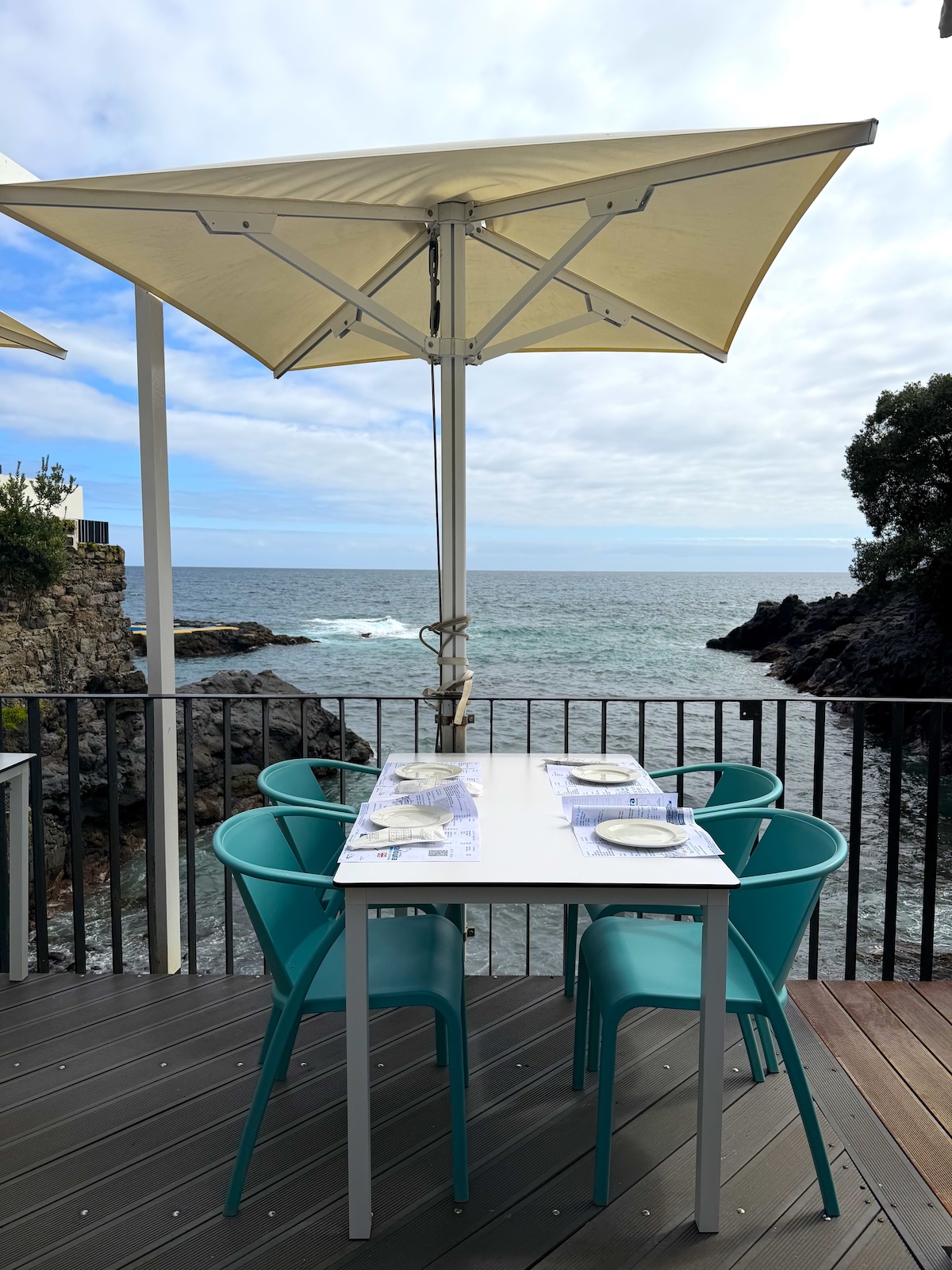
- Casa do Abel (Caloura): Owned by the same people who run Bar Caloura, they have this other restaurant specializing in meat, though we didn’t get a chance to try it.
- Mercado da Vila (Vila Franca do Campo): Several chefs from other restaurants on the island got together and set up this market where you can sample foods from different places (the Azores, Mexico, Italy, Japan…). We didn’t get a chance to try it, though the prices seem a bit steep.
- Atlântico Azorean Restaurant (Vila Franca do Campo): recommended for sushi and seafood.
- Queijadas de Vila Franca (Vila Franca do Campo): to try the famous “queijadas,” a real treat!


Transportation: Renting a Car in São Miguel
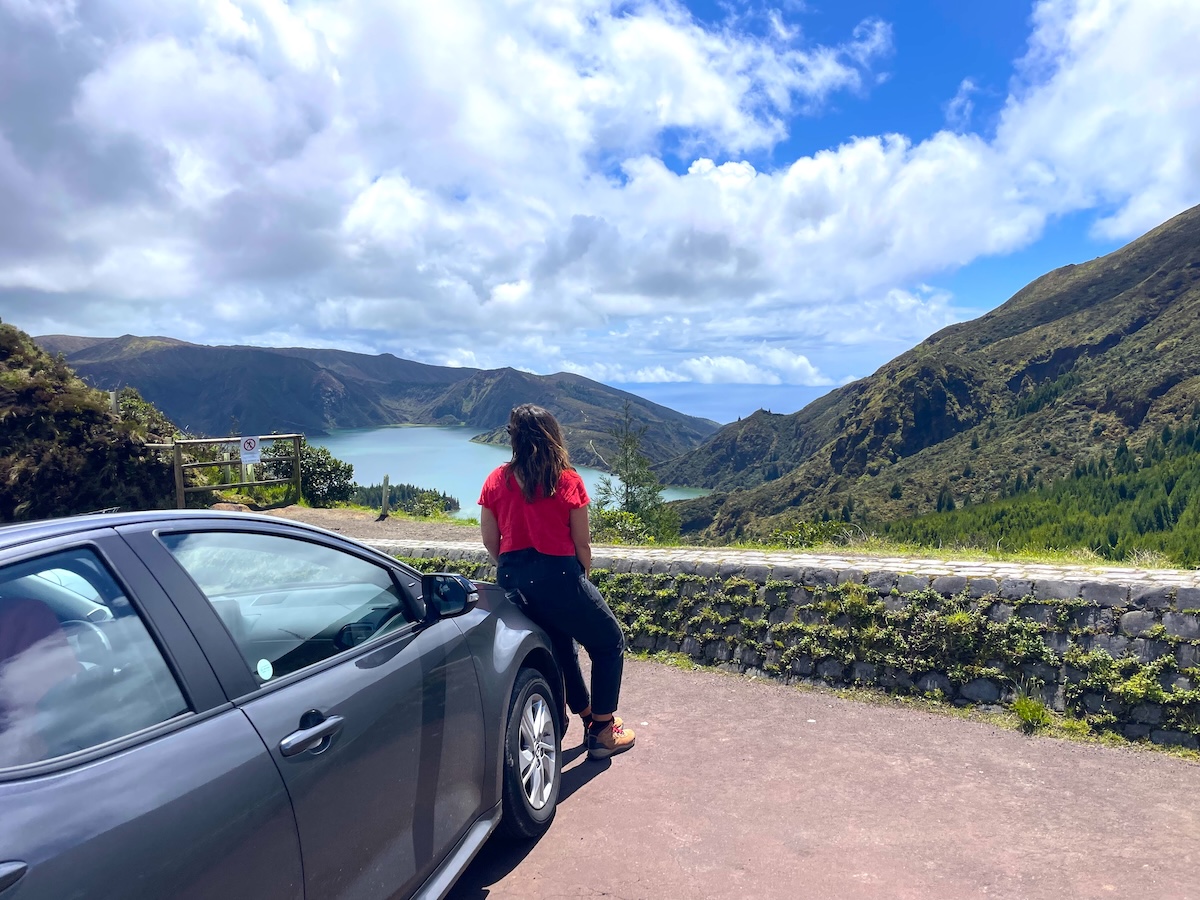
While in Ponta Delgada you can walk to most places of interest, as on all the Azores islands, in São Miguel we consider it essential to rent a car to fully enjoy the island, make the most of your time, and visit all the places recommended in our guide at your own pace.

At Randomtrip, we rented a car through Autatlantis, both in São Miguel and on the other islands, and everything went perfectly: the service upon arrival was quick and efficient, the car (a Citroën C3) was like new, and we didn’t have a single issue. Virtually all companies include a deductible in their insurance, and Autatlantis is one of those with the lowest deductible (€700, compared to €1,300–€1,500 at other companies).
Rental car prices in São Miguel rarely drop below €25 a day, and, especially in the summer, we recommend booking well in advance to avoid running out of cars or finding that the few available have exorbitant prices (in some summers, rates reached €100 per day, and we know several people who couldn’t rent a car because they waited until the last minute).

If there is no availability with Autatlantis, you can check and compare other companies with availability for your dates on comparison sites like DiscoverCars. Remember to carefully review each company’s rental terms (deductible, what the insurance covers, fuel policy, reviews…) and not just the price.
Parking in Ponta Delgada: While you generally won’t have to worry too much about parking spaces in the Azores, Ponta Delgada is the exception—if you’re staying in the city center, there may not be any free parking available. Be sure to check when booking your accommodation to see if it offers free parking and/or if there are free public parking areas nearby.
Another option if rental cars aren’t available or are too expensive is to rent a motorcycle (scooter), though we honestly don’t recommend it due to the long distances you have to cover on São Miguel and the unstable, changeable weather in the Azores.
There is also the option of getting around São Miguel by public transportation: there are 3 bus companies that connect some of the island’s main points; you can view the schedules here. Connections and frequencies are quite limited, but if you’re traveling on a tight budget, it can be a valid option for visiting some of São Miguel’s main attractions.
How to get from Ponta Delgada Airport to downtown (and vice versa)
Ponta Delgada Airport (or São João Paulo II Airport (PDL)) is very close to the city center, so if you don’t rent a car, it’s super easy to get between the airport and downtown. Here are the different options:
- Book a transfer: You can book a private car transfer in advance that will be waiting for you upon arrival (or when you return to the airport); the price per vehicle is €25 (up to 4 people)
- Taxi: You’ll find taxis at the airport exit, and the fare from the airport to downtown Ponta Delgada is €10

How to get internet in Ponta Delgada, São Miguel
To always have internet on your smartphone during your trip to the Azores Islands, the easiest and most convenient way (if your phone supports eSIM) is to buy an eSIM from Holafly, which has unlimited data (you get a 5% discount with the code RANDOMTRIP), or to buy an eSIM from Airalo, cheaper but with limited data (15% discount with the code RANDOMTRIP15). We tested Holafly’s eSIM card in our last trip to the Azores and it worked like a charm. You can read about our experience with Holafly here
The other option, cheaper but more cumbersome, is to buy a local SIM; Meo, Vodafone and Nos are the main companies in Portugal, all of them work perfectly in the Azores Islands.
More info about buying an eSIM or local SIM card for your Azores trip here:

How much does it cost to travel to Ponta Delgada, São Miguel?
As always, giving a general estimate is very difficult since it depends heavily on your travel style. What we can do is provide you with a price guide so you can use it to calculate your budget for your trip around the entire island (not just the capital):
- Flights: You can sometimes find flights for €50 (round-trip from Lisbon) to Ponta Delgada, but it depends on how far in advance you book and your travel dates (it’s harder to find cheap prices in the summer).
- Car rental: starting at €25–€30 per day for the most economical car (depending on the company and the number of days). Prices go up in the summer, and it can be difficult to find a car on short notice.
- Accommodation: Starting at €50/night for a room with a private bathroom or a centrally located apartment with a kitchen.
- Restaurant meals: between €10 and €25 per person for lunch or dinner at a restaurant
In total, as a rough guide, a one-week trip to São Miguel with a rental car can cost between €500 and €750 per person (with the cheaper options for car, accommodation, and restaurants).

Useful apps for traveling to Ponta Delgada
Here are some apps we recommend that will come in handy on your trip to Ponta Delgada and São Miguel:
- SpotAzores: (Android/iOS/Web): Here you can view all the webcams located at different points across the islands to check the weather. Since the weather is highly changeable and it can be raining in one part of the island while the sun is shining in another, this app is the quickest way to stay informed and avoid unnecessary travel.Note! The Lagoa do Fogo camera is located at a fairly high elevation, so even if the camera shows cloudy conditions, you might still have a view of the lagoon from the lookout point.
- Windy (Android/iOS/Web): an essential app for our trips, especially in the Azores. It lets you check forecasts for rain, clouds, wind, etc., to help you plan your days based on the weather (since some places lose a lot of their appeal depending on the weather). Obviously, the forecasts aren’t 100% reliable. It also shows available webcams
- Google Maps (Android/iOS): This is the app we use to save and categorize all the places we want to visit or have already visited, as well as for GPS in rental cars. You can view other people’s reviews of places, photos, restaurant menus, contact phone numbers, and more.
- Maps.me (Android/iOS): an app similar to Google Maps but one that works better offline (though Google Maps can also work online) and which, in many cases, has information that Google Maps doesn’t have, especially regarding hiking trails. Useful whenever you’re going on a hike, to get your bearings, download the route from the official Azores hiking trails website (click on Downloads->GPS), etc.
Tips for visiting Ponta Delgada and São Miguel as a responsible tourist
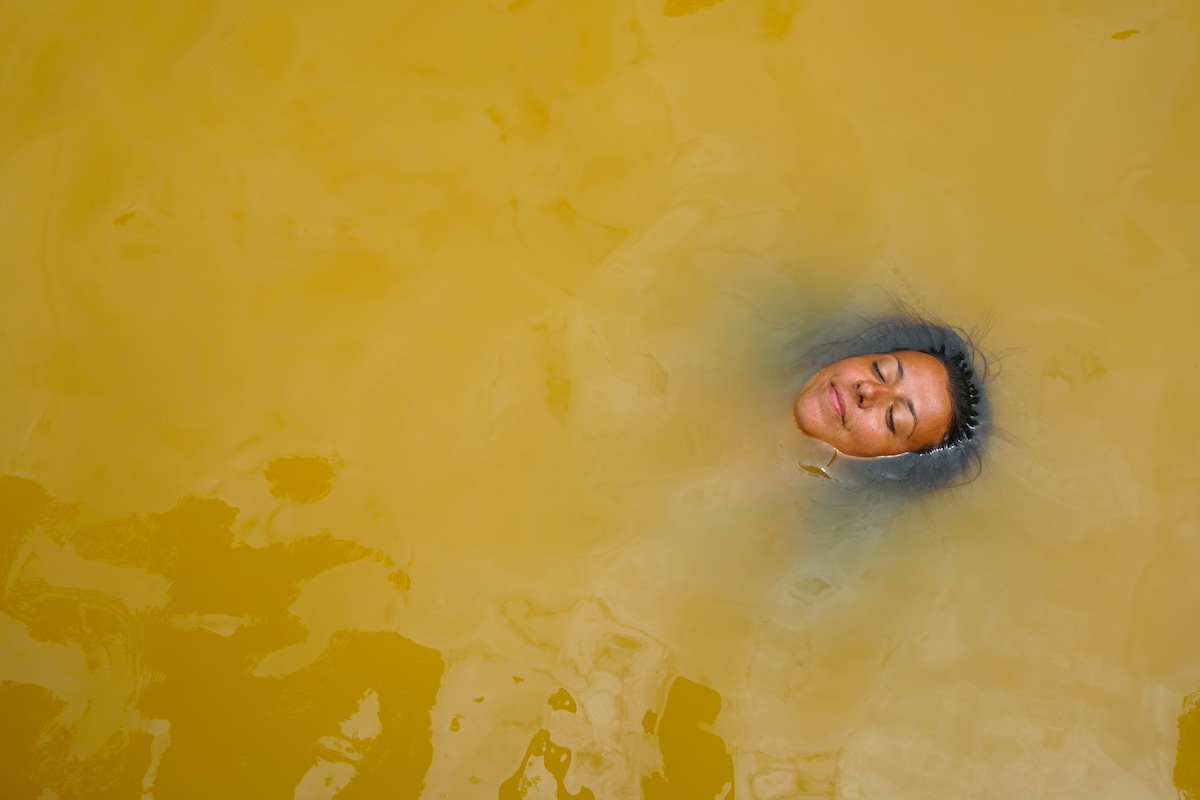
- During whale-watching activities , follow the guidelines provided by the center and be wary if they do not include measures such as: a ban on swimming with dolphins; maintaining a reduced and constant boat speed and a minimum distance of 50 meters from the animal; avoiding the presence of multiple boats within a 150-meter radius of the cetacean group; and not staying with the same animal for more than 10 minutes.
- Do not allow the disturbance, pollution, or destruction of seabird nesting habitats. “Cagarros” (shearwaters, in Spanish) are migratory birds that nest in the Azores and will be familiar to you on your trip because of their distinctive “awa awa” call, as if they were singing the chorus of Radiohead’s “Video Killed the Radio Star.” To prevent young shearwaters from being captured or hit by cars on the road, the Government of the Azores annually promotes the SOS Cagarro Campaign , which we recommend you learn about upon arriving in the archipelago.
- Never try to touch or feed an animal.Don’t be an accomplice to animal abuse!
- Do not buy handicrafts made from marine animals or materials extracted from the sea (e.g., dolphin teeth, turtle shells, shark jaws, sperm whale ivory, etc.). The ivory trade, currently the only valuable product from the sperm whale, remains a justification for hunters. Buy local handicrafts made from alternative materials such as wood, stone, or vegetable ivory.
- Respect other people and the island: don’t play loud music on the beach (if you want to listen to music, use headphones), don’t leave trash behind, don’t throw away cigarette butts, etc. Leave the beach in better condition than you found it (if you see plastic, pick it up).
- Swimming in some natural pools is dangerous due to strong currents. Don’t try to be a hero.
- Always travel with travel insurance: medical expenses, theft, or flight issues during a trip can cost you a fortune, so it’s best to get travel insurance. At Randomtrip, we always use IATI and highly recommend it. If you purchase your insurance through this link, you’ll get a 5% discount.

Checklist: What to Pack in Your Backpack/Suitcase for Ponta Delgada and São Miguel
Here’s a list of essentials you can’t forget to pack for your trip to the island:
- A reusable water bottle like one of these to carry water with you all the time and void single-use plastic.
- A good camera to register your adventures. At Randomtrip we carry a Sony ZV-E10 and a Gopro Hero12 Black (for underwater pictures)
- A Power bank: taking so many pictures will drain your batteries, so it’s always a good idea to carry a good powerbank. At Randomtrip we travel with these 2 (Anker 20000 mAh and Anker 10000 mAh), which allow us to charge both our phones and our cameras.
- Water Shoes like these ones, ideal for not hurting your feet when entering the water or not touching the ground. Keep in mind that in the Azores you will find lots of volcanic rock pools or pebble beaches so you will want to carry your water shoes at all times to make it easier to enter the water.
- Hiking shoes because the best way to get to know the Azores is by hiking the trails. At Randomtrip we use these Columbia ones.
- Snorkel kit (mask and tube) like this one, a must to take on this trip to contemplate the seabed.
- Water proof dry bag like this one, very useful for keeping your camera equipment, cell phone and wallet safe from getting wet on any boat trip (or even if the tide comes in on the beach).
- Sun screen: always look for a Coral Friendly Sunscreen, i.e. one that protects your skin without harming marine ecosystems by avoiding ingredients such as oxybenzone and octinoxate, which are harmful to corals. Nor that it has been tested on animals.
- Mosquito repellent: like this one, it should have at least 15% deet
- Fast drying towel like this one which doesn’t take a lot of space in your luggage
- A hat or a cap (like this one) and sunglasses to protect yourself from the sun
- Windbreaker waterproof jacket: like this one, to protect yourself from the sudden weather changes in Azores
- First aid kit: In our first-aid kit there is always a medicine against seasickness (such as biodramine for seasickness on boats), antibiotics, anti-diarrhea medication (and a probiotic to recover more quickly), antihistamines, painkillers and antipyretics
- Travel insurance: always travel with travel insurance. We collaborate with different travel insurance companies so that you can get a discount with some of them:
If all this is what awaits you in Ponta Delgada, imagine what awaits you across the entire island of São Miguel! We’ll tell you everything you need to know to plan an incredible trip around the Azorean “Green Island” in our complete guide to São Miguel.
Have a great trip!